Hajj Prohibited Items: What Pilgrims Can’t Bring
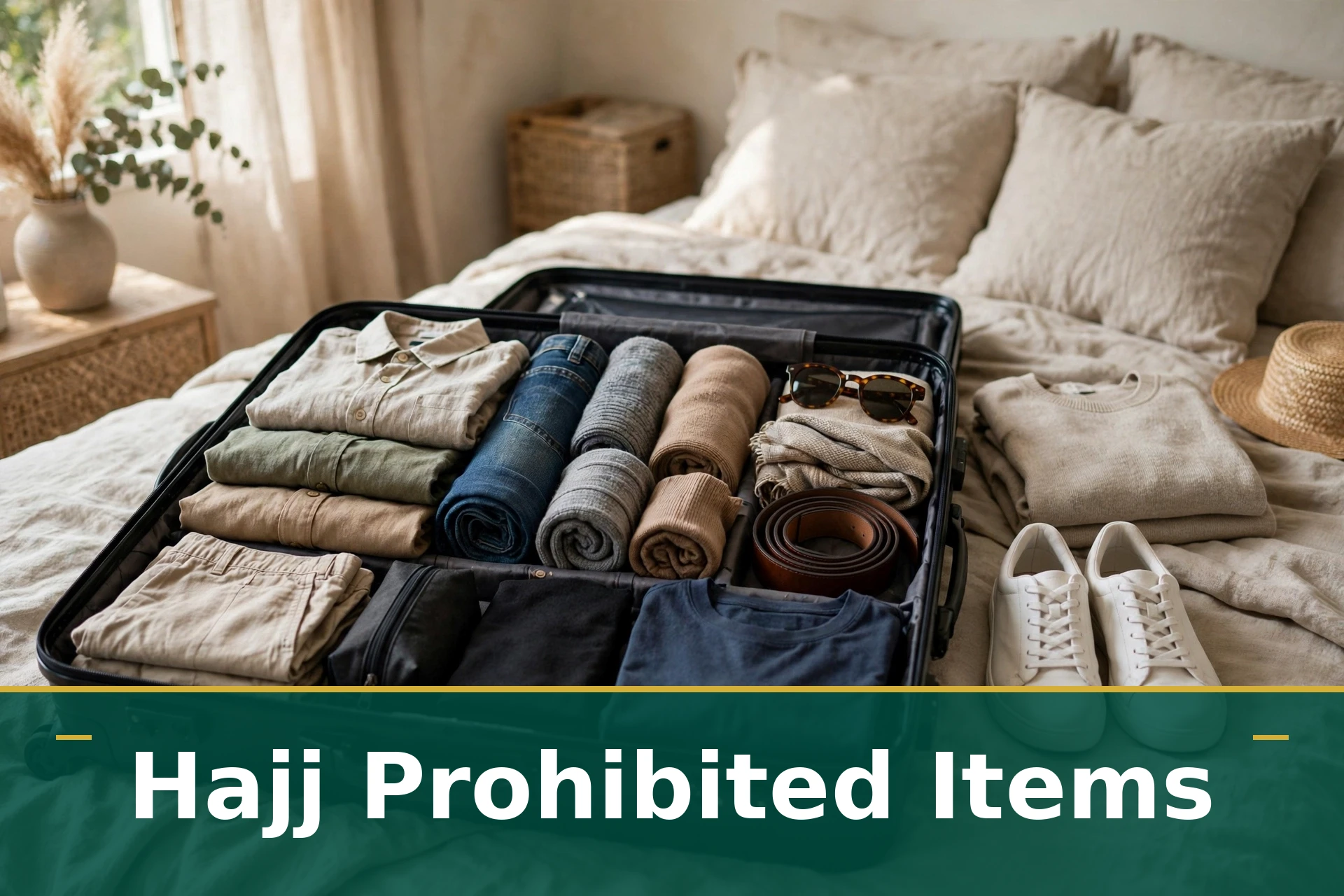
Hajj prohibited items fall into two very different groups: things you cannot take on the flight to Saudi Arabia, and things that are forbidden while you are in Ihram. The first group is not Hajj-specific at all — it is the standard airline dangerous-goods rules that apply to every flight, set by the International Air Transport Association (IATA) and enforced in Saudi Arabia by the General Authority of Civil Aviation (GACA). The second group comes from the Qur’an and the Sunnah, and it applies only while you are in Ihram. This guide explains both, so you can pack correctly and perform your Hajj without problems. If you are new to the pilgrimage, start with our guide to Hajj and the three types of Hajj.
Key Points
- Sharp objects, tools, guns and flammable items are banned from hand luggage on every flight (aviation rules, not Hajj-only).
- In Ihram: no perfume, no stitched clothes for men, no head covering, no hunting, no arguing.
- Hajj 1448 expected 14–19 May 2027.
- Book through Nusuk.
A. What You Cannot Take on the Flight
Every airline bans dangerous goods from hand luggage. These rules exist for aviation safety: a sharp object, a firearm or a flammable substance in the cabin puts everyone on board at risk, and a fire in the hold can be catastrophic. They apply to every flight, not only Hajj flights, and they apply on the way home as well as on the way out. The four groups below are the standard dangerous-goods categories used by IATA and enforced by GACA for flights to and from Saudi Arabia. Some of these items may go in checked luggage if your airline allows it; others may not be carried at all. Always check your own airline’s list before you pack, because an airline can be stricter than the minimum rules.
| Item group | Examples | Hand luggage | Checked luggage |
|---|---|---|---|
| Sharp objects | Scissors, knives, scalpels, razor blades | Banned | Usually allowed, if the airline permits |
| Tools | Hammers, nails, screwdrivers, drilling tools | Banned | Usually allowed, if the airline permits |
| Firearms and weapons | Guns, bullets, Tasers | Banned | Only if declared and the airline permits; most pilgrims should leave them at home |
| Flammable, explosive and pressurised substances | Poisonous substances, flammable liquids, fireworks, materials under pressure | Banned | Banned in most cases, or strictly limited |
The reason for these bans is aviation safety, not the Hajj itself. A fire or an explosion in the cabin or the hold endangers everyone on board, and a sharp object can be used as a weapon. That is why the same rules apply on every flight you take, whether or not it is a Hajj flight.
If an item is confiscated at the airport, you will not get it back. Pack it in your checked luggage if your airline allows it — or leave it at home. When in doubt, ask the airline before you travel.
B. What Is Forbidden While in Ihram
The second group of prohibitions has nothing to do with the airport. Once you enter the state of Ihram, certain things become forbidden for the pilgrim until Hajj is complete. These rules come from the Qur’an and the Sunnah, and they apply to every pilgrim, whether he is performing Ifrad, Qiran or Tamattu’.
The Qur’an sets out the main prohibitions in one verse. The following is the relevant phrase of Qur’an 2:197 — not the whole verse:
Arabic:
الْحَجُّ أَشْهُرٌ مَّعْلُومَاتٌ ۚ فَمَن فَرَضَ فِيهِنَّ الْحَجَّ فَلَا رَفَثَ وَلَا فُسُوقَ وَلَا جِدَالَ فِي الْحَجِّ
Transliteration: Al-hajju ashhurun ma’loomaat, fa man farada feehinnal-hajja fa laa rafatha wa laa fusooqa wa laa jidaala fil-hajj
Translation: “Hajj is [during] well-known months, so whoever has made Hajj obligatory upon himself therein [by entering the state of Ihram], there is [to be for him] no sexual relations and no disobedience and no disputing during Hajj.”
In practice, this means: while in Ihram, a pilgrim must avoid sexual relations, disobedience and arguing. Men must not wear stitched garments, such as shirts, trousers or underwear; they must not wear perfume, and they must not cover the head. Women must not wear the niqab (face veil) or gloves while in Ihram, though they still cover the rest of the body as usual. Hunting is also forbidden while in Ihram. These rules are reported in Sahih al-Bukhari.
These prohibitions end when the pilgrim exits Ihram after the rites — for example, after stoning Jamarat al-Aqaba and shaving or trimming the hair on the 10th of Dhul-Hijjah. If you are unsure whether something is allowed in Ihram, ask a scholar or your Hajj group leader before you act.
C. Practical Packing Notes
Bring your medicines in your hand luggage, with the prescription and a doctor’s letter if you can. Keep them in their original packaging, and carry enough for the whole trip plus a few extra days in case of delays.
Carry power banks and spare lithium batteries in your hand luggage, never in checked luggage. Airlines require spare lithium batteries in the cabin, where a problem can be spotted and dealt with quickly.
Liquids, gels and pastes in hand luggage must be in containers of 100 ml or less, carried in a single clear, resealable bag. Larger bottles go in checked luggage.
Pack your Ihram garments, medicines and important documents in your hand luggage, so a delayed suitcase does not leave you without them.
Hajj 2027: Expected Dates and Booking
Hajj 1448 is expected to take place from 14 to 19 May 2027, with the Day of Arafah expected on Saturday 15 May 2027. These dates are expected and depend on the sighting of the moon; local sighting may shift them by a day. Pilgrims should confirm the final dates with their Hajj group and the official Saudi announcements. Pilgrims book through Nusuk, the official Saudi platform for Hajj. Saudi Arabia’s preparations for the pilgrimage were discussed at the Hajj Conference 2026 in Jeddah.
Frequently Asked Questions
What items are banned on flights to Hajj?
The same dangerous-goods rules that apply to every flight: sharp objects, tools, firearms and flammable or pressurised substances are banned from hand luggage under IATA rules enforced by Saudi Arabia’s GACA. Some may go in checked luggage if your airline allows; others are banned entirely. Check your airline’s own list before you pack.
Can I bring scissors or a razor to Hajj?
Small scissors (with blades under 6 cm) and disposable razors are generally allowed in hand luggage. Larger scissors, knives and loose razor blades must go in checked luggage, if your airline allows them there. When in doubt, pack them in your checked bag.
What is forbidden while in Ihram?
Sexual relations, disobedience and arguing (Qur’an 2:197). Men must not wear stitched clothes, perfume or a head covering; women must not wear a niqab or gloves; and hunting is forbidden. These rules apply until you exit Ihram.
Can women wear a niqab in Ihram?
No. A woman in Ihram must not wear the niqab or gloves. She still covers the rest of her body as usual.
Can I bring medicines to Hajj?
Yes. Carry them in your hand luggage with your prescription, in their original packaging, and bring enough for the whole trip plus a few extra days in case of delays.
When is Hajj 2027?
Hajj 1448 is expected from 14 to 19 May 2027, with the Day of Arafah expected on Saturday 15 May 2027. The dates depend on the sighting of the moon and may shift by a day. Pilgrims book through Nusuk.
Sources
Sources: The Holy Qur’an (Surah al-Baqarah 2); Sahih al-Bukhari; International Air Transport Association