Zamzam Water Benefits
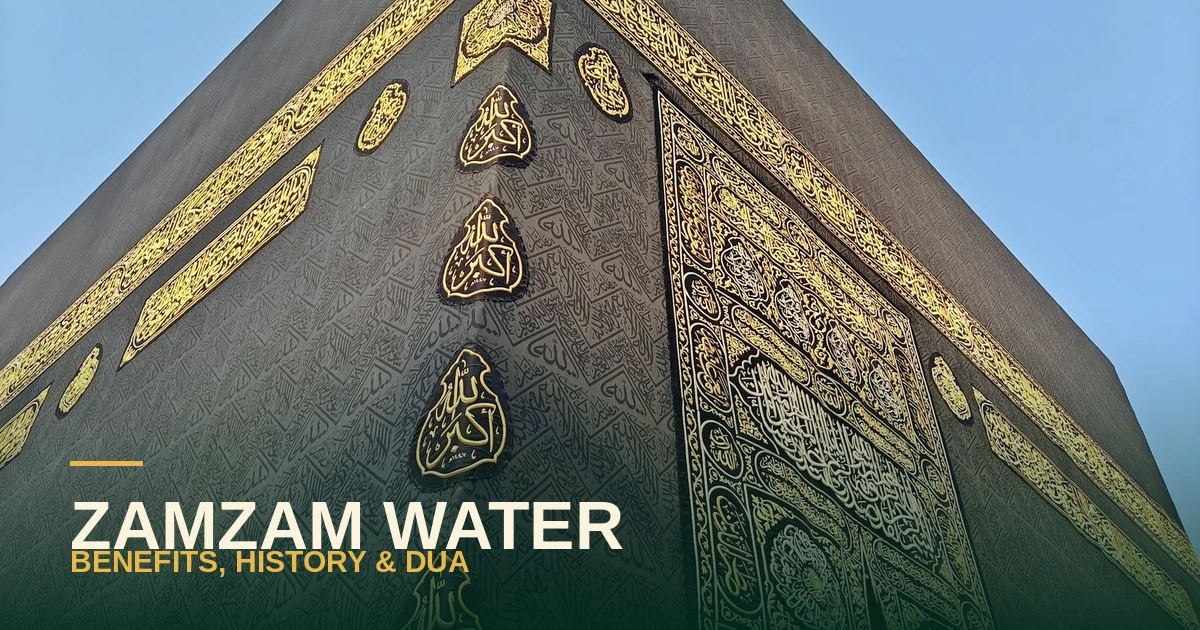
Zamzam water is the blessed water of the well inside Masjid al-Haram in Makkah, a short distance from the Kaaba. Muslims believe it first sprang for Hajar and her infant son Ismail (peace be upon them) in a valley with no water and no people, and it has flowed for pilgrims ever since. The Prophet Muhammad (peace and blessings be upon him) praised it, drank it, and taught that it is drunk with an intention — so this guide covers its story, what the hadith say about its benefits, the dua to say when drinking it, and the etiquette of drinking it, with Arabic, transliteration and meaning throughout.
Key Points
- Zamzam is the blessed well inside Masjid al-Haram in Makkah, which first flowed for Hajar and her infant son Ismail (peace be upon them), as narrated in Sahih al-Bukhari 3364.
- The Prophet (peace and blessings be upon him) said: “The water of Zamzam is for whatever it is drunk for” (Sunan Ibn Majah 3062, graded hasan) — drink it with a sincere intention and dua.
- He also called it “the best water on the face of the earth” and “a kind of food and a healing from sickness” (al-Tabarani; graded sahih by al-Albani in Sahih al-Jami’ 3302).
- When he drank it, Ibn Abbas (may Allah be pleased with him) would say: “O Allah, I ask You for beneficial knowledge, abundant provision, and healing from every disease” (al-Hakim, al-Mustadrak 1739).
- The etiquette reported from Ibn Abbas is: say Bismillah, face the Qiblah, drink in three draughts, and drink your fill (Sunan Ibn Majah 3061).
- Zamzam is a means of blessing by Allah’s permission — it is not a replacement for medical treatment, and no one should promise a guaranteed cure from it.
Where Did Zamzam Water Come From?
The story is narrated in full in Sahih al-Bukhari 3364. Ibrahim (peace be upon him) left Hajar and the infant Ismail near the site of the Kaaba, in a valley with no people and no water, with only a bag of dates and a small water-skin. When the water ran out and the child grew thirsty, Hajar ran seven times between the hills of Safa and Marwa searching for help — the origin of the sa’i rite pilgrims still perform today. Then she heard a voice and saw an angel at the place of Zamzam, digging the earth until water flowed. She cupped it with her hands and filled her water-skin, and the angel told her not to fear being neglected, for this was the House of Allah, which the boy and his father would build.
Before leaving them, Ibrahim (peace be upon him) had turned towards the Kaaba and prayed. His words are recorded in the Qur’an — the opening words of Qur’an 14:37:
Arabic:
رَبَّنَا إِنِّي أَسْكَنْتُ مِنْ ذُرِّيَّتِي بِوَادٍ غَيْرِ ذِي زَرْعٍ عِنْدَ بَيْتِكَ الْمُحَرَّمِ
Transliteration: Rabbanaa innee askantu min dhurriyyatee biwaadin ghayri dhee zar’in ‘inda baytikal-muharram.
Translation: “Our Lord, I have settled some of my descendants in an uncultivated valley near Your sacred House.” (Qur’an 14:37 — opening words, as quoted in Sahih al-Bukhari 3364)
The well that answered that prayer still stands beside the Kaaba, and every pilgrim who performs Hajj or Umrah drinks from it. You can read the full step-by-step rites in our guide to performing Umrah and our Hajj 2027 guide.
What Did the Prophet Say About Zamzam Water?
The best-known hadith about Zamzam is short and often quoted:
Arabic:
مَاءُ زَمْزَمَ لِمَا شُرِبَ لَهُ
Transliteration: Maa’u Zamzama limaa shuriba lah.
Translation: “The water of Zamzam is for whatever it is drunk for.” (Sunan Ibn Majah 3062, graded hasan by Darussalam)
Scholars explain this to mean that the drinker should make a sincere intention and dua while drinking — for knowledge, for provision, for healing, for protection — and hope for Allah’s answer, since the outcome rests with Him alone.
The Prophet (peace and blessings be upon him) also praised the water itself. Ibn Abbas (may Allah be pleased with him) reported that he said: “The best water on the face of the earth is the water of Zamzam; it is a kind of food and a healing from sickness” (al-Tabarani; graded sahih by al-Albani in Sahih al-Jami’ 3302). And in the long narration of Abu Dharr (may Allah be pleased with him) in Sahih Muslim 2473, Abu Dharr stayed near the Kaaba for thirty nights with no food but Zamzam water, and felt no hunger. When the Prophet (peace and blessings be upon him) asked who had been feeding him, and Abu Dharr answered that he had only Zamzam, the Prophet (peace and blessings be upon him) said:
Arabic:
إِنَّهَا مُبَارَكَةٌ إِنَّهَا طَعَامُ طُعْمٍ
Transliteration: Innahaa mubaarakah, innahaa ta’aamu tu’m.
Translation: “It is blessed; it is food that nourishes.” (Sahih Muslim 2473)
What Dua Should I Say When Drinking Zamzam Water?
There is no dua for Zamzam water narrated from the Prophet (peace and blessings be upon him) himself. The dua pilgrims use is the one reported from his Companion, Ibn Abbas (may Allah be pleased with him), who would say it when he drank Zamzam:
Arabic:
اللَّهُمَّ إِنِّي أَسْأَلُكَ عِلْمًا نَافِعًا وَرِزْقًا وَاسِعًا وَشِفَاءً مِنْ كُلِّ دَاءٍ
Transliteration: Allaahumma innee as’aluka ‘ilman naafi’an, wa rizqan waasi’an, wa shifaa’an min kulli daa’.
Translation: “O Allah, I ask You for beneficial knowledge, abundant provision, and healing from every disease.” (Reported from Ibn Abbas — al-Hakim, al-Mustadrak 1739; Sunan al-Daraqutni 2738; Musannaf Abd al-Razzaq 9112)
You may also make your own dua in your own words — for your health, your family, your livelihood, or anything lawful you need. The dua for provision in it matches the morning dua of the Prophet (peace and blessings be upon him) itself, which we explain in our dua for rizq guide. What matters is sincerity and presence of heart, not a fixed formula: no hadith fixes a particular wording as obligatory for drinking Zamzam.
What Are the Zamzam Water Benefits?
According to the hadith, the benefits of Zamzam are:
It is blessed water. The Prophet (peace and blessings be upon him) called it blessed (Sahih Muslim 2473), and the best water on the face of the earth (Sahih al-Jami’ 3302).
It is drunk with an intention. “The water of Zamzam is for whatever it is drunk for” (Sunan Ibn Majah 3062) — so drink it hoping for the good you ask Allah for, whether knowledge, provision or healing.
It is described as food and healing. The hadith call it “a kind of food and a healing from sickness” (Sahih al-Jami’ 3302) and “food that nourishes” (Sahih Muslim 2473). Scholars understand this as a blessing Allah has placed in it, by His permission — not as a property of the water on its own.
An honest note belongs here. Zamzam is a means of blessing, not a medicine, and this post promises no cure. If you are ill, keep taking your prescribed treatment and follow your doctor’s advice; drink Zamzam with hope in Allah’s mercy, as the Companions did, and leave the outcome to Him. Claims online that a single drink “guarantees” healing go beyond what the hadith say.
How Should I Drink Zamzam Water?
The etiquette reported from Ibn Abbas (may Allah be pleased with him) is simple, and it is the practice most pilgrims follow in the Haram:
- Say Bismillah before drinking.
- Face the Qiblah if you can.
- Drink in three draughts — pausing between sips — rather than gulping it in one go.
- Drink your fill, and then make your dua.
This etiquette is reported in Sunan Ibn Majah 3061, where Ibn Abbas explains to a man how to drink Zamzam properly. (Grading note: Darussalam classed this narration hasan; al-Albani classed it da’if — weak — so the etiquette is presented here as the reported practice of a Companion, not as a confirmed Prophetic command.) Afterwards, say Alhamdulillah, as after any drink.
Can Zamzam Water Be Taken Home?
Yes. Scholars state that the blessing and virtue of Zamzam water are not affected if it is taken out of Makkah and carried to another place, and pilgrims have carried it home for centuries. A practical note for travellers, checked in November 2026: Saudi Arabia does not export Zamzam water as a commercial good, but pilgrims are allowed to take one bottle prepared for travel (Saudipedia). Rules at airports change, so confirm the current allowance with your airline before you fly. Today the well is managed through the official King Abdullah Zamzam Watering Project, which bottles and distributes the water in the Haram and to pilgrims. If you are offered Zamzam water far from Makkah, buy it only from a source you trust — its blessing is in the water itself, not in a label, and counterfeit bottles are a real problem in some markets.
Conclusion
Zamzam water is a gift tied to the story of Hajar’s trust in Allah — a spring that appeared in a valley with no water at all, and that has quenched pilgrims ever since. Drink it as the Prophet (peace and blessings be upon him) and his Companions drank it: with Bismillah, with a sincere intention, and with the dua of Ibn Abbas on your tongue — asking Allah for beneficial knowledge, abundant provision, and healing from every disease — and leave the answer to the One who made the water flow.
Frequently Asked Questions
What are the Zamzam water benefits?
The hadith describe it as blessed water, the best water on the face of the earth, a kind of food and a healing from sickness (Sahih al-Jami’ 3302; Sahih Muslim 2473), and ‘for whatever it is drunk for’ (Sunan Ibn Majah 3062). Drink it with a sincere intention and dua, and understand the benefit as coming from Allah, by His permission.
What dua should I say when drinking Zamzam water?
The dua reported from Ibn Abbas (may Allah be pleased with him): ‘Allaahumma innee as’aluka ‘ilman naafi’an, wa rizqan waasi’an, wa shifaa’an min kulli daa” — ‘O Allah, I ask You for beneficial knowledge, abundant provision, and healing from every disease’ (al-Hakim, al-Mustadrak 1739). You may also make your own dua in your own words.
Is Zamzam water a cure for illness?
The hadith call it ‘a healing from sickness’, and Muslims drink it hoping for healing by Allah’s permission. It is not a replacement for medical treatment — keep taking prescribed medicine and follow your doctor’s advice, and do not treat any drink as a guaranteed cure.
How do I drink Zamzam water correctly?
Say Bismillah, face the Qiblah if you can, drink in three draughts, drink your fill, and then make your dua (Sunan Ibn Majah 3061). There is no fixed number of cups and no obligatory wording — the dua of Ibn Abbas above is the reported practice of a Companion.
Can I drink Zamzam water at home, far from Makkah?
Yes. Scholars state that its blessing is not affected by carrying it outside Makkah, and pilgrims have always taken it home. Saudi Arabia does not export it commercially, but pilgrims may take one travel bottle — confirm the current rule with your airline (checked November 2026).
Where does Zamzam water come from?
From the well inside Masjid al-Haram in Makkah, beside the Kaaba. According to Sahih al-Bukhari 3364, it first flowed for Hajar and her infant son Ismail (peace be upon them) when an angel dug the earth at the place of Zamzam, after Hajar had run seven times between Safa and Marwa.
Sources: The Holy Qur’an; Sahih al-Bukhari; Sahih Muslim; Sunan Ibn Majah; Sahih al-Jami’; al-Mustadrak by al-Hakim; Sunan al-Daraqutni; Musannaf Abd al-Razzaq; Saudipedia; IslamQA; IslamOnline.