Is Vaping Haram in Islam? Fatwas Explained
Is vaping haram in Islam? The majority of Islamic bodies that have ruled on it say yes: in November 2026 Indonesia’s top clerical council, the MUI, declared the use, production and sale of e-cigarettes haram, joining Malaysia’s National Fatwa Council, which ruled the same way in 2015, and several Malaysian states that have since banned vape sales on the basis of fatwas. The Qur’an does not name vaping — e-cigarettes did not exist in the Prophet’s (SAW) time — so the ruling is derived from the same principles as smoking: the prohibition on harming oneself and others, and the proven health harm of inhaling nicotine and chemicals. A minority of scholars hold a softer view, and this guide presents both positions with their sources.
Key Points
- Indonesia’s MUI declared vaping haram in Fatwa No. 131/2026 (signed 6 Nov 2026, announced 9 Nov 2026) — covering use, production and sale.
- Malaysia’s National Fatwa Council ruled vaping haram in 2015; Perlis (2022) and Pahang (2025) followed with state fatwas and sales bans.
- The ruling rests on the harm principle: Qur’an 2:195 (“do not throw yourselves into destruction”) and 7:157, plus the hadith “there should be neither harming nor reciprocating harm” (Sunan Ibn Majah 2340).
- Health authorities including the US CDC state that e-cigarette aerosol is not harmless water vapour and that nicotine is addictive.
- Most scholars who rule smoking haram extend the ruling to vaping; a minority hold it makruh or conditionally permissible. This article presents the positions — it does not issue a fatwa.
What Is Vaping?
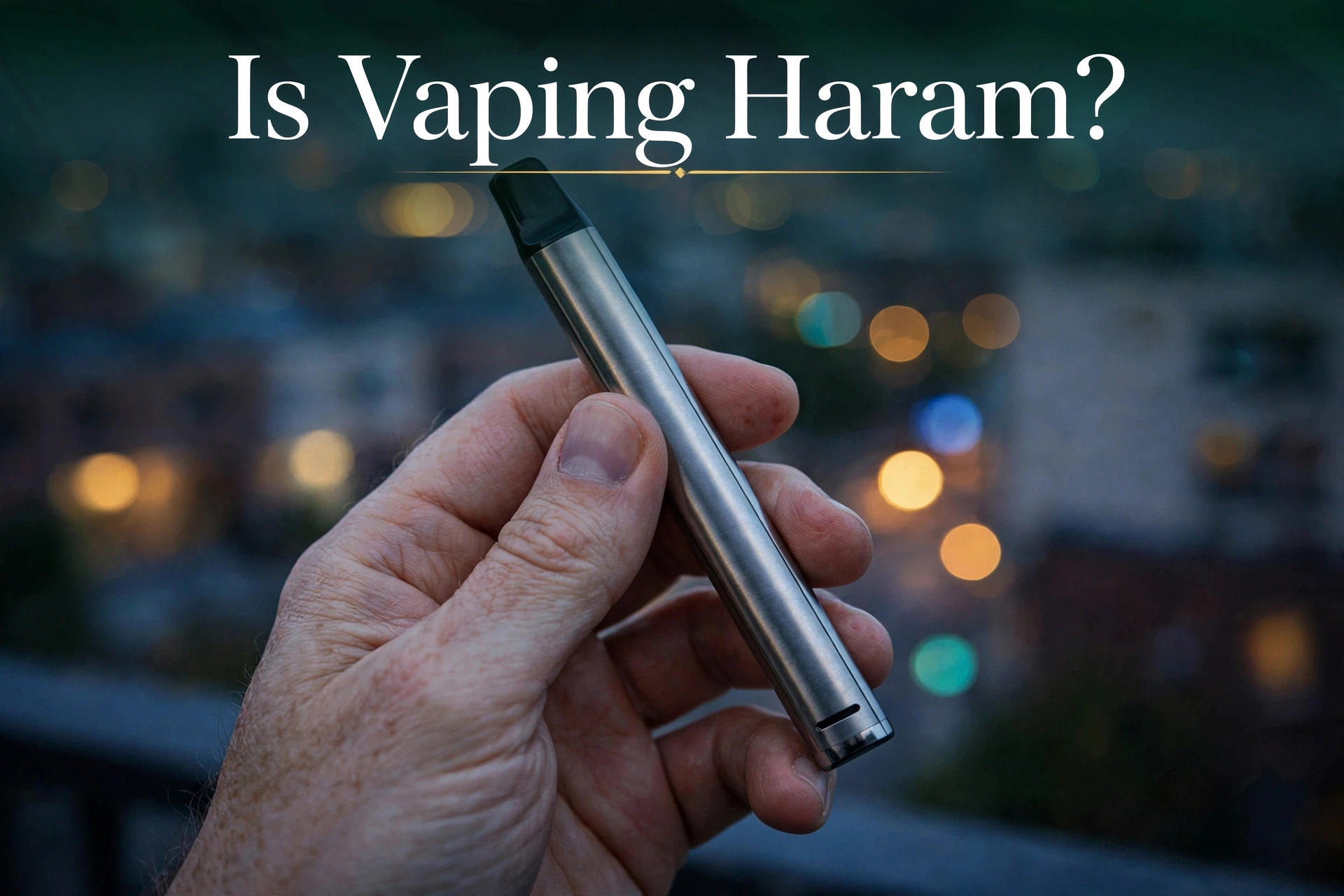
Vaping is inhaling and exhaling an aerosol produced by an electronic cigarette or similar device. The device heats a liquid — usually containing nicotine, glycerine and flavourings — into a vapour the user inhales. Unlike a cigarette, nothing is burned, which is why manufacturers and many users describe it as safer than smoking. Health authorities disagree with the “safe” claim: the US Centers for Disease Control and Prevention (CDC) states that e-cigarette aerosol is “not harmless water vapour” and that it can contain nicotine, formaldehyde, heavy metals such as lead, and volatile organic compounds. Nicotine itself is highly addictive, and the long-term effects of inhaling heated flavourings are still being studied.
The New Fatwa: Indonesia’s MUI, November 2026
The freshest ruling on vaping comes from Indonesia, the world’s largest Muslim-majority country. The Indonesian Ulema Council (MUI) declared the use, production and sale of electronic cigarettes haram in Fatwa No. 131/2026, signed on 6 November 2026 and announced publicly on 9 November 2026.
The fatwa’s stated grounds are threefold: e-cigarettes endanger health, damage the environment, and could be used to consume narcotics and other addictive substances. The ruling covers not only using a vape but also manufacturing it and selling it commercially. It also separately declares haram the use of vaping devices to consume narcotics.
The ruling followed a request from Indonesia’s National Police Chief, General Suyudi Ario Seto, who asked the MUI to consider a fatwa on vaping during a visit to the council’s headquarters on 13 October 2026.
One point matters for readers: a fatwa is a religious ruling, not a law. The MUI fatwa creates no criminal penalties and does not by itself ban vape sales in Indonesia — that would need separate government regulation. What it does is settle the religious question for Indonesian Muslims who follow the MUI: vaping is haram.
What Other Scholars and Bodies Have Said
Indonesia’s ruling is the latest in a series, and the direction has been consistent — towards prohibition, not permission:
- Malaysia, 2015: the National Fatwa Council of Malaysia (the fatwa committee of the National Council for Islamic Religious Affairs) declared the use of e-cigarettes and vapes haram at a special meeting on 21 December 2015, on the grounds that they harm health. Malaysia’s 1995 ruling had already declared smoking forbidden.
- Perlis, Malaysia, 2022: the Perlis State Fatwa Committee ruled vaping haram in 2022, and the state banned retail vape sales from 1 August 2025.
- Pahang, Malaysia, 2025: the Pahang Mufti’s Department issued a fatwa prohibiting vape use; the state executive council endorsed it on 14 May 2025 with the consent of the Sultan of Pahang, and an immediate ban followed in June 2025, with a sales ban from 1 January 2026.
- Philippines, 2025: the Bangsamoro Darul Ifta’, the highest Islamic juridical body in the Bangsamoro region, is reported to have declared smoking, vaping and e-cigarettes haram in November 2025.
No major fatwa body has ruled vaping halal outright. The disagreement among scholars is between haram (the majority position among bodies that have ruled) and makruh (disliked) — with some scholars, particularly in the Hanafi school, classifying vaping as makruh tahrimi (prohibitively disliked) rather than haram, and a small number allowing it only where the liquid contains no nicotine and no harmful substance. That conditional view has grown harder to hold as the evidence of harm has grown.
The Islamic Reasoning: Why Scholars Rule It Haram
The reasoning follows the same path as the ruling on smoking, which the contemporary majority of scholars hold to be haram:
- The prohibition on self-harm. Qur’an 2:195 says, in the relevant phrase:
Arabic:
وَلَا تُلْقُوا بِأَيْدِيكُمْ إِلَى التَّهْلُكَةِ
Transliteration: Wa laa tulqoo bi-aydeekum ilat-tahlukah
Translation: “And do not throw yourselves with your own hands into destruction.”
- The prohibition on what is harmful and impure. Qur’an 7:157 describes the Prophet (SAW) as one who “makes lawful for them the good things and prohibits for them the evil things”. Scholars apply this to substances proved harmful.
- The no-harm principle. The Prophet (SAW) said:
Arabic:
لَا ضَرَرَ وَلَا ضِرَارَ
Transliteration: Laa darara wa laa diraar
Translation: “There should be neither harming nor reciprocating harm.” (Sunan Ibn Majah 2340, graded hasan.)
- Harming others. Second-hand aerosol exposes bystanders to nicotine and chemicals, which engages the same “harming others” argument used against smoking — and is one reason vaping is banned in mosques and in many public places.
- Waste of wealth. Money spent on a harmful habit is wealth spent on what harms rather than benefits, which scholars count as a supporting argument, not a standalone proof.
The counter-argument — that vaping is less harmful than smoking, and therefore a lesser evil for a smoker trying to quit — is taken seriously by scholars. Some allow vaping as a temporary step towards quitting smoking, where a doctor advises it and the intention is to stop altogether. That is a medical-cessation argument, not a general permission to vape, and it is attributed to those scholars rather than presented as the site’s view.
Does Vaping Break the Fast?
Yes, according to the scholars who have addressed it: vaping breaks the fast, just as smoking does, because it involves intentionally inhaling a substance with taste and effect into the body. A person who vapes during Ramadan must make up the fast, and the ruling on vaping being haram makes the point stronger, not weaker.
What If You Vape Now?
If you vape, the scholarly advice is practical, not preachy: stop, and ask Allah for help in stopping. Nicotine is addictive, so quitting is hard — that is a medical fact, not a moral failing. Speak to your doctor about cessation support where it is available, tell someone you trust, and replace the habit with something better. Dua helps with resolve — the Prophet’s (SAW) dua against anxiety and sorrow is a good place to start — but dua goes with practical steps, not instead of them.
Frequently Asked Questions
Is vaping haram in Islam?
The majority of Islamic bodies that have ruled on it say yes — including Indonesia’s MUI (Fatwa No. 131/2026, November 2026) and Malaysia’s National Fatwa Council (2015). A minority of scholars hold it makruh rather than haram. No major body has ruled it halal.
What did Indonesia’s MUI rule about vaping?
In Fatwa No. 131/2026, signed 6 November 2026 and announced 9 November 2026, the MUI declared the use, production and sale of e-cigarettes haram, citing health risks, environmental damage and the risk of drug misuse. It is a religious ruling, not a criminal law.
Is vaping haram if it has no nicotine?
Scholars differ. The fatwas that rule vaping haram generally cover the device and the practice, not only nicotine — because the aerosol itself contains harmful chemicals and the habit itself is the problem. A small number of scholars allow nicotine-free vaping conditionally. This is a minority view.
Is vaping the same as smoking in Islamic law?
Most scholars who rule smoking haram extend the ruling to vaping for the same harm reasoning. The two are treated together in the fatwas from Malaysia and Indonesia, though vaping has its own rulings because it is a different device.
Does vaping break the fast?
Yes — scholars who have addressed it hold that vaping breaks the fast, like smoking, because it involves intentionally inhaling a substance into the body.
Can vaping help me quit smoking?
Some scholars allow it as a temporary, doctor-advised step towards quitting smoking altogether. That is a cessation argument, not a general permission to vape, and you should speak to your doctor about it.
Sources
Sources: Indonesian Ulema Council (MUI), Fatwa No. 131/2026; National Fatwa Council of Malaysia; Pahang Mufti’s Department; Perlis State Fatwa Committee; US Centers for Disease Control and Prevention; The Holy Qur’an (Surah al-Baqarah 2; Surah al-A’raf 7); Sunan Ibn Majah