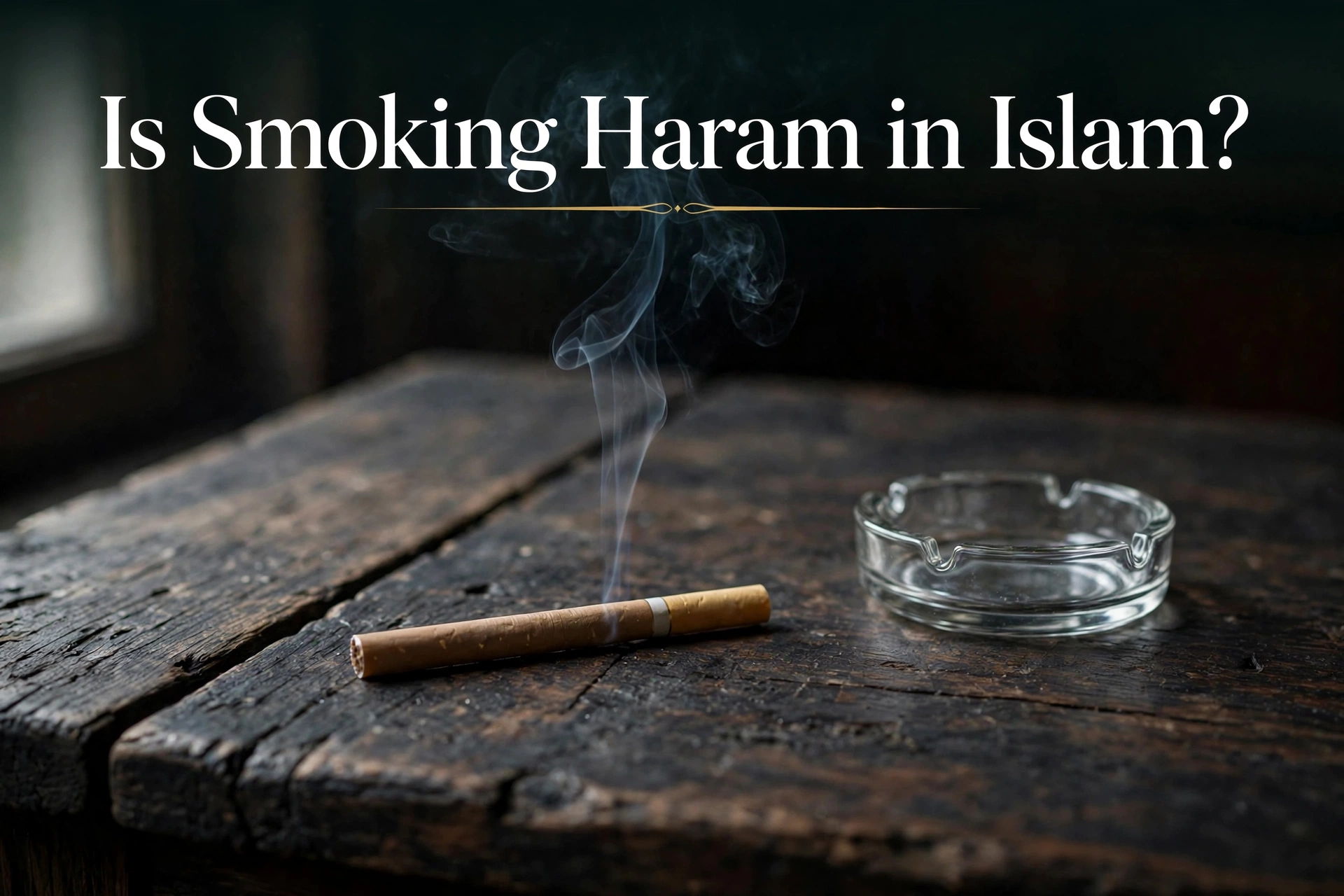
Is Smoking Haram In Islam?
Is smoking haram in Islam? No verse of the Qur’an names smoking, because tobacco only reached the Muslim world centuries after the Prophet (peace be upon him). The contemporary majority of scholars, however, rule smoking haram: the Qur’an forbids us to throw ourselves into destruction and declares impure things unlawful, the Prophet (peace be upon him) taught that there should be neither harming nor reciprocating harm, and modern medicine has proved beyond doubt that smoking destroys health.
A minority of scholars still hold smoking to be makruh (disliked) rather than haram. This article sets out the majority view, the minority view and the evidence behind them, so you can see how the ruling is reached.
Key Points
- No verse of the Qur’an or hadith names smoking. The ruling is derived from general principles about protecting life and avoiding harm.
- The contemporary majority of scholars rule smoking haram, including Al-Azhar, Saudi Arabia’s Permanent Committee and Malaysia’s National Fatwa Council.
- A minority of scholars still hold smoking to be makruh (disliked).
- The World Health Organization reports that tobacco kills more than 8 million people every year, including around 1.2 million non-smokers killed by second-hand smoke.
- The ruling rests on Qur’an 2:195 and 7:157 and the hadith “There should be neither harming nor reciprocating harm” (Sunan Ibn Majah 2340).
What Do Scholars Say About Smoking?
Tobacco is not named in the Qur’an or the Sunnah. It is a plant from the Americas, and it reached the Muslim world in the sixteenth and seventeenth centuries, long after the time of the Prophet (peace be upon him). Scholars therefore had to reason from general principles: the Qur’an’s commands to protect life, to take what is pure and good, and to keep away from what is impure and harmful. To understand the words themselves, see what haram and halal mean in Islam.
The early scholars differed. When tobacco first spread, its harm was not yet known: some ruled it haram, some makruh (disliked), and a few mubah (permissible). The disagreement was never about the principle — everyone agreed that whatever is proved harmful is prohibited — but about whether the harm of smoking was proved.
Today, with the medical evidence settled, the contemporary majority hold smoking haram. Al-Azhar’s Fatwa Committee in Egypt, Saudi Arabia’s Permanent Committee for Scholarly Research and Ifta — which ruled that smoking, growing and selling tobacco are haram, citing the hadith “there must be no harm and no harming” and Qur’an 7:157 — and Malaysia’s National Fatwa Council in 1996 have all ruled smoking haram. Similar fatwas have been issued in Egypt, Indonesia, Kuwait, Morocco, Oman, Qatar, Pakistan, the Philippines and the UAE.
A minority still holds makruh. Indonesia’s Council of Ulama (MUI), for example, ruled in 2009 that smoking in public or near pregnant women is haram, but smoking in general is makruh. This article presents the majority view first, because it is the position of most scholars and fatwa bodies today, and the minority view honestly, because scholars still differ. As Shaykh Yusuf al-Qaradawi explained, the disagreement was never about the principle — whatever is proved harmful is prohibited — but about whether the harm of smoking was proved. Now that it is proved, he argued, the dispute has effectively ended.
What the Qur’an and Hadith Say
Three Qur’anic texts and one hadith sit at the centre of the ruling. The first is a command to protect life.
The relevant phrase from Qur’an 2:195 (not the whole verse):
Arabic:
وَلَا تُلْقُوا بِأَيْدِيكُمْ إِلَى التَّهْلُكَةِ
Transliteration: Wa laa tulqoo bi-aydeekum ilat-tahlukah
Translation: “And do not throw yourselves with your own hands into destruction.”
Scholars read this as a general prohibition on destroying our own health — and smoking, which is proved to destroy health, falls under it.
The second text describes the Prophet (peace be upon him) as the one who makes lawful what is good and pure and prohibits what is evil and impure. The relevant phrase from Qur’an 7:157 (not the whole verse):
Arabic:
وَيُحِلُّ لَهُمُ الطَّيِّبَاتِ وَيُحَرِّمُ عَلَيْهِمُ الْخَبَائِثَ
Transliteration: Wa yuhillu lahumut-tayyibaati wa yuharrimu ‘alayhimul-khabaa’ith
Translation: “[The Prophet] makes lawful for them the good things and prohibits for them the evil things.”
Tobacco, scholars argue, is not among the good and pure things: it harms the body, fouls the breath and brings no benefit.
The third text commands believers to eat from what is good and pure. Allah says in Qur’an 2:172:
Arabic:
يَا أَيُّهَا الَّذِينَ آمَنُوا كُلُوا مِن طَيِّبَاتِ مَا رَزَقْنَاكُمْ وَاشْكُرُوا لِلَّهِ إِن كُنتُمْ إِيَّاهُ تَعْبُدُونَ
Transliteration: Yaa ayyuhal-ladheena aamanu kuloo min tayyibaati maa razaqnaakum wash-kuroo lillaahi in kuntum iyyaahu ta’budoon
Translation: “O you who believe, eat from the good things We have provided for you and be grateful to Allah, if it is Him you worship.”
The point is the same: what we take into our bodies should be good and pure, not something that harms us.
The hadith that ties the ruling together is the Prophet’s statement of the no-harm principle:
Arabic:
لَا ضَرَرَ وَلَا ضِرَارَ
Transliteration: Laa darara wa laa diraar
Translation: “There should be neither harming nor reciprocating harm.” (Sunan Ibn Majah 2340, graded hasan.)
This hadith is the basis for many rulings in Islamic law: a person may not harm himself, and may not harm others. Smoking does both.
What the Health Evidence Shows
The World Health Organization’s tobacco fact sheet gives the scale of the harm. Tobacco kills more than 8 million people every year — more than 7 million from direct use, and around 1.2 million non-smokers who die from breathing second-hand smoke. Tobacco kills up to half of the people who use it and do not quit. Around 1.3 billion people use tobacco, and over 80 percent of them live in low- and middle-income countries.
Smoking is a major cause of lung cancer and other cancers, heart disease, stroke and chronic lung disease, and it damages nearly every organ in the body. It also increases the risk of tuberculosis. Cigarette smoke contains carbon monoxide, which binds to haemoglobin — the protein in red blood cells that carries oxygen — so less oxygen reaches the body’s tissues.
Second-Hand Smoke and Harming Others
The harm of smoking does not stop with the smoker. Around 1.2 million non-smokers die every year from second-hand smoke, including children and family members who breathe the smoke at home. This is the honest basis for the ‘harming others’ argument: the Prophet’s teaching that there should be neither harming nor reciprocating harm covers the smoke that reaches other people’s lungs, not only the smoker’s own.
The Smell of Smoke and the Mosque
There is a separate point about the smell of smoke. The Prophet (peace be upon him) said that whoever had eaten garlic or onion should keep away from the mosque (Sahih al-Bukhari 855, Book of Adhan), because the smell would disturb others at prayer. That hadith is about garlic and onion, not about smoking, and it does not rule smoking haram on its own. Scholars use it by analogy: if the smell of garlic is reason enough to stay away from the congregation, then the smell of smoke — which is stronger and lasts longer — is a reason to avoid troubling others in the mosque.
Smoking and Wasted Wealth
Some scholars add a supporting argument about money. Cigarettes cost a great deal over a lifetime and give nothing of benefit in return, and the Prophet (peace be upon him) prohibited wasting wealth. This is a supporting argument, not a standalone proof: the main basis for the ruling is the harm to health and to others. Muslims ask the same kind of question about many everyday matters — from whether KFC is halal to which seafood is halal and haram — and each is answered by weighing the evidence against the principles of the Qur’an and Sunnah.
How to Quit Smoking
Quitting is hard, and most people who succeed have tried more than once. A practical approach is to set a quit date, tell family and friends so they can support you, and remove cigarettes, ashtrays and lighters from your home, car and workplace. Notice your triggers — the cup of tea, the break at work, the feeling of stress — and plan something else for those moments, such as a walk, a glass of water or a short prayer.
If your doctor advises it, nicotine replacement or other support can help with cravings, and you should speak to your doctor before starting any treatment — especially if you have a health condition or are pregnant. Many people also find strength in dua: turning to Allah for help, and making dua for shifa (healing), can steady a person through the difficult days. If you slip, do not give up; treat it as a setback, not a failure, and start again.
Frequently Asked Questions
Is smoking haram in Islam?
No verse names smoking, but the contemporary majority rule it haram, from Qur’an 2:195 and 7:157, the hadith ‘There should be neither harming nor reciprocating harm’ (Sunan Ibn Majah 2340) and the proved medical harm. A minority hold it makruh.
Why do scholars say smoking is haram when the Qur’an does not mention it?
Tobacco did not exist in the Prophet’s time, so no verse names it. Scholars apply general principles — protecting life and avoiding harm — once the harm of smoking was proved.
Is smoking makruh or haram?
The majority say haram, including Al-Azhar, Saudi Arabia’s Permanent Committee and Malaysia’s National Fatwa Council. A minority, such as Indonesia’s MUI, say makruh.
Does smoking break the fast?
Yes. Smoking breaks the fast, because it involves deliberately inhaling smoke and substances into the body. This is the standard position of the scholars.
Is vaping the same ruling as smoking?
Scholars differ. Most who rule smoking haram extend it to vaping for the same harm, but it is not a settled ruling, and this article does not present it as our own fatwa.
How can I quit smoking?
Set a quit date, remove cigarettes, plan for your triggers, ask family and friends for support, and speak to your doctor about nicotine replacement or other help.
Sources
Sources: The Holy Qur’an (Surah al-Baqarah 2; Surah al-A’raf 7); Sunan Ibn Majah; World Health Organization; Al-Azhar Fatwa Committee; Permanent Committee for Scholarly Research and Ifta.