Black Seed (Kalonji) Benefits: Hadith, Uses & Safety
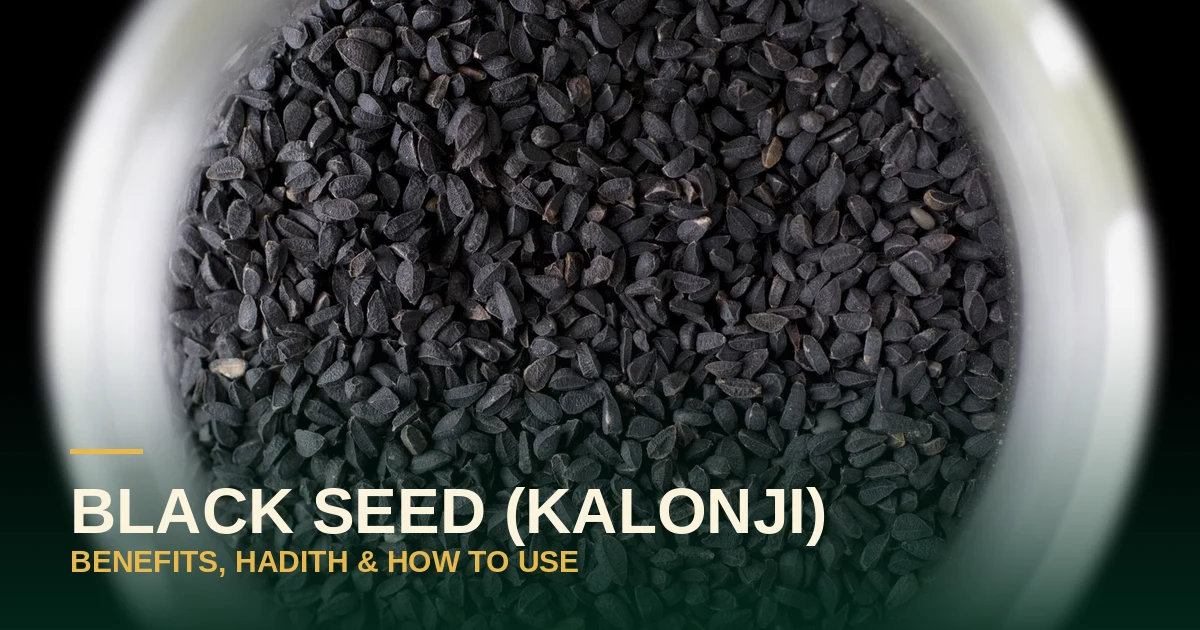
What is black seed (kalonji) good for? The Prophet Muhammad (peace be upon him) said: ‘There is healing in black cumin for all diseases except death’ (Sahih al-Bukhari 5688). Black seed — kalonji in Urdu and Hindi, habbat al-barakah (the blessed seed) in Arabic, Nigella sativa to botanists — has been used in traditional medicine for centuries, and interest in black seed benefits continues to grow.
Modern research has begun to study its main active compound, thymoquinone, but the evidence is still limited. This guide gives the hadith with its full Arabic, transliteration and meaning, the traditional uses, what modern studies actually show, and the safety limits you should know before using it.
Key Points
- The Prophet (peace be upon him) said there is healing in black cumin for all diseases except death (Sahih al-Bukhari 5688; also Sahih Muslim 2215).
- Black seed is kalonji in Urdu/Hindi, habbat al-barakah (the blessed seed) in Arabic, and Nigella sativa in botanical terms.
- Its main active compound is thymoquinone; laboratory and small clinical studies have examined it for anti-inflammatory and antioxidant activity.
- Traditional uses include whole seeds in food, ground seeds mixed with honey, and black seed oil — these are traditional uses, not prescriptions.
- The evidence from modern studies is still limited: black seed is not a proven treatment for any specific disease, and no outcome is guaranteed.
- Food amounts are generally considered safe, but concentrated supplements may interact with medicines and lower blood pressure and blood sugar — ask a doctor first, especially if you are pregnant or on medication.
What Is Black Seed (Kalonji)?
Black seed is the seed of Nigella sativa, a flowering plant. It is known as kalonji in Urdu and Hindi, habbat al-barakah — the blessed seed — in Arabic, and shuniz in Persian. It has a bitter, peppery taste. It is used both as a spice and as a remedy, and it is also pressed into oil. Ground seed is often mixed with honey.
What Did the Prophet (Peace Be Upon Him) Say About Black Seed?
The Prophet (peace be upon him) said there is healing in black cumin for all diseases except death.
Arabic:
فِي الْحَبَّةِ السَّوْدَاءِ شِفَاءٌ مِنْ كُلِّ دَاءٍ إِلَّا السَّامَ
Transliteration: Fee al-habbati-s-sawdaa’i shifaa’un min kulli daa’in illaa-s-saam.
Translation: ‘There is healing in black cumin for all diseases except death.’ (Sahih al-Bukhari 5688; also Sahih Muslim 2215.)
‘As-Saam’ means death. The hadith is also reported in Sahih Muslim 2215.
A second hadith, Sahih al-Bukhari 5687 (Aisha), reports a method: five or seven seeds of black cumin, crushed, mixed with oil, and dropped into the nostrils. This is reported here in English only, as a reported method — not as a prescription — and anyone considering it should consult a doctor first.
What Does Modern Research Say?
Modern research has begun to study thymoquinone, the main active compound in black seed. Laboratory and small clinical studies have examined it for anti-inflammatory and antioxidant activity, and have studied it in relation to blood sugar, cholesterol, blood pressure and skin conditions.
The evidence is still limited. Most studies are small, short or laboratory-based. Black seed is not a proven treatment for any specific disease, and no outcome is guaranteed.
How Is Black Seed Traditionally Used?
Whole seeds are used in food. Ground seed is mixed with honey — traditionally about half a teaspoon of ground seed in a teaspoon of honey, once a day. Black seed oil is taken in small amounts, about a teaspoon a day, or applied to the skin and hair.
All of these are traditional uses, not prescriptions, and none of them replaces prescribed medicine.
Is Black Seed Safe?
Food amounts are generally considered safe. Concentrated forms, such as supplements and oil taken in larger amounts, may interact with medicines and may lower blood pressure and blood sugar.
Pregnant women should ask a doctor first, and so should anyone taking regular medication or living with a medical condition. Black seed is never a substitute for medical care.
Conclusion
Black seed carries a striking hadith and the name ‘the blessed seed’. Use it as tradition uses it — in food, with honey, or as oil — keep the claims honest, and ask a doctor before taking concentrated supplements.
Related reading: the benefits of olive oil in Islam; dua for shifa for health improvement; and the honey pack.
Frequently Asked Questions
What is black seed (kalonji)?
Black seed is the seed of Nigella sativa, known as kalonji in Urdu and Hindi, habbat al-barakah (the blessed seed) in Arabic, and shuniz in Persian. It is used as a spice and as a traditional remedy, and it is pressed into oil.
What did the Prophet (peace be upon him) say about black seed?
‘There is healing in black cumin for all diseases except death’ (Sahih al-Bukhari 5688; also Sahih Muslim 2215). ‘As-Saam’ in the hadith means death.
What is thymoquinone?
Thymoquinone is the main active compound in black seed. Laboratory and small clinical studies have examined it for anti-inflammatory and antioxidant activity.
How is black seed traditionally used?
Whole seeds in food, ground seed mixed with honey (about half a teaspoon of ground seed in a teaspoon of honey, once a day), or black seed oil in small amounts or on the skin and hair. These are traditional uses, not prescriptions.
Is black seed safe?
Food amounts are generally considered safe. Concentrated supplements may interact with medicines and may lower blood pressure and blood sugar. Pregnant women and people taking medication should ask a doctor first.
Can black seed cure a disease?
No outcome is guaranteed. Black seed is not a proven treatment for any specific disease, and it is not a substitute for medical care.
Sources: Sahih al-Bukhari; Sahih Muslim