Three Types of Hajj: Ifrad, Qiran & Tamattu’
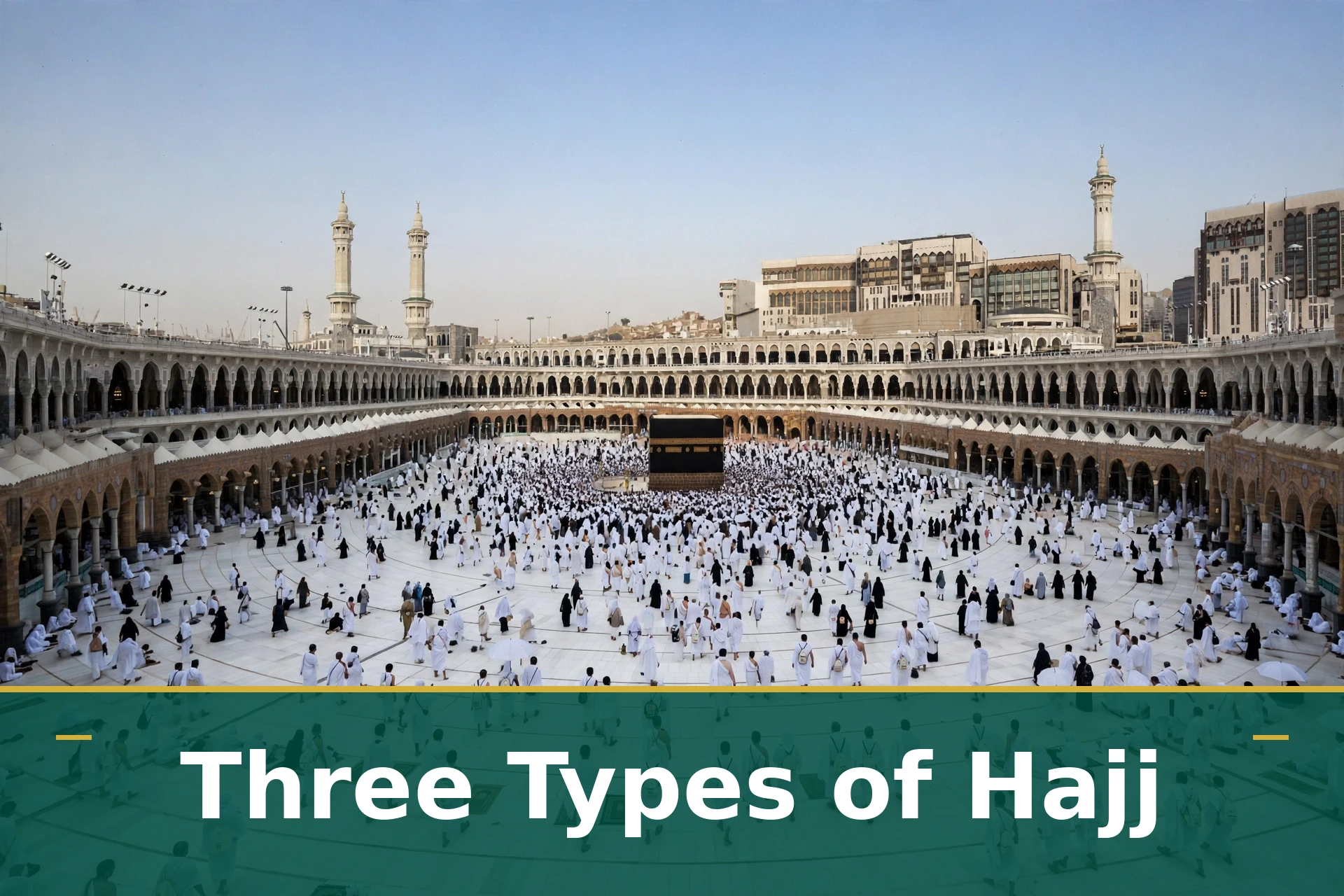
There are three types of Hajj: Ifrad, Qiran and Tamattu’. In Ifrad, the pilgrim performs Hajj alone, in a single Ihram, and no sacrifice (Hady) is required. In Qiran, the pilgrim combines Umrah and Hajj in one Ihram and stays in Ihram until Hajj is complete, and a sacrifice is required. In Tamattu’, the pilgrim performs Umrah first, leaves Ihram, and then enters a new Ihram for Hajj, and a sacrifice is required. Hajj is one of the five pillars of Islam, and every Muslim who is able must perform it once in a lifetime. All three types are valid ways of performing Hajj; the difference is how Umrah is combined with Hajj, and who each type is for. This guide explains each type, compares them side by side, and gives the evidence from the Qur’an and the Sunnah.
Key Points
- Ifrad = Hajj alone, one Ihram, no Hady required.
- Qiran = Umrah + Hajj in one Ihram, Hady required.
- Tamattu’ = Umrah, exit Ihram, then Hajj with a new Ihram, Hady required.
- Tamattu’ and Qiran are for pilgrims from outside Makkah.
- The Prophet (SAW) performed Qiran in his Farewell Hajj (majority view).
The Three Types of Hajj at a Glance
The table below compares the three types at a glance.
| Type | Ihram | Umrah included? | Hady (sacrifice) required? | Who it suits |
|---|---|---|---|---|
| Ifrad | One Ihram, for Hajj only | No | No — voluntary only | Residents of Makkah and the Haram area; anyone who chooses Hajj alone |
| Qiran | One Ihram for Umrah and Hajj together | Yes, in the same Ihram | Yes | Pilgrims from outside Makkah |
| Tamattu’ | Two: one for Umrah, then a new one for Hajj | Yes, then exit Ihram | Yes | Pilgrims from outside Makkah; the most common choice for international pilgrims |
1. Ifrad Hajj — Hajj Alone
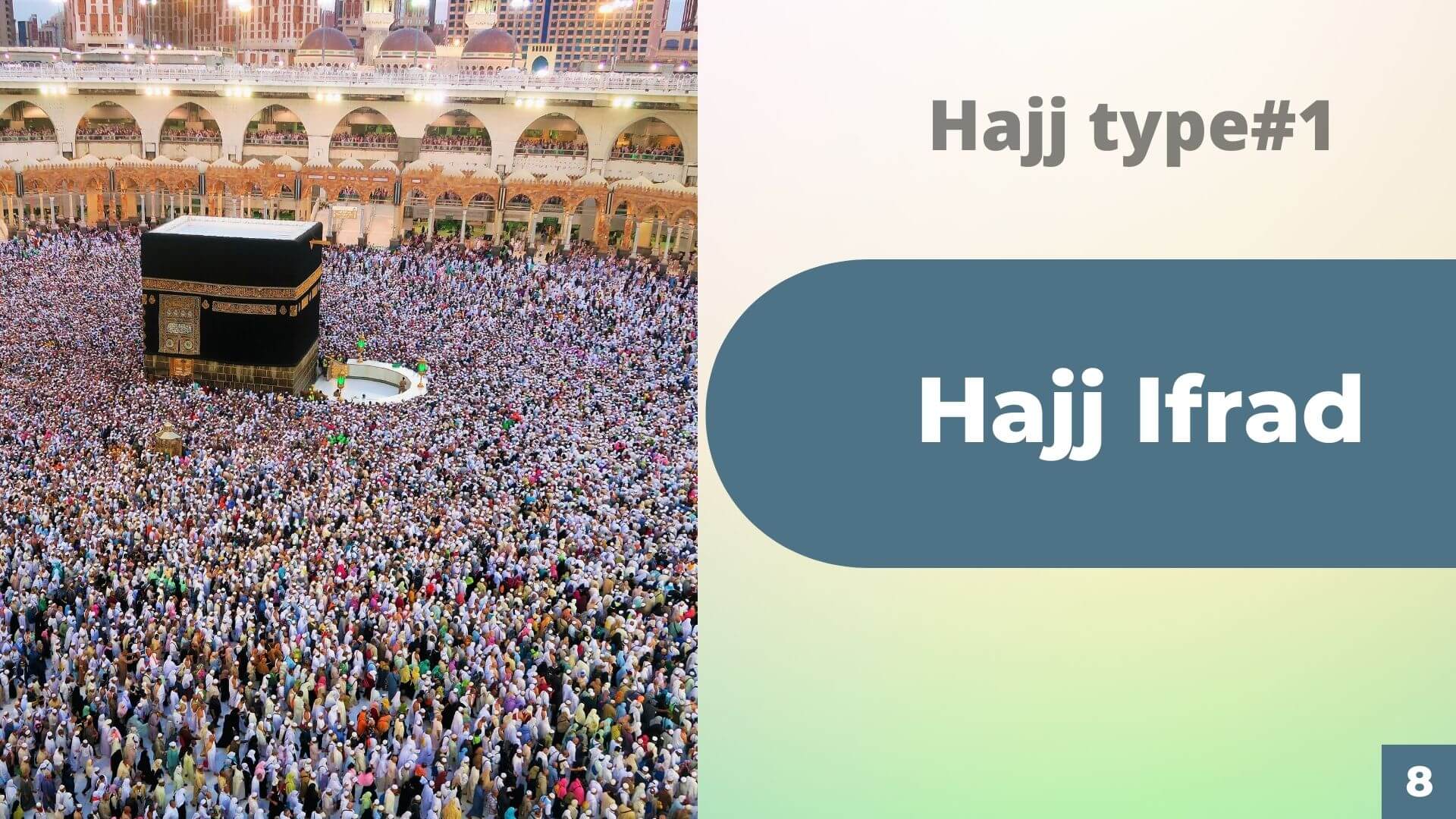
Ifrad means ‘to do something alone’. The pilgrim who performs Ifrad — called a Mufrid — enters Ihram with the intention of Hajj only, reciting the Talbiyah, and performs the rites of Hajj. No Umrah is included in that Ihram.
The Mufrid stays in Ihram until he stones Jamarat al-Aqaba on the 10th of Dhul-Hijjah, then shaves his head or trims his hair and exits Ihram. No sacrifice (Hady) is required for Ifrad, though the pilgrim may offer one voluntarily.
An Ifrad pilgrim is not banned from Umrah altogether: he may perform Umrah separately at another time. What changes the type is performing Umrah in the Hajj months and then Hajj in the same journey — that is Tamattu’, not Ifrad.
Ifrad is the type for the residents of Makkah and the Haram area, as Qur’an 2:196 states. It is also open to anyone who wishes to perform Hajj alone.
2. Qiran Hajj — Umrah and Hajj in One Ihram

Qiran means ‘to join together’. The pilgrim who performs Qiran — called a Qarin — enters Ihram once, with the intention of Umrah and Hajj together, and performs both in that single Ihram.
The Qarin performs Umrah first and then, without leaving Ihram, goes on to perform Hajj. He stays in Ihram from the time he enters it until Hajj is complete, and he cannot exit Ihram until both Umrah and Hajj are done. A sacrifice (Hady) is required for Qiran.
Qiran is for pilgrims coming from outside Makkah. The Prophet (SAW) performed Qiran in his Farewell Hajj, according to the majority of scholars: Ibn Umar (RA) narrated that during the Farewell Hajj the Prophet (SAW) performed Umrah and Hajj together and drove the sacrificial animals with him (Sahih al-Bukhari 1691). Some scholars hold that he performed Tamattu’.
Aisha (RA) narrated that on the Farewell Hajj the Prophet (SAW) told the companions that whoever wanted to assume Ihram for Hajj could do so, and whoever wanted Umrah could do so; some assumed Ihram for Umrah while others for Hajj (Sahih al-Bukhari 1783).
3. Tamattu’ Hajj — Umrah First, Then Hajj

Tamattu’ comes from a word meaning ‘to enjoy’ or ‘to benefit’ — the pilgrim benefits from the concession of performing Umrah and Hajj in one journey, with a break in between. The pilgrim who performs it is called a Mutamatti’.
The Mutamatti’ enters Ihram for Umrah during the Hajj months, performs Umrah, and then exits Ihram — cutting the hair and returning to normal life. Later, when the days of Hajj arrive, he enters a new Ihram for Hajj. A sacrifice (Hady) is required for Tamattu’.
Tamattu’ is the most common type for international pilgrims, because it allows a rest between Umrah and Hajj. Like Qiran, it is for pilgrims coming from outside Makkah.
Who Can Do Which Type?
The rule comes from the end of Qur’an 2:196: the concession of Tamattu’ — and by extension Qiran — is for ‘those whose family is not in the area of al-Masjid al-Haram’. In other words, Tamattu’ and Qiran are for pilgrims who travel to Makkah from outside. Residents of Makkah and the Haram area perform Ifrad. This is the rule that decides which of the three types of Hajj a pilgrim may perform.
Jeddah is not inside the Haram boundary, so people living in Jeddah are not residents of the Haram area and may perform Tamattu’ or Qiran like any other pilgrim from outside Makkah. An earlier version of this article wrongly said that Jeddah was inside the Haram boundary; that error has been corrected.
What the Qur’an Says
The rules for Tamattu’ and the sacrifice, and who they apply to, are set out in Qur’an 2:196. The following are the relevant phrases of the verse — not the whole verse:
Arabic:
فَمَن تَمَتَّعَ بِالْعُمْرَةِ إِلَى الْحَجِّ فَمَا اسْتَيْسَرَ مِنَ الْهَدْيِ ۚ ذَٰلِكَ لِمَن لَّمْ يَكُنْ أَهْلُهُ حَاضِرِي الْمَسْجِدِ الْحَرَامِ
Transliteration: Fa man tamatta’a bil-‘umrati ilal-hajji fa mastaysara minal-hady, dhaalika liman lam yakun ahluhu haadiree al-masjidil-haraam
Translation: “So whoever performs Umrah [during the Hajj months] followed by Hajj [shall offer] whatever can be obtained with ease of sacrificial animals. That is for those whose family is not in the area of al-Masjid al-Haram.”
Hajj 2027: Expected Dates
Hajj 1448 is expected to take place from 14 to 19 May 2027, with the Day of Arafah expected on Saturday 15 May 2027. These dates are expected and depend on the sighting of the moon; local sighting may shift them by a day. Pilgrims planning any of the three types of Hajj should confirm the final dates with their Hajj group and the official Saudi announcements. Saudi Arabia’s preparations for the pilgrimage were discussed at the Hajj Conference 2026 in Jeddah.
Frequently Asked Questions
What are the three types of Hajj?
Ifrad (Hajj alone), Qiran (Umrah and Hajj in one Ihram) and Tamattu’ (Umrah first, then Hajj with a new Ihram). All three are valid; they differ in how Umrah is combined with Hajj and whether a sacrifice (Hady) is required.
Which type of Hajj is best for pilgrims from outside Saudi Arabia?
Tamattu’ is the most common choice for international pilgrims, because it lets you perform Umrah first, rest, and then enter Ihram again for Hajj. Qiran is also open to pilgrims from outside Makkah. The choice depends on your travel plans and the guidance of your group or scholar.
What is the difference between Tamattu’ and Qiran?
In Tamattu’ you perform Umrah, exit Ihram, and then enter a new Ihram for Hajj. In Qiran you perform Umrah and Hajj in a single Ihram and stay in Ihram throughout. Both require a sacrifice (Hady).
Is a sacrifice (Hady) required for all three types?
No. Hady is required for Qiran and Tamattu’, but not for Ifrad — though a Mufrid may still offer a sacrifice voluntarily. The requirement comes from Qur’an 2:196.
Can people living in Makkah perform Tamattu’?
No. Tamattu’ and Qiran are for pilgrims coming from outside Makkah. Residents of the Haram area perform Ifrad only, as Qur’an 2:196 states. Jeddah is outside the Haram boundary, so people living in Jeddah are not residents of the Haram area.
Which type did the Prophet (SAW) perform?
According to the majority of scholars, the Prophet (SAW) performed Qiran in his Farewell Hajj, combining Umrah and Hajj in one Ihram and offering a sacrifice. Some scholars hold that he performed Tamattu’.
Sources
Sources: The Holy Qur’an (Surah al-Baqarah 2); Sahih al-Bukhari