Hajj Talbiyah Meaning, Audio, Translation
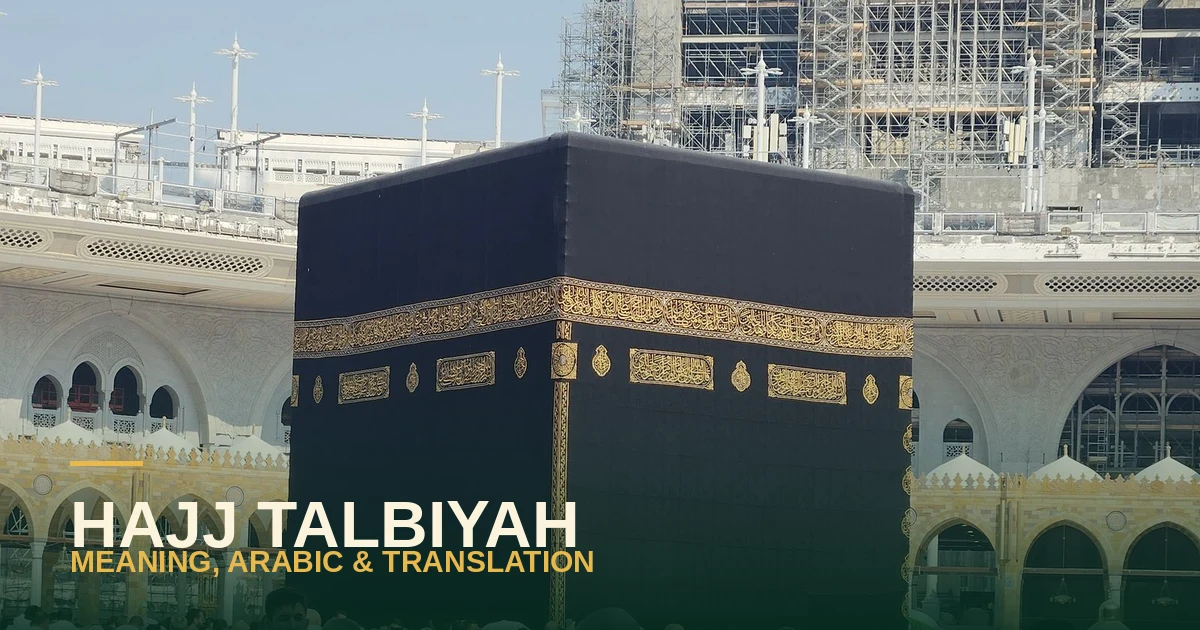
What is the Hajj Talbiyah? It is the short declaration a pilgrim repeats after entering Ihram for Hajj or Umrah: “Here I am, O Allah, here I am. Here I am, You have no partner, here I am.” In a few lines it answers Allah’s call and affirms that He has no partner and that all praise, blessing and sovereignty belong to Him alone. This guide gives the full Arabic text, transliteration and translation, explains each phrase, and shows when to start and stop reciting it.
Key Points
- The Talbiyah is the pilgrim’s response to Allah’s call, first said on entering Ihram at the Miqat.
- The full Arabic text, transliteration and translation are given below — learn it exactly as the Prophet (peace be upon him) recited it (Sahih al-Bukhari 1549; Sahih Muslim 1184a).
- Men recite it aloud, and women recite it quietly.
- Hajj pilgrims stop reciting at the stoning of Jamarat al-Aqaba on 10 Dhul Hijjah, and Umrah pilgrims stop just before Tawaf.
- After the first Talbiyah, sending Salawat upon the Prophet (peace be upon him) and making dua is recommended.
- Scholars differ on the ruling — Hanafi and Maliki hold it obligatory, Shafi’i and Hanbali hold it Sunnah — so a pilgrim should not treat it lightly.
What Is the Talbiyah?
The word Talbiyah comes from an Arabic root that means to answer or respond. When a pilgrim says “Labbayk”, he is saying, in effect, “Here I am, answering Your call.” The call goes back to Prophet Ibrahim (peace be upon him), who was commanded to call people to Hajj, and every pilgrim answers that call again with the Talbiyah. Said at the very start of the pilgrimage, it sets the tone for the journey.
What Is the Talbiyah in Arabic, Transliteration and Translation?
The Talbiyah is short enough to memorise in a few minutes, yet it carries the whole meaning of the pilgrimage. Here is the wording the Prophet (peace be upon him) recited, reported by Abdullah ibn Umar (may Allah be pleased with him) in Sahih al-Bukhari 1549 and Sahih Muslim 1184a:
Arabic:
لَبَّيْكَ اللَّهُمَّ لَبَّيْكَ، لَبَّيْكَ لَا شَرِيكَ لَكَ لَبَّيْكَ، إِنَّ الْحَمْدَ وَالنِّعْمَةَ لَكَ وَالْمُلْكَ، لَا شَرِيكَ لَكَ
Transliteration: Labbayka Allaahumma labbayk, labbayka laa shareeka laka labbayk, innal-hamda wan-ni’mata laka wal-mulk, laa shareeka lak.
Translation: “Here I am, O Allah, here I am. Here I am, You have no partner, here I am. Indeed, all praise, grace and sovereignty belong to You. You have no partner.” (Sahih al-Bukhari 1549; Sahih Muslim 1184a)
Recite it slowly, pausing briefly at each of the four phrases: “Labbayka Allaahumma labbayk” — “labbayka laa shareeka laka labbayk” — “innal-hamda wan-ni’mata laka wal-mulk” — “laa shareeka lak.” The pauses help the pilgrim reflect on each phrase instead of rushing through it.
Note: after the Prophet’s Talbiyah, Ibn Umar (may Allah be pleased with him) himself added extra words of his own (Sahih Muslim 1184a). Those were his own addition, not part of the Prophet’s wording, so learn the text above.
What Does Each Phrase Mean?
Each part of the Talbiyah carries its own meaning. Labbayka — “Here I am, at Your service,” repeated for emphasis. Allaahumma — “O Allah,” the call addressed to Allah alone. Labbayka laa shareeka laka labbayk — “Here I am, You have no partner, here I am,” the heart of the Talbiyah. Innal-hamda — “Indeed, all praise,” all praise belongs to Allah. Wan-ni’mata — “And grace,” every blessing comes from Him. Laka wal-mulk — “Belong to You, and sovereignty,” all authority is His. Laa shareeka lak — “You have no partner,” the declaration closes as it began, with tawhid.
How to Recite the Talbiyah
Recite it slowly and clearly, pausing briefly at each of the four phrases above, and repeat the whole Talbiyah at least three times. Men should raise their voices; women should recite it quietly, in a low voice. After the first Talbiyah, it is recommended to send Salawat upon the Prophet (peace be upon him) and to make dua for yourself and for others.
When to Start and When to Stop
The Talbiyah begins at Ihram. As soon as the pilgrim has entered Ihram at the Miqat, the boundary point for pilgrims travelling to Makkah, it is recited and repeated often from that point onward. It may be recited in all states: standing, sitting, walking and travelling, and whenever the time or place changes, such as after Salah. Women in menstruation may also recite it, because it is dhikr (remembrance of Allah), not prayer. The stopping point depends on which pilgrimage you are performing: Hajj pilgrims keep reciting until Jamarat al-Aqaba is stoned on the 10th of Dhul Hijjah, or just before Tawaf al-Ziyarah, whichever comes first. Umrah pilgrims stop reciting just before they begin the Tawaf of Umrah. The Talbiyah is not recited during Tawaf or Sa’i. For Hajj dates, registration and preparation, see our evergreen Hajj guide.
Is Talbiyah Obligatory or Sunnah?
Scholars differ on the ruling. According to the Hanafi and Maliki schools, reciting the Talbiyah is obligatory, so leaving it out is a serious omission that requires a compensatory sacrifice (dam) in their view — it should not be treated lightly. According to the Shafi’i and Hanbali schools, it is a Sunnah, so the pilgrimage is still valid even if it is not recited. A pilgrim should therefore not treat it lightly.
The Talbiyah in hadith: Abdullah ibn Umar (may Allah be pleased with him) reported that the Messenger of Allah (peace be upon him) used to recite the Talbiyah in these words: “Labbayka Allaahumma labbayk, labbayka laa shareeka laka labbayk, innal-hamda wan-ni’mata laka wal-mulk, laa shareeka lak.” (Sahih al-Bukhari 1549; Sahih Muslim 1184a.)
Listen to the Talbiyah (Audio)
Listen to this short recitation:
What Are the Benefits of Reciting the Talbiyah?
It keeps the purpose in mind: every repetition reminds the pilgrim why he travelled, to answer Allah’s call. It renews tawhid: “You have no partner” is repeated again and again, fixing the oneness of Allah in the heart. It brings humility: “Here I am, at Your service” places the pilgrim before his Lord as a servant. It fills the journey with dhikr: the hours of travel and waiting are filled with remembrance of Allah instead of idle talk.
The Talbiyah is the first word of the pilgrimage and its constant companion: a short declaration of tawhid, repeated from the Miqat to the stoning of Aqaba. Learn it in the Prophet’s own wording, recite it slowly, and let every repetition remind you why you travelled.
Frequently Asked Questions
What is the Talbiyah?
The declaration a pilgrim recites after entering Ihram for Hajj or Umrah. It means “Here I am, O Allah, here I am.”
What is the Talbiyah in Arabic and English?
The Arabic text, transliteration and translation are given above. In English, it means “Here I am, O Allah, here I am. Here I am, You have no partner, here I am.”
When should I start reciting Talbiyah?
As soon as you enter Ihram at the Miqat.
When should I stop Talbiyah in Hajj and Umrah?
Hajj pilgrims stop at the stoning of Jamarat al-Aqaba on 10 Dhul Hijjah. Umrah pilgrims stop just before Tawaf.
Do women recite Talbiyah loudly?
No. Men recite it aloud, and women recite it quietly.
Is Talbiyah obligatory or Sunnah?
Scholars differ. The Hanafi and Maliki schools hold it obligatory, so leaving it out is a serious omission that requires a compensatory sacrifice (dam) in their view. The Shafi’i and Hanbali schools hold it a Sunnah, so the pilgrimage remains valid without it.
Sources: Sahih al-Bukhari; Sahih Muslim