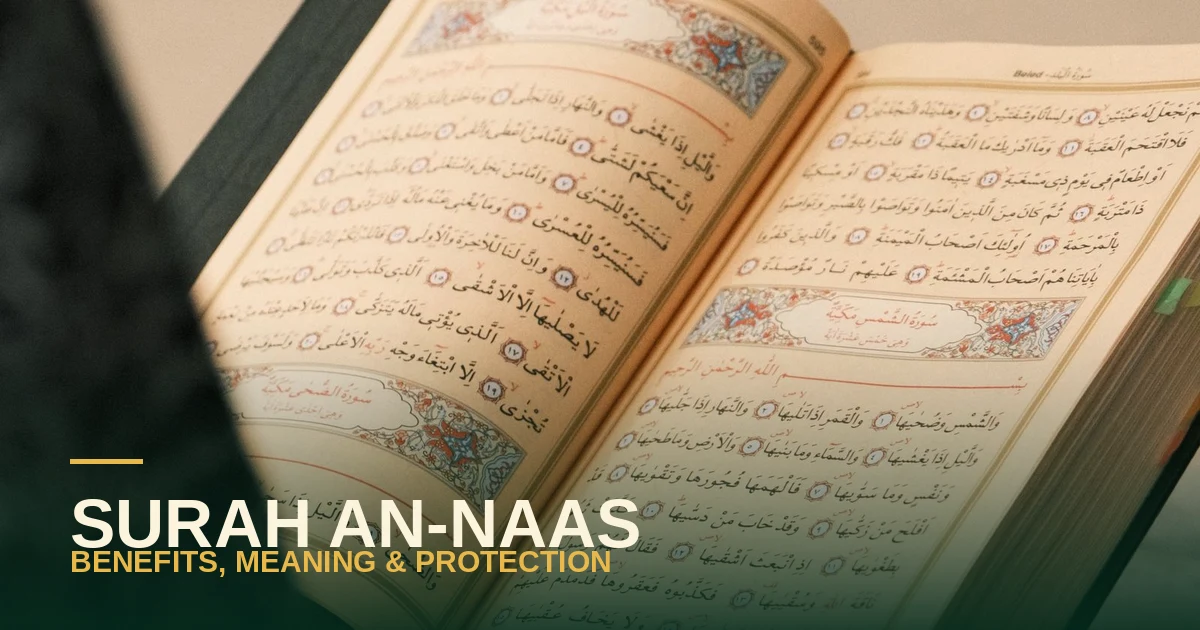
Surah An Naas And Its Benefits
What is Surah An-Naas? It is the last surah of the Qur’an — chapter 114, six short verses — and it is a prayer for protection: “Say, ‘I seek refuge in the Lord of mankind, the Sovereign of mankind, the God of mankind, from the evil of the retreating whisperer.’” The Prophet Muhammad (peace and blessings be upon him) recited it every night before sleep, and morning and evening, as part of the two surahs of seeking refuge. This guide gives the full surah in Arabic with transliteration and meaning, explains what each verse means, and shows when to recite it.
Key Points
- Surah An-Naas is chapter 114, the last surah of the Qur’an — six verses in Juz 30, revealed in Makkah.
- Its name means “mankind” — it is a prayer seeking refuge in the Lord, Sovereign and God of mankind.
- The Prophet (peace be upon him) said of Al-Falaq and An-Naas: “What wonderful verses have been sent down today, the like of which has never been seen!” (Sahih Muslim 814a)
- He recited the three Quls — Al-Ikhlas, Al-Falaq and An-Naas — into his cupped hands every night before sleep, three times (Sahih al-Bukhari 5017).
- Reciting them three times in the morning and three times in the evening “will suffice you against everything” (Jami’ at-Tirmidhi 3575).
- No other fixed count is prescribed for this surah — the counts of 100, 17, 700 and 11 times found in older articles are not from the hadith.
What Is Surah An-Naas?
Surah An-Naas is the 114th and last chapter of the Holy Qur’an. It has only six verses, it sits in Juz 30, and it was revealed in Makkah. Its name, “An-Naas”, means “mankind” — not “the men”. The whole surah is a single prayer: the believer turns to Allah and asks for His protection. It is the second of the two surahs of seeking refuge, Al-Mu’awwidhatayn, together with Surah Al-Falaq (chapter 113), which comes just before it. The two are almost always recited together, and the Prophet (peace and blessings be upon him) taught his companions to use them for protection morning and evening and at bedtime.
What Does Surah An-Naas Say?
Here is the surah in full:
Arabic:
قُلْ أَعُوذُ بِرَبِّ النَّاسِ مَلِكِ النَّاسِ إِلَٰهِ النَّاسِ مِنْ شَرِّ الْوَسْوَاسِ الْخَنَّاسِ الَّذِي يُوَسْوِسُ فِي صُدُورِ النَّاسِ مِنَ الْجِنَّةِ وَالنَّاسِ
Transliteration: Qul a’oodhu bi-rabbin-naas. Malikin-naas. Ilaahin-naas. Min sharril-waswaasil-khannaas. Alladhee yuwaswisu fee sudoorin-naas. Minal-jinnati wan-naas.
Translation: “Say, ‘I seek refuge in the Lord of mankind, the Sovereign of mankind, the God of mankind, from the evil of the retreating whisperer — who whispers [evil] into the breasts of mankind — from among the jinn and mankind.’” (Saheeh International; Qur’an 114:1-6)
The surah opens by naming Allah three times: the Lord of mankind, the Sovereign of mankind, and the God of mankind. Each name is a reason to turn to Him for protection: He is the One who created us and sustains us, the One who rules over us, and the One alone who deserves our worship. Then the surah names the danger: the evil of the retreating whisperer — the one who whispers evil into the hearts of people and then withdraws when Allah is remembered. That whisperer may be from among the jinn or from among mankind itself: a harmful thought, a bad companion, or a whisper of doubt. The surah teaches the believer to answer every whisper with refuge in Allah.
What Did the Prophet Say About These Two Surahs?
‘Uqba ibn ‘Amir (may Allah be pleased with him) reported that Allah’s Messenger (peace and blessings be upon him) said: “What wonderful verses have been sent down today, the like of which has never been seen! They are: ‘Say: I seek refuge with the Lord of the dawn,’ and ‘Say: I seek refuge with the Lord of men.’” (Sahih Muslim 814a.) On another occasion, while travelling with ‘Uqbah between al-Juhfah and al-Abwa’, a wind and intense darkness enveloped them, and the Prophet (peace and blessings be upon him) began to seek refuge in Allah by reciting the two surahs. He then said to ‘Uqbah: “Seek refuge with them, for no one can seek refuge with anything like them.” (Sunan Abi Dawud 1463, Sahih, al-Albani.)
When Should I Recite Surah An-Naas?
There are three established times, all from authentic hadiths. At bedtime: Aisha (may Allah be pleased with her) reported that whenever the Prophet (peace and blessings be upon him) went to bed every night, he used to cup his hands together and blow over them after reciting Surah Al-Ikhlas, Surah Al-Falaq and Surah An-Naas, and then rub his hands over whatever parts of his body he was able to rub, starting with his head, face and front of his body — three times (Sahih al-Bukhari 5017). Morning and evening: the Prophet (peace and blessings be upon him) told Abdullah ibn Khubayb to say “Say: He is Allah, the One” and Al-Mu’awwidhatain when he reached evening and when he reached morning, three times — “they will suffice you against everything” (Jami’ at-Tirmidhi 3575, Hasan Sahih). In prayer: ‘Uqbah heard the Prophet (peace and blessings be upon him) reciting the two surahs when he led the people in prayer (Sunan Abi Dawud 1463). Beyond these times, recite the surah whenever you feel afraid, anxious or troubled, and teach it to your children — it is short enough for a child to memorise in one sitting.
Does Surah An-Naas Protect From Black Magic and the Evil Eye?
Muslims recite Surah An-Naas seeking Allah’s protection from every harm, including the whisperings of devils, envy and the evil eye — and the hadiths above show the Prophet (peace and blessings be upon him) using these surahs for protection. But protection comes from Allah, not from the recitation itself as a mechanical formula: the surah is a means of seeking His protection, and it should be recited with understanding and trust in Him, not as a charm. It is also not a replacement for medical treatment: if you or your child is ill, see a doctor alongside your recitation and dua. And no fixed count is prescribed — the claims found in older articles (100 times for 40 days, 17 times before bed, 700 times over seven Fridays, 11 times for travel) are not from the Qur’an or the hadith of this surah, and they have been removed from this guide.
What Does the Surah Teach About Whisperings?
The heart of the surah is the “retreating whisperer” — al-waswas al-khannas. The whisperer comes close with a bad thought, a doubt, or a temptation, and retreats when Allah is remembered. That is why the surah is so short and so practical: the moment a whisper comes, the believer answers it by seeking refuge in the Lord of mankind. Regular recitation of the surah, morning and evening, keeps that refuge close at hand. Read our guide to Surah Al-Falaq benefits for the companion surah, and the guide to Ayat al-Kursi for the verse the Prophet (peace and blessings be upon him) also taught for protection at bedtime. See also our guide to Surah Al-Kahf benefits.
Surah An-Naas is six verses long, and it carries a complete lesson: turn to Allah — the Lord, Sovereign and God of mankind — and ask Him for protection from every whisper, from the jinn and from mankind. Learn it, recite it three times morning and evening and at bedtime with the other two Quls, and teach it to your children. Protection is from Allah, and this surah is how the Prophet (peace and blessings be upon him) taught us to ask for it.
Frequently Asked Questions
What is Surah An-Naas?
Surah An-Naas is chapter 114, the last surah of the Qur’an — six short verses in Juz 30, revealed in Makkah. Its name means “mankind”, and it is a prayer seeking refuge in the Lord, Sovereign and God of mankind from the evil of the retreating whisperer.
What does Surah An-Naas mean in English?
“An-Naas” means “mankind” (or “people” / “humanity”). The surah is a prayer for protection: “Say, ‘I seek refuge in the Lord of mankind, the Sovereign of mankind, the God of mankind, from the evil of the retreating whisperer.’”
When should I recite Surah An-Naas?
At bedtime, and three times in the morning and three times in the evening, with Surah Al-Ikhlas and Surah Al-Falaq (the three Quls). It is also recited in prayer and whenever you feel afraid, anxious or troubled.
How many times should I recite Surah An-Naas?
Three times in the morning, three times in the evening, and three times at bedtime with the other two Quls — no other fixed count is prescribed.
Does Surah An-Naas protect from black magic and the evil eye?
Recitation is a means of seeking Allah’s protection; protection comes from Allah; it is not a charm or a replacement for medical treatment.
What are Al-Mu’awwidhatayn?
Surah Al-Falaq and Surah An-Naas — the two surahs of seeking refuge.
Sources: The Holy Qur’an; Sahih al-Bukhari; Sahih Muslim; Jami’ at-Tirmidhi; Sunan Abi Dawud.