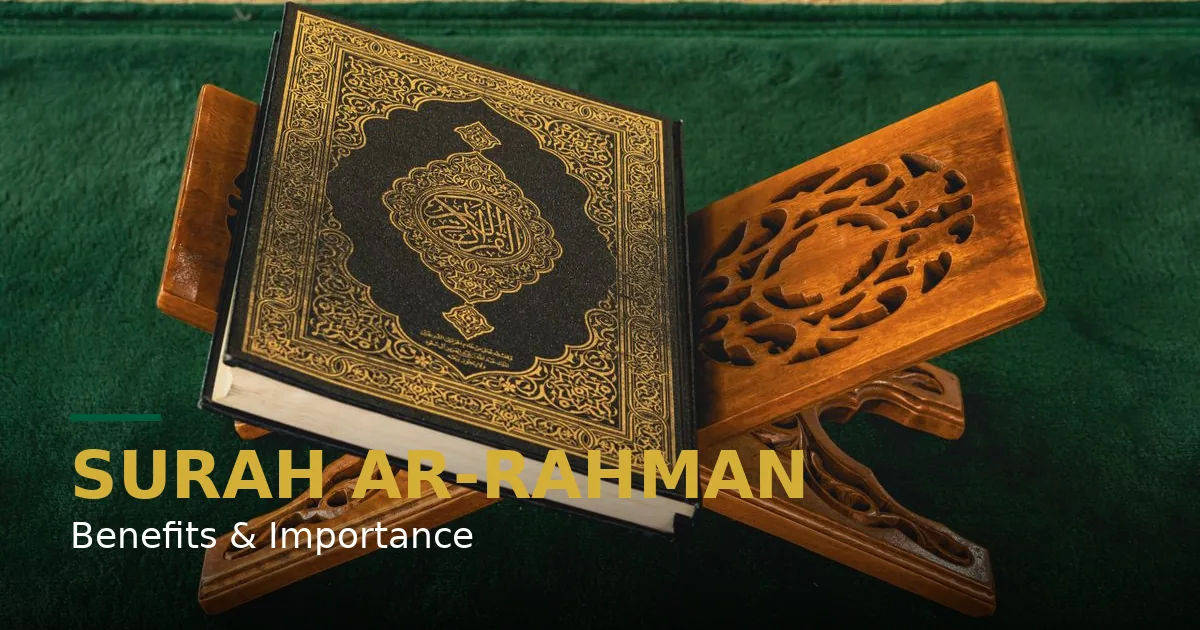
Surah Rahman: 7 Benefits and Importance
Surah Ar-Rahman is the 55th chapter of the Quran, with 78 verses in Juz 27. Its name means “The Most Merciful”, and its central theme is gratitude: Allah lists His blessings on humans and jinn, then asks 31 times, “So which of the favours of your Lord would you deny?” The surah’s real benefits are the reward of reciting Allah’s words, a heart trained to notice blessings, and the hope of Paradise for those who fear standing before their Lord — not guaranteed cures, wealth or marriages.
Key Points
- Surah Ar-Rahman is Qur’an 55: 78 verses in Juz 27, named “The Most Merciful”.
- Its refrain (55:13) is repeated 31 times.
- Allah created humans from clay like pottery and jinn from a smokeless flame of fire (55:14–15) — not angels.
- The Prophet (SAW) praised the jinn’s reply to the refrain (Tirmidhi 3291, Hasan).
- Every letter of the Qur’an recited earns reward multiplied by ten (Tirmidhi 2910, Hasan).
- No cure, wealth, job or 21-day marriage guarantee is established.
- The “bride of the Quran” narration is graded munkar (rejected).
What Is Surah Ar-Rahman About?
The surah opens with Allah’s own name, Ar-Rahman, the Most Merciful, and then names the greatest blessing first: He taught the Quran. From there it moves through creation — human beings, jinn, the sun and the moon, the earth spread out with fruit, date-palms and grain — then the reckoning on the Day of Judgement, then the gardens promised to those who fear their Lord, and the warning of the Fire for those who denied Him. It ends as it began, with praise of Allah’s name, the Possessor of Majesty and Honour. What makes the surah different from most others is its audience. It speaks to two groups at once: human beings and jinn. The refrain uses the dual form, “rabbikumaa” — “your Lord, both of you” — so every blessing and every warning in the surah is addressed to both. That is why the same question returns again and again: both audiences are being asked to answer for the blessings they received.
What Does the Repeated Verse Mean?
The most famous feature of the surah is the verse that returns 31 times, first appearing at 55:13:
Arabic:
فَبِأَيِّ آلَاءِ رَبِّكُمَا تُكَذِّبَانِ
Transliteration: Fabi-ayyi aalaa-i Rabbikumaa tukadh-dhibaan.
Translation: “So which of the favors of your Lord would you deny?” (Saheeh International.)
The word “aalaa” means favours and blessings. The question is not asking for information; it is a challenge to reflect. After each blessing Allah names — the Quran, speech, the sun and moon, the two seas, the fruits of the earth, the gardens of Paradise — the question comes back: which of these will you deny? A person who reads the surah slowly cannot avoid counting blessings, because the surah keeps stopping to ask. The Prophet (SAW) himself taught his Companions how to answer it. Jabir (RA) reported that the Prophet (SAW) recited Surah Ar-Rahman to his Companions from beginning to end, and they stayed silent. He told them he had recited it to the jinn on the Night of the Jinn, and they had responded better than the Companions had. Every time he reached the refrain, the jinn said:
Arabic:
لَا بِشَيْءٍ مِنْ نِعَمِكَ رَبَّنَا نُكَذِّبُ، فَلَكَ الْحَمْدُ
Transliteration: Laa bi-shay-in min ni’amika Rabbanaa nukadh-dhibu, falakal-hamd.
Translation: “We do not deny any of Your favors, our Lord! And Yours is praise.” (Jami’ at-Tirmidhi 3291, graded Hasan.)
That reply is the best way to read the surah: not silently, and not as a formula, but as a conversation. Each time the question comes, the reader answers in the heart: I deny none of Your favours, my Lord; all praise belongs to You.
What Do the Opening Verses Teach Us?
The surah begins with four short verses that set out its whole message:
Arabic:
الرَّحْمَٰنُ، عَلَّمَ الْقُرْآنَ، خَلَقَ الْإِنسَانَ، عَلَّمَهُ الْبَيَانَ
Transliteration: Ar-Rahmaan. ‘Allamal-Qur’aan. Khalaqal-insaan. ‘Allamahul-bayaan.
Translation: “The Most Merciful. Taught the Qur’an. Created man. [And] taught him eloquence.” (Saheeh International.)
Three lessons stand out here. First, the Quran itself is presented as an act of mercy: before Allah mentions creating human beings, He mentions teaching the Quran. Guidance comes before everything else. Second, human beings are described as taught, not self-made — our knowledge, our speech, even our ability to express ourselves, is a gift. Third, the surah’s order matters: mercy first, then teaching, then creation. A reader who keeps that order in mind will read the rest of the surah differently, as a list of gifts rather than a list of demands.
Who Did Allah Create — And From What?
One point in the surah is often misquoted, so it is worth stating exactly. Allah says He created human beings from clay like pottery, and He created the jinn from a smokeless flame of fire:
Arabic:
خَلَقَ الْإِنسَانَ مِن صَلْصَالٍ كَالْفَخَّارِ، وَخَلَقَ الْجَانَّ مِن مَّارِجٍ مِّن نَّارٍ
Transliteration: Khalaqal-insaana min salsaalin kal-fakhkhaar. Wa khalaqal-jaanna min maarijin min naar.
Translation: “He created man from clay like [that of] pottery. And He created the jinn from a smokeless flame of fire.” (Saheeh International.)
Humans and jinn are different creations with different origins, and both are accountable. The surah does not say here that Allah created angels from clay or fire — angels are a separate creation, and this passage is about humans and jinn. Getting this right matters, because the whole surah is built on the fact that two different kinds of beings received Allah’s blessings and will both be asked about them.
What Does the Surah Say About Balance in the Universe?
After creation, the surah turns to the order of the world. The sun and the moon move by precise calculation:
Arabic:
الشَّمْسُ وَالْقَمَرُ بِحُسْبَانٍ
Transliteration: Ash-shamsu wal-qamaru bihusbaan.
Translation: “The sun and the moon [move] by precise calculation.” (Saheeh International; this is a phrase from 55:5, labelled as such.)
The surah then describes the heaven raised up and the balance set down, with a command to people: do not transgress in the balance, and establish weight in justice. The point is practical as well as cosmic. The same Allah who fixed the paths of the sun and moon also fixed a moral balance for human dealings, and the surah treats cheating in weights and measures as part of the same disorder as denying His favours. The refrain returns again:
Arabic:
رَبُّ الْمَشْرِقَيْنِ وَرَبُّ الْمَغْرِبَيْنِ، فَبِأَيِّ آلَاءِ رَبِّكُمَا تُكَذِّبَانِ
Transliteration: Rabbul-mashriqayni wa Rabbul-maghribayn. Fabi-ayyi aalaa-i Rabbikumaa tukadh-dhibaan.
Translation: “Lord of the two sunrises and Lord of the two sunsets. So which of the favors of your Lord would you deny?” (Saheeh International, Qur’an 55:17–18.)
He is Lord of every sunrise and every sunset, in every season and every land. The blessing of light and time itself is part of the question.
What Does the Surah Say About Paradise and the Day of Judgement?
The second half of the surah looks forward. It warns that the guilty will be recognised by their marks and seized by their forelocks and feet, and it describes the Fire as the end of denial. Then it turns, with the same refrain, to the reward of those who feared standing before their Lord:
Arabic:
وَلِمَنْ خَافَ مَقَامَ رَبِّهِ جَنَّتَانِ
Transliteration: Wa liman khaafa maqaama Rabbihii jannataan.
Translation: “But for he who has feared the position of his Lord are two gardens.” (Saheeh International, Qur’an 55:46.)
The description that follows is vivid: gardens with flowing springs, every fruit in pairs, couches lined with silk brocade, and companions described in the surah itself:
Arabic:
فِيهِنَّ قَاصِرَاتُ الطَّرْفِ لَمْ يَطْمِثْهُنَّ إِنسٌ قَبْلَهُمْ وَلَا جَانٌّ
Transliteration: Feehinna qaasiraatut-tarfi lam yatmithhunna insun qablahum wa laa jaann.
Translation: “In them are women limiting [their] glances, untouched before them by man or jinni.” (Saheeh International, Qur’an 55:56.)
Two things should be noticed. First, the reward is tied to a condition — fearing the standing before Allah — not to reciting a set number of times. Second, the surah describes Paradise in pairs: two gardens, then two more gardens below them, every fruit in two kinds. The repetition of the refrain through these passages means the reader is asked, even while hearing about Paradise, to remember that it too is a favour, not something earned by right.
What Are the Real Benefits of Reciting Surah Ar-Rahman?
The honest answer is narrower than many popular lists, and that is a strength, not a weakness. What is established is this. First, reward. The Prophet (SAW) said: “Whoever recites a letter from the Book of Allah will have a reward, and that reward will be multiplied by ten. I do not say that Alif Lam Mim is one letter, but Alif is a letter, Lam is a letter and Mim is a letter.” (Jami’ at-Tirmidhi 2910, graded Hasan.) That promise covers the whole Quran, and Surah Ar-Rahman is part of it. Every letter recited with sincerity earns reward, whether the reader understands every word or is still learning. Second, a trained heart. The surah’s 31 questions are a form of training: a person who reads them regularly starts noticing blessings in ordinary life — health, family, food, shelter, time — instead of taking them for granted. Gratitude is itself one of the surah’s benefits, because the surah keeps practising it on the reader. Third, a model response. The hadith of the jinn (Jami’ at-Tirmidhi 3291) shows the attitude Allah’s Messenger (SAW) praised: answering each blessing with acknowledgement and praise, rather than silence. A reader who takes that attitude into daily life is following a Prophetic example. Fourth, hope tied to conduct. The surah promises two gardens to whoever fears standing before his Lord (55:46). That is a real hope, but it is conditional on a life of God-consciousness, not on reciting the surah a fixed number of times. The surah motivates good deeds; it does not replace them. Fifth, comfort in hardship. Many believers find that reading about Allah’s blessings steadies them in difficulty, because it puts their problems beside a much longer list of gifts. That is a real, human benefit of reflection — but it is not a medical treatment, and it is not a promise that any particular problem will disappear.
Arabic:
مَنْ قَرَأَ حَرْفًا مِنْ كِتَابِ اللَّهِ فَلَهُ بِهِ حَسَنَةٌ، وَالْحَسَنَةُ بِعَشْرِ أَمْثَالِهَا، لَا أَقُولُ الم حَرْفٌ، وَلَكِنْ أَلِفٌ حَرْفٌ، وَلَامٌ حَرْفٌ، وَمِيمٌ حَرْفٌ
Transliteration: Man qara-a harfan min Kitaabillaahi falahuu bihii hasanah, wal-hasanatu bi-‘ashri amthaalihaa, laa aqoolu Alif-Laam-Meem harf, wa laakin Alifun harf, wa Laamun harf, wa Meemun harf.
Translation: “Whoever recites a letter from Allah’s Book, then he receives the reward from it, and the reward of ten the like of it. I do not say that Alif Lam Mim is a letter, but Alif is a letter, Lam is a letter and Mim is a letter.” (Jami’ at-Tirmidhi 2910, graded Hasan; al-Tirmidhi: hasan sahih.)
How Can You Build a Habit of Reading It?
No fixed time, number of repetitions or number of days is established for this surah, so no formula should be treated as part of the religion. What works for most people is simple: read a few verses every day with their translation, learn the refrain and its reply by heart, and pause after each blessing the surah names to think of the matching blessing in your own life. Reading after Fajr is a good habit for many people because the morning is quiet, but the surah can be read at any time. If you cannot read Arabic, listening to a good recitation while following the translation is a good way to begin, and learning to read the Arabic is worth the effort over time. Make general dua for your needs — health, family, marriage, work, provision — alongside your reading, and take the practical steps those needs require: see a doctor when you are ill, seek lawful help when you are in debt, and look for a spouse through proper, honest means. Dua and effort go together. For duas for provision, see our dua for rizq; for healing, see our dua for shifa.
What Should You Not Believe About Surah Ar-Rahman?
Three corrections matter. First, the surah does not cure disease. Reciting or listening to the Quran brings spiritual comfort and reward, but no verse promises that it will heal cancer, diabetes, hepatitis or kidney disease, and anyone who is ill should seek medical treatment. Second, there is no established 21-day or 11-times formula that guarantees marriage, wealth or a job. Making dua is encouraged, but fixing a number of days and promising a result in that time has no basis in the sources and should not be taught as religion. Third, the popular title “bride of the Quran” rests on a narration that scholars have graded as munkar (rejected) — al-Albani listed it in his collection of weak narrations (no. 1350) — so it should not be presented as an established virtue of the surah. The surah needs no weak narration to recommend it: its own words, its refrain and its promise of two gardens are enough. Surah Ar-Rahman is, above all, a surah to be read slowly and answered honestly. Thirty-one times it asks which of your Lord’s favours you will deny. The best response is the one the jinn gave: we deny none of them, our Lord, and to You belongs all praise.
Frequently Asked Questions
How many verses are in Surah Ar-Rahman?
Surah Ar-Rahman is the 55th chapter of the Qur’an, with 78 verses in Juz 27.
How many times is “So which of the favors of your Lord would you deny?” repeated?
31 times, first appearing at 55:13.
What does Surah Ar-Rahman teach us?
Gratitude for Allah’s blessings on humans and jinn, balance in the universe and in dealings, the Day of Judgement, and the gardens promised to those who fear standing before their Lord.
Does Surah Ar-Rahman cure illness?
No. Reciting the Qur’an brings reward and spiritual comfort, but no verse promises it will heal disease. Anyone who is ill should seek medical treatment.
Is Surah Ar-Rahman called the “bride of the Quran”?
The narration behind that title is graded munkar (rejected) by scholars — al-Albani listed it in his collection of weak narrations (no. 1350) — so it is not an established virtue of the surah.
What is the best way to read Surah Ar-Rahman daily?
Read a few verses every day with their translation, learn the refrain and its reply by heart, and pause after each blessing the surah names. No fixed time or number of repetitions is established.
Sources: Quran.com; Sunnah.com; Islam Question and Answer; Tafsir Ibn Kathir
Related reading
- Surah Yusuf benefits
- powerful duas for depression
- Tahajjud prayer
- Surah Al-Fatiha benefits
- Surah Al-Falaq benefits
- Ayat al-Kursi
- Astaghfirullah benefits
- 7 prayers to get married soon
- how many pages in the Quran
- dua for safety from Dajjal