Surah Al-Waqiah Importance And Its Benefits
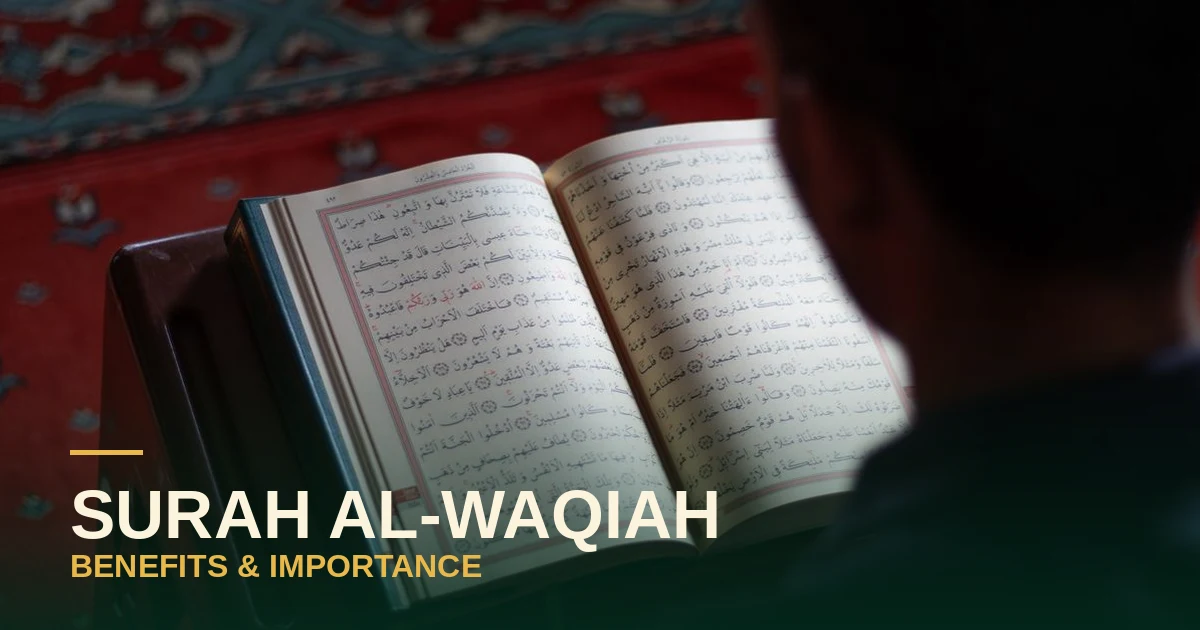
What is Surah Al-Waqiah about, and what are its benefits? Surah Al-Waqiah is the 56th chapter of the Qur’an, a Makki surah of 96 verses whose name means “The Inevitable Event” — the Day of Judgement. Its benefits come from its message and its recitation: it describes the Day of Judgement in vivid detail, sorts people into three groups, and reminds the reader that Allah is the Provider. A report links reciting it nightly with protection from poverty, but the chain of that report is discussed by scholars, so it is not presented here as a certain promise. This guide explains what the surah says, when to recite it, and what is — and is not — established about its benefits.
Key Points
- Surah Al-Waqiah is the 56th chapter of the Qur’an, a Makki surah of 96 verses in 3 ruku’, revealed in Makkah.
- Its name means “The Inevitable Event” — the Day of Judgement, which the surah describes in vivid detail.
- It sorts people on the Day of Judgement into three groups — the foremost, the companions of the right, and the companions of the left (Qur’an 56:7–12).
- It is widely recited at night, between Maghrib and Isha or before sleeping, and takes about five minutes to recite.
- A report links reciting it with protection from poverty, but the chain of that report is discussed by hadith scholars, so it is not presented here as certain.
- No fixed number of recitations is prescribed in the Qur’an or the Sunnah — the reward lies in regular recitation with understanding, not in a set count.
WHAT IS SURAH AL-WAQIAH?
Surah Al-Waqiah is the 56th chapter of the Holy Qur’an. “Al-Waqiah” means “The Inevitable Event” — the Day of Judgement, whose coming cannot be stopped. The surah has 96 verses (ayahs) in 3 ruku’, 379 words and 1,756 letters. It is a Makki surah, revealed to the Prophet Muhammad (peace be upon him) in Makkah, and it comes after Surah Ar-Rahman in the order of the mushaf. It opens with the event itself:
Arabic:
إِذَا وَقَعَتِ الْوَاقِعَةُ، لَيْسَ لِوَقْعَتِهَا كَاذِبَةٌ، خَافِضَةٌ رَافِعَةٌ
Transliteration: Idhaa waqa’ati-l-waaqi’ah, laysa liwaq’atihaa kaadhibah, khaafidatun raafi’ah.
Translation: “When the Occurrence occurs, there is, at its occurrence, no denial. It will bring down [some] and raise up [others].” (Saheeh International; Qur’an 56:1–3)
WHEN WAS SURAH AL-WAQIAH REVEALED?
Scholars of the Qur’an call Surah Al-Waqiah a Makki surah because it was revealed in Makkah during the Prophet’s (peace be upon him) mission there. Some commentators discuss whether a few verses — such as verses 39–40 and 81–82 — may have been revealed in the Medinan period, but the surah as a whole is Makki in character: it focuses on the reality of the Hereafter, the certainty of resurrection, and the fate of the three groups of people on the Day of Judgement.
WHO ARE THE THREE GROUPS?
The heart of the surah is its sorting of people into three groups on the Day of Judgement:
Arabic:
وَكُنْتُمْ أَزْوَاجًا ثَلَاثَةً، فَأَصْحَابُ الْمَيْمَنَةِ مَا أَصْحَابُ الْمَيْمَنَةِ، وَأَصْحَابُ الْمَشْأَمَةِ مَا أَصْحَابُ الْمَشْأَمَةِ، وَالسَّابِقُونَ السَّابِقُونَ، أُولَٰئِكَ الْمُقَرَّبُونَ، فِي جَنَّاتِ النَّعِيمِ
Transliteration: Wa kuntum azwaajan thalaathah, fa-as-haabu-l-maymanati maa as-haabu-l-maymanah, wa as-haabu-l-mash’amati maa as-haabu-l-mash’amah, wa-s-saabiqoona-s-saabiqoon, ulaa’ika-l-muqarrabboon, fee jannaati-n-na’eem.
Translation: “And you become [of] three kinds: Then the companions of the right – what are the companions of the right? And the companions of the left – what are the companions of the left? And the forerunners, the forerunners – those are the ones brought near [to Allah], in the Gardens of Pleasure.” (Saheeh International; Qur’an 56:7–12)
The foremost (as-sabiqun) are those who raced ahead in faith and good deeds — they are brought near to Allah in the Gardens of Pleasure. The companions of the right are the people of salvation, who receive their record in their right hand. The companions of the left are those who denied the truth and face punishment. The surah then describes the reward of each group and the punishment of the last, in some of the most vivid imagery in the Qur’an — gardens, flowing water, fruits, and, for the deniers, boiling water and fire. Reading these verses regularly keeps the reality of the Day of Judgement in front of the heart.
WHEN IS THE BEST TIME TO RECITE SURAH AL-WAQIAH?
The surah takes no more than five minutes to recite, so it is easy to make it a daily habit. A report, whose chain scholars discuss, encourages reciting it every night, and many Muslims read it between Maghrib and Isha, or before going to bed after Isha. Reading it at night pairs well with the duas for provision — see our post on the dua for rizq — since the surah’s themes of provision and the Hereafter go together.
WHAT ARE THE BENEFITS OF SURAH AL-WAQIAH?
A living reminder of the Hereafter: the surah opens with the shaking of the earth and the sorting of people into three groups, and reading it regularly keeps the reality of the Day of Judgement in front of the heart. Provision and protection from poverty: a well-known report describes Surah Al-Waqiah as “the Surah of Wealth” and says that whoever recites it every night will not be struck by poverty. The chain of this report is discussed by hadith scholars, so it should not be presented as a certain promise — but the surah is widely recited with this hope, and its message about Allah as the Provider (ar-Razzaq) is certain in the Qur’an itself. Peace of heart and success: like all recitation of the Qur’an, reading Surah Al-Waqiah with understanding brings calm, guidance and reward. Its verses on Allah’s power in creation — the rain, the fire, the crops — strengthen trust in Him, which is the foundation of success in this life and the next.
WHAT ABOUT RECITING SURAH AL-WAQIAH A FIXED NUMBER OF TIMES?
You will find many claims online — recite it 41 times, or 14 times after Fajr — for wealth or relief from need. Neither the Qur’an nor the Sunnah prescribes any such count for this surah. The reward is in reciting it regularly and understanding it, ideally every night. Fixed counts and guaranteed results are popular practices, not established teachings, and should not be treated as part of the religion.
Related reading: Surah Ar-Rahman — 7 benefits and importance, our dua for shifa for health improvement, and Surah Yaseen benefits and importance.
FREQUENTLY ASKED QUESTIONS
What is Surah Al-Waqiah about?
Surah Al-Waqiah is the 56th chapter of the Qur’an, a Makki surah of 96 verses whose name means “The Inevitable Event” — the Day of Judgement. It describes the Day of Judgement in vivid detail, sorts people into three groups, and reminds the reader that Allah is the Provider.
How many verses are in Surah Al-Waqiah?
Surah Al-Waqiah has 96 verses in 3 ruku’. It is the 56th chapter of the Qur’an, a Makki surah revealed in Makkah.
When should I recite Surah Al-Waqiah?
At night — between Maghrib and Isha, or before going to bed after Isha. The surah takes no more than five minutes to recite.
Does reciting Surah Al-Waqiah prevent poverty?
A report describes Surah Al-Waqiah as the Surah of Wealth and says that whoever recites it every night will not be struck by poverty. The chain of this report is discussed by hadith scholars, so it should not be presented as a certain promise.
How many times should I recite Surah Al-Waqiah?
No fixed number is prescribed in the Qur’an or the Sunnah. The reward is in reciting it regularly and understanding it, ideally every night.
What are the three groups in Surah Al-Waqiah?
The foremost, the companions of the right, and the companions of the left (Qur’an 56:7–12).
Sources: The Holy Qur’an; Sahih al-Bukhari; Sahih Muslim; Sunan Ibn Majah; Tafsir Ibn Kathir