Surah Al Fatiha And Its Benefits
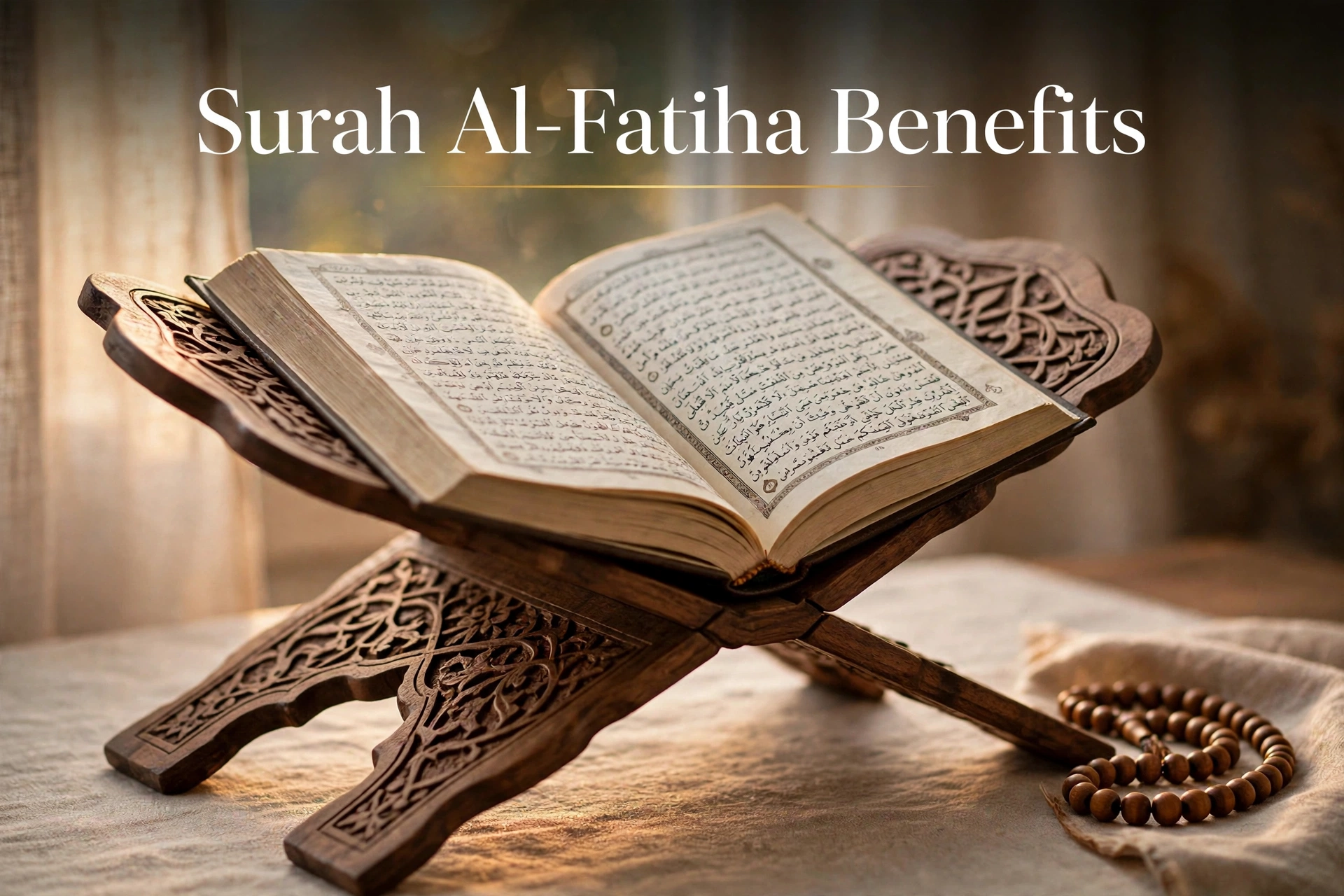
Surah Al-Fatiha is the first chapter of the Qur’an: seven short verses that every Muslim recites in every rak’ah of every prayer. Its name means “The Opening”, because it opens the Qur’an and opens the prayer. The Prophet (peace be upon him) called it the greatest surah in the Qur’an. This article explains the Surah Al-Fatiha benefits, with the full Arabic text, transliteration and meaning, its names, and the authentic hadith behind them.
Key Points
- Surah Al-Fatiha has 7 verses. It is the first chapter of the Qur’an and was revealed in Makkah, according to the majority view.
- “Al-Fatiha” means “The Opening” — it opens the Qur’an and opens the prayer.
- The Prophet (peace be upon him) called it the greatest surah in the Qur’an (Sahih al-Bukhari 4474).
- No prayer is valid without it (Sahih al-Bukhari 756).
- It is a ruqyah: a companion used it to treat a scorpion sting (Sahih al-Bukhari 2276).
Surah Al-Fatiha: The Full Arabic Text
Below is the complete surah — all seven verses — in Arabic, with transliteration and translation.
Arabic:
بِسْمِ اللَّهِ الرَّحْمَٰنِ الرَّحِيمِ ﴿١﴾ الْحَمْدُ لِلَّهِ رَبِّ الْعَالَمِينَ ﴿٢﴾ الرَّحْمَٰنِ الرَّحِيمِ ﴿٣﴾ مَالِكِ يَوْمِ الدِّينِ ﴿٤﴾ إِيَّاكَ نَعْبُدُ وَإِيَّاكَ نَسْتَعِينُ ﴿٥﴾ اهْدِنَا الصِّرَاطَ الْمُسْتَقِيمَ ﴿٦﴾ صِرَاطَ الَّذِينَ أَنْعَمْتَ عَلَيْهِمْ غَيْرِ الْمَغْضُوبِ عَلَيْهِمْ وَلَا الضَّالِّينَ ﴿٧﴾
Transliteration: Bismillaahir-Rahmaanir-Raheem. Alhamdu lillaahi Rabbil-‘aalameen. Ar-Rahmaanir-Raheem. Maaliki yawmid-deen. Iyyaaka na’budu wa iyyaaka nasta’een. Ihdinas-siraatal-mustaqeem. Siraatal-ladheena an’amta ‘alayhim ghayril-maghdoobi ‘alayhim wa lad-daaalleen.
Translation: “In the name of Allah, the Most Compassionate, the Most Merciful. All praise is for Allah, Lord of all worlds. The Most Compassionate, the Most Merciful. Master of the Day of Judgement. You alone we worship, and You alone we ask for help. Guide us to the straight path — the path of those You have blessed, not of those who have earned Your anger, nor of those who have gone astray.”
What Does Al-Fatiha Mean?
“Al-Fatiha” means “The Opening”. The surah opens the Qur’an — it is the first chapter of the Book — and it opens the prayer, because no rak’ah is complete without it. It is also the first complete surah that was revealed, and the first surah that a Muslim child usually learns.
Al-Fatiha has seven verses. The majority view — held by Ibn Abbas, Qatadah and Abu’l-Aliyah, may Allah be pleased with them — is that it was revealed in Makkah, so it is a Makki surah. A minority view holds that it was revealed in Madinah. The majority view is the one followed here.
The Names of Surah Al-Fatiha
Surah Al-Fatiha has many names, and each name tells us something about it. Scholars list more than twenty names for this surah. The best known are:
- Al-Fatihah — The Opening, because it opens the Qur’an.
- Umm al-Qur’an — The Mother of the Qur’an, because it gathers the whole message of the Qur’an in seven verses.
- Umm al-Kitab — The Mother of the Book.
- Sab’ul-Mathani — The Seven Oft-Repeated Verses, because its seven verses are repeated in every prayer.
- Al-Hamd — The Praise, because it begins with praise of Allah.
- As-Salah — The Prayer, because it is the heart of the prayer.
- Ash-Shifa — The Cure.
- Ar-Ruqyah — The Spiritual Cure.
- Asas al-Qur’an — The Foundation of the Qur’an.
The name Sab’ul-Mathani comes from Qur’an 15:87:
Arabic:
وَلَقَدْ آتَيْنَاكَ سَبْعًا مِّنَ الْمَثَانِي وَالْقُرْآنَ الْعَظِيمَ
Transliteration: Wa laqad aataynaaka sab’an minal-mathaanee wal-Qur’aanal-‘azeem
Translation: “And We have certainly given you seven of the often repeated [verses] and the great Qur’an.”
The Benefits of Surah Al-Fatiha
1. The greatest surah in the Qur’an
The Prophet (peace be upon him) said to Abu Sa’id ibn al-Mu’alla (may Allah be pleased with him), “I will teach you a surah which is the greatest surah in the Qur’an” — and then he taught him: “Al-Hamdu Lillahi Rabbil-‘Alamin — Surah Al-Fatiha, which is the Seven Oft-Repeated Verses and the Glorious Qur’an which has been given to me.” (Sahih al-Bukhari 4474.) The Prophet (peace be upon him) also said that no surah like it was revealed in the Torah, the Gospel or the Psalms (Jami’ at-Tirmidhi 3125, graded sahih).
2. Essential in every prayer
Al-Fatiha is recited in every rak’ah of every prayer, and the prayer is not valid without it. The Prophet (peace be upon him) said, “Whoever does not recite Surat Al-Fatiha in his prayer, his prayer is invalid.” This was narrated by Ubadah ibn as-Samit (may Allah be pleased with him) (Sahih al-Bukhari 756). That is why it is the first surah a Muslim learns, and the one recited most often in a lifetime.
3. A cure and a ruqyah
Al-Fatiha is a ruqyah — a recitation used for healing and protection. Once, when a tribe’s chief had been stung by a scorpion, a companion of the Prophet (peace be upon him) recited Surah Al-Fatiha over him as a ruqyah, and he recovered. When the Prophet (peace be upon him) heard about it, he asked, “How did you know that it was a ruqyah?” (Sahih al-Bukhari 2276.) Like Ayat al-Kursi, which is also recited for protection, Al-Fatiha is among the verses Muslims turn to when seeking healing — and for a dua to recite when someone is unwell, see our dua for shifa.
4. One of the two lights
The angel Jibril (peace be upon him) brought the Prophet (peace be upon him) the glad tidings of two lights that had been given to no prophet before him: the Opening of the Book — Surah Al-Fatiha — and the last verses of Surah Al-Baqarah (Sahih Muslim 806). Other chapters are also known for their benefits, such as Surah Al-Waqiah and Surah Yaseen, but Al-Fatiha holds a place of its own: it is recited more than any other surah, and it gathers the whole message of the Qur’an — praise of Allah, His mercy, the Day of Judgement, worship and seeking help, and the request for guidance — into seven verses.
The Meaning of the Verses
A short verse-by-verse meaning, in plain words:
- “In the name of Allah, the Most Compassionate, the Most Merciful” — we begin in Allah’s name, remembering His mercy.
- “All praise is for Allah, Lord of all worlds” — all praise belongs to Allah, who created and cares for everything.
- “The Most Compassionate, the Most Merciful” — His mercy covers all things.
- “Master of the Day of Judgement” — He alone will judge every person on the Day of Judgement.
- “You alone we worship, and You alone we ask for help” — worship is for Allah alone, and help is asked from Him alone.
- “Guide us to the straight path” — we ask Allah to keep us on the right way.
- “The path of those You have blessed, not of those who have earned Your anger, nor of those who have gone astray” — the path of the prophets and the righteous, not the path of those who knew the truth and turned away, nor of those who lost their way.
Frequently Asked Questions
What is Surah Al-Fatiha?
Surah Al-Fatiha is the first chapter of the Qur’an. It has seven verses, and it is recited in every rak’ah of every prayer.
How many verses are in Surah Al-Fatiha?
Surah Al-Fatiha has seven verses, including the Bismillah. It is the shortest complete chapter that is recited in every prayer.
What does Al-Fatiha mean?
Al-Fatiha means ‘The Opening’. It opens the Qur’an as its first chapter, and it opens the prayer, because no rak’ah is complete without it.
Why is Surah Al-Fatiha called the greatest surah?
Because the Prophet (peace be upon him) said, ‘I will teach you a surah which is the greatest surah in the Qur’an,’ and then taught Abu Sa’id ibn al-Mu’alla (may Allah be pleased with him) Surah Al-Fatiha (Sahih al-Bukhari 4474).
Is prayer valid without Surah Al-Fatiha?
No. The Prophet (peace be upon him) said, ‘Whoever does not recite Surat Al-Fatiha in his prayer, his prayer is invalid’ (Sahih al-Bukhari 756). It is recited in every rak’ah.
Can Surah Al-Fatiha be recited for healing?
Yes. Al-Fatiha is a ruqyah: a companion recited it over a tribe’s chief who had been stung by a scorpion, and he recovered. The Prophet (peace be upon him) approved it, asking, ‘How did you know that it was a ruqyah?’ (Sahih al-Bukhari 2276).
Sources
Sources: The Holy Qur’an (Surah al-Fatiha 1; Surah al-Hijr 15); Sahih al-Bukhari; Sahih Muslim; Jami’ at-Tirmidhi.