Ayat al Kursi Importance And Benefits
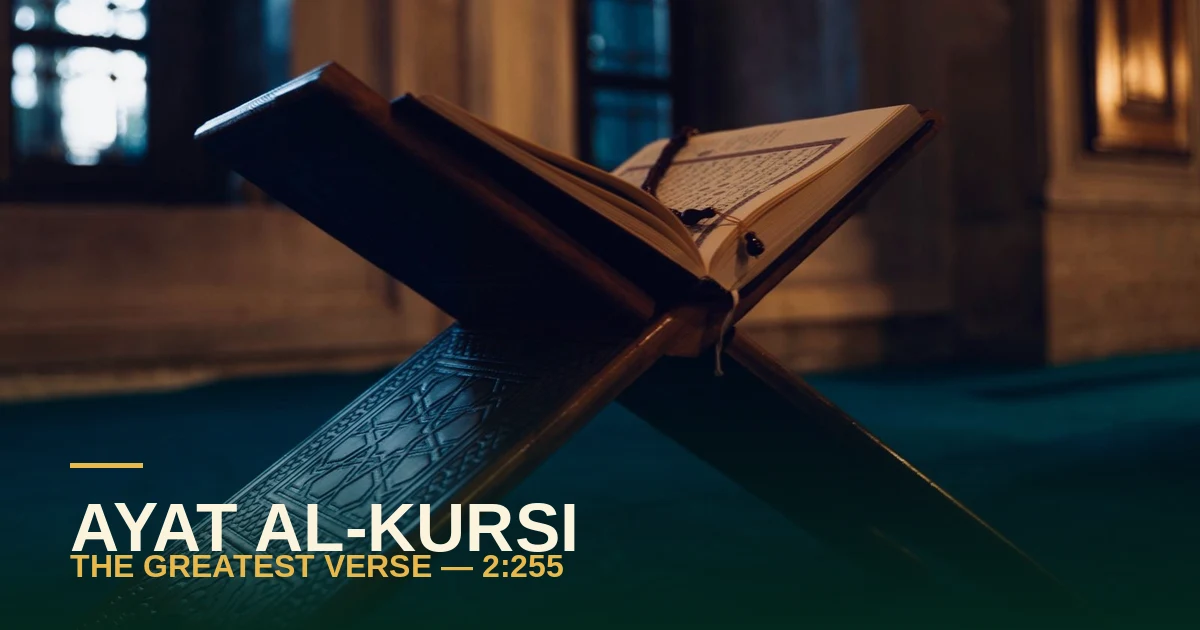
What is Ayat al-Kursi? It is verse 255 of Surah al-Baqarah, known as the Throne Verse, and the Prophet Muhammad (peace be upon him) called it the greatest verse in the Book of Allah (Sahih Muslim 810). Reciting it after every obligatory prayer carries the promise that nothing stands between the reciter and Paradise except death, and reciting it before sleep brings Allah’s protection through the night (Sahih al-Bukhari 2311). This guide gives the verse in Arabic with full transliteration and meaning, explains why it is the greatest verse, and sets out when to recite it.
Key Points
- Ayat al-Kursi is verse 255 of Surah al-Baqarah, known as the Throne Verse, named for the Kursi — the Footstool of Allah — that extends over the heavens and the earth.
- The Prophet (peace be upon him) called it the greatest verse in the Book of Allah (Sahih Muslim 810).
- Whoever recites it after every obligatory prayer, nothing stands between him and Paradise except death (Sunan an-Nasa’i, al-Sunan al-Kubra; graded Sahih by al-Albani).
- Reciting it before sleep brings a guardian appointed by Allah, and no devil comes near until morning (Sahih al-Bukhari 2311).
- Recite it morning and evening, after prayers and when leaving home as part of daily protection.
- No fixed number of recitations is prescribed in the Qur’an or the Sunnah — recite it regularly and with understanding, not by a set count.
What Is Ayat al-Kursi?
Ayat al-Kursi — the Throne Verse — is verse 255 of Surah al-Baqarah, the second chapter of the Holy Qur’an. It is a verse describing Allah’s oneness, life, knowledge and power, and it takes its name from the Kursi, the Footstool of Allah, which extends over the heavens and the earth. In short: Ayat al-Kursi is the greatest verse of the Qur’an, and reciting it after prayer and before sleep brings Allah’s protection and the promise of Paradise.
What Does Ayat al-Kursi Say?
Here is the verse in full:
Arabic:
اللَّهُ لَا إِلَٰهَ إِلَّا هُوَ الْحَيُّ الْقَيُّومُ ۚ لَا تَأْخُذُهُ سِنَةٌ وَلَا نَوْمٌ ۚ لَّهُ مَا فِي السَّمَاوَاتِ وَمَا فِي الْأَرْضِ ۗ مَن ذَا الَّذِي يَشْفَعُ عِندَهُ إِلَّا بِإِذْنِهِ ۚ يَعْلَمُ مَا بَيْنَ أَيْدِيهِمْ وَمَا خَلْفَهُمْ ۖ وَلَا يُحِيطُونَ بِشَيْءٍ مِّنْ عِلْمِهِ إِلَّا بِمَا شَاءَ ۚ وَسِعَ كُرْسِيُّهُ السَّمَاوَاتِ وَالْأَرْضَ ۖ وَلَا يَئُودُهُ حِفْظُهُمَا ۚ وَهُوَ الْعَلِيُّ الْعَظِيمُ
Transliteration: Allaahu laa ilaaha illaa Huwal-Hayyul-Qayyoom. Laa ta’khudhuhuu sinatun wa laa nawm. Lahuu maa fis-samaawaati wa maa fil-ard. Man dhal-ladhii yashfa’u ‘indahuu illaa bi-idhnih. Ya’lamu maa bayna aydiihim wa maa khalfahum, wa laa yuhiituuna bi-shay’in min ‘ilmihii illaa bimaa shaa’. Wasi’a kursiyyuhus-samaawaati wal-ard, wa laa ya’uuduhuu hifzuhumaa, wa Huwal-‘Aliyyul-‘Aziim.
Translation: “Allah — there is no deity except Him, the Ever-Living, the Sustainer of all existence. Neither drowsiness overtakes Him nor sleep. To Him belongs whatever is in the heavens and whatever is on the earth. Who is it that can intercede with Him except by His permission? He knows what is before them and what will be after them, and they encompass not a thing of His knowledge except for what He wills. His Kursi extends over the heavens and the earth, and their preservation tires Him not. And He is the Most High, the Most Great.” (Saheeh International; Qur’an 2:255)
The verse teaches that Allah alone deserves worship, that He never sleeps or tires, that everything belongs to Him, and that no one can intercede with Him except by His permission. Reading it with understanding is itself an act of worship.
Why Is Ayat al-Kursi the Greatest Verse?
The Prophet Muhammad (peace be upon him) asked Ubayy ibn Ka’b, “Do you know which verse in the Book of Allah is the greatest?” Ubayy answered, “Ayat al-Kursi.” The Prophet (peace be upon him) said, “May knowledge be pleasant for you, O Abu al-Mundhir” (Sahih Muslim 810). Scholars explain that it is the greatest verse because no other verse describes Allah’s names and attributes — His life, His sustaining of all existence, His perfect knowledge, and His power over the heavens and the earth — as completely as this one does.
What Are the Benefits of Reciting Ayat al-Kursi?
Protection through the night: Abu Hurayrah (may Allah be pleased with him) reported that the Prophet (peace be upon him) said that when you go to your bed, recite Ayat al-Kursi, for Allah will appoint a guardian over you and no devil will come near you until morning (Sahih al-Bukhari 2311). A promise of Paradise: the Prophet (peace be upon him) said that whoever recites Ayat al-Kursi after every prescribed prayer, nothing stands between him and Paradise except death (Sunan an-Nasa’i, al-Sunan al-Kubra; graded Sahih by Ibn Hibban and by al-Albani in Sahih al-Jami’ 6464). Protection for home and family: Muslims recite Ayat al-Kursi in the morning and evening adhkar and when leaving the house, trusting in Allah’s protection for themselves, their children and their homes. Like the dua for rizq and the recitation of Surah Al-Waqiah, it is a means of drawing close to Allah — and protection ultimately comes from Allah alone. Peace of heart: reciting a verse that describes Allah’s perfect power and care reminds the believer that nothing escapes His knowledge and nothing happens except by His will. That remembrance brings calm in worry and strength in hardship.
When Should I Recite Ayat al-Kursi?
There is no fixed number of recitations prescribed in the Qur’an or the Sunnah. The established times are after every obligatory prayer, before sleeping, and in the morning and evening adhkar. Many Muslims also recite it when leaving the house and when they feel afraid or anxious. The reward lies in reciting it regularly and with understanding — not in a fixed count.
Ayat al-Kursi is one verse, and it carries the whole of tawhid in it: Allah’s life, His sustaining of all existence, His perfect knowledge, and His power over the heavens and the earth. Learn it, understand it, and recite it after every prayer and before sleep — the greatest verse, kept close, every day.
Frequently Asked Questions
What is Ayat al-Kursi?
Ayat al-Kursi is verse 255 of Surah al-Baqarah, known as the Throne Verse, named for the Kursi — the Footstool of Allah — that extends over the heavens and the earth.
What does Ayat al-Kursi mean in English?
“Allah — there is no deity except Him, the Ever-Living, the Sustainer of all existence. Neither drowsiness overtakes Him nor sleep. To Him belongs whatever is in the heavens and whatever is on the earth. Who is it that can intercede with Him except by His permission? He knows what is before them and what will be after them, and they encompass not a thing of His knowledge except for what He wills. His Kursi extends over the heavens and the earth, and their preservation tires Him not. And He is the Most High, the Most Great.” (Saheeh International; Qur’an 2:255)
Why is Ayat al-Kursi the greatest verse in the Qur’an?
The Prophet Muhammad (peace be upon him) told Ubayy ibn Ka’b that it is the greatest verse in the Book of Allah (Sahih Muslim 810), because no other verse describes Allah’s names and attributes — His life, His sustaining of all existence, His perfect knowledge, and His power over the heavens and the earth — as completely as this one does.
What happens if I recite Ayat al-Kursi after every prayer?
The Prophet (peace be upon him) said that whoever recites Ayat al-Kursi after every prescribed prayer, nothing stands between him and Paradise except death (Sunan an-Nasa’i, al-Sunan al-Kubra; graded Sahih by al-Albani).
Should I recite Ayat al-Kursi before sleeping?
Yes. The Prophet (peace be upon him) said that when you go to your bed, recite Ayat al-Kursi, for Allah will appoint a guardian over you and no devil will come near you until morning (Sahih al-Bukhari 2311).
How many times should I recite Ayat al-Kursi?
No fixed number of recitations is prescribed in the Qur’an or the Sunnah. Recite it regularly and with understanding — after prayers, before sleep, and in the morning and evening — not by a set count.
Sources: The Holy Qur’an; Sahih al-Bukhari; Sahih Muslim; Sunan an-Nasa’i; Tafsir Ibn Kathir.