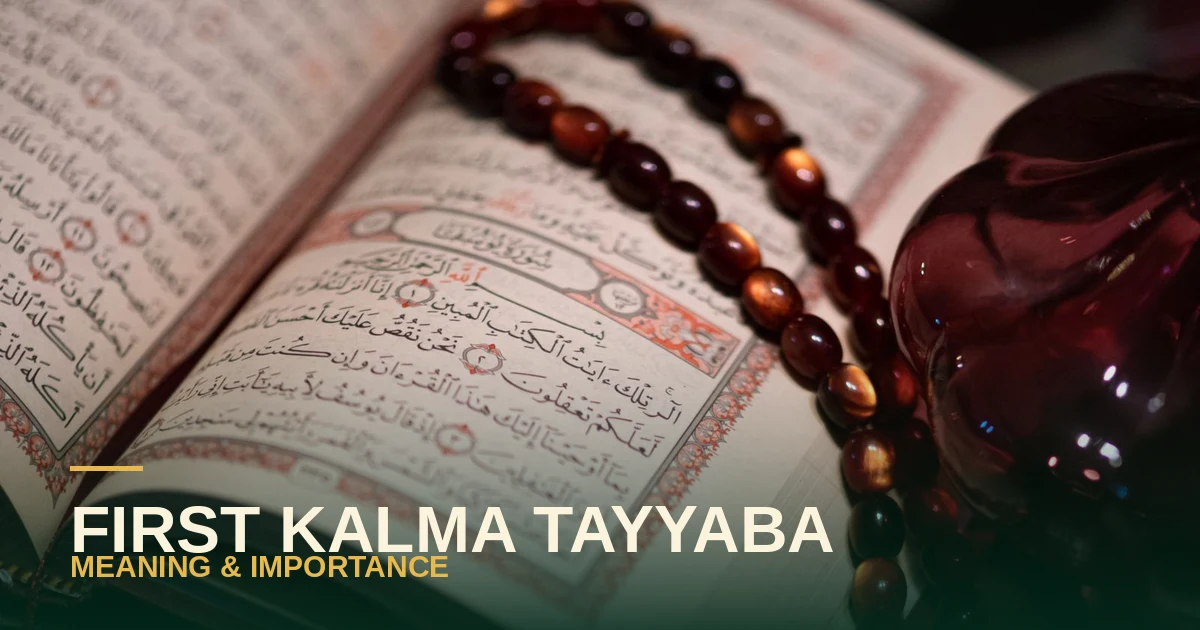
First Kalma Tayyaba And Its Importance
What is the First Kalma? It is the Kalma Tayyaba: “La ilaha illallah Muhammadur Rasulullah” — “There is no deity worthy of worship except Allah; Muhammad is the Messenger of Allah.” It is the first of the six kalmas, the doorway into Islam, and the sentence every Muslim child learns first and every new Muslim says to enter the faith. This guide gives the kalma in Arabic with transliteration and meaning, explains what each half means, and sets out the reward the Qur’an and the hadiths promise for saying it sincerely.
Key Points
- The First Kalma is the Kalma Tayyaba: “La ilaha illallah Muhammadur Rasulullah” — “There is no deity worthy of worship except Allah; Muhammad is the Messenger of Allah.”
- Its two halves are each established in the Qur’an — “La ilaha illallah” (Qur’an 37:35) and “Muhammadur Rasulullah” (Qur’an 48:29).
- It is the doorway to Islam — the testimony of faith by which a person enters the religion.
- Allah Himself bears witness to its first half: “Allah witnesses that there is no deity except Him” (Qur’an 3:18).
- Whoever says it sincerely from the heart will be the luckiest to gain the Prophet’s intercession on the Day of Resurrection (Sahih al-Bukhari 99).
- Whoever dies knowing it fully enters Paradise (Sahih Muslim 26a).
What Is the First Kalma?
The First Kalma is called the Kalma Tayyaba — the Pure Word. Here it is in full:
Arabic:
لَا إِلَٰهَ إِلَّا اللَّهُ مُحَمَّدٌ رَسُولُ اللَّهِ
Transliteration:
Laa ilaaha illallaahu Muhammadur Rasoolullaah.
Translation:
“There is no deity worthy of worship except Allah; Muhammad is the Messenger of Allah.”
Muslims learn it as children, repeat it in their daily prayers and remembrance, and teach it to anyone who wishes to enter Islam. It is short — two short phrases — yet it carries the whole of the Islamic faith: the oneness of Allah, and the messengership of Muhammad (peace and blessings be upon him). The six kalmas together are a teaching tool, especially for young Muslims and new Muslims: each one gathers a core belief into words that can be memorised. The first is the foundation on which the other five stand. Note carefully: the First Kalma is Tayyaba, not Shahadat. The Kalma Shahadat — “Ashhadu an la ilaha illallah wa ashhadu anna Muhammadan ‘abduhu wa rasuluh” — is the SECOND kalma. The two are close in meaning, which is why they are sometimes confused, but they are different kalmas, and this guide keeps them distinct.
What Does “La Ilaha Illallah” Mean?
The first half of the kalma is the declaration of Tawheed, the oneness of Allah. Word by word: “La ilaha” means “there is no deity”; “illallah” means “except Allah”. Together: “There is no deity worthy of worship except Allah.” It is a denial and an affirmation in one breath: it denies that anything else deserves worship — no idol, no person, no power, no desire — and affirms that worship belongs to Allah alone. Allah Himself bears witness to this truth, together with the angels and the people of knowledge:
Arabic:
شَهِدَ اللَّهُ أَنَّهُ لَا إِلَٰهَ إِلَّا هُوَ وَالْمَلَائِكَةُ وَأُولُو الْعِلْمِ قَائِمًا بِالْقِسْطِ ۚ لَا إِلَٰهَ إِلَّا هُوَ الْعَزِيزُ الْحَكِيمُ
Transliteration:
Shahidallaahu annahu laa ilaaha illaa huwa wal-malaa’ikatu wa oolool-‘ilmi qaa’iman bil-qist, laa ilaaha illaa huwal-‘azeezul-hakeem.
Translation:
“Allah witnesses that there is no deity except Him, and [so do] the angels and those of knowledge — [that He is] maintaining [creation] in justice. There is no deity except Him, the Exalted in Might, the Wise.” (Saheeh International; Qur’an 3:18)
Scholars explain the testimony as having three parts: belief in the heart, statement by the tongue, and action by the limbs. Saying the words without believing them is not faith, and believing them without living by them is an incomplete faith. The kalma is the doorway, and the life of worship and good character that follows is the house itself.
What Does “Muhammadur Rasulullah” Mean?
The second half of the kalma is the declaration of the messengership of Muhammad (peace and blessings be upon him): “Muhammad is the Messenger of Allah.” It means that Muhammad (peace and blessings be upon him) was sent by Allah with guidance and the true religion, that the Qur’an he brought is Allah’s word, and that his teaching — his Sunnah — is the way to live the faith. The two halves belong together: the first tells us whom to worship, and the second tells us how to worship Him — by following the Messenger Allah sent. That is why the kalma is the doorway to Islam: accepting both halves, with the heart and the tongue, is what makes a person a Muslim. For the steps of entering Islam, see our guide to how to convert to Islam.
Why Is the Kalma the Doorway to Islam?
A person enters Islam by saying the testimony of faith with belief and understanding. There is no ceremony, no priest, and no fee: the words themselves, said sincerely before witnesses, are the entry. The testimony is also the first pillar of Islam — the Shahada — and every other pillar rests on it: prayer, charity, fasting and pilgrimage all begin from the belief the kalma states. It is the sentence whispered into a newborn’s ear, the sentence a dying person is reminded to say, and the sentence every Muslim hopes will be their last words. That is why parents teach it to their children before anything else, and why new Muslims learn it first: everything else in the religion flows from it.
What Is the Reward of Saying the Kalma Sincerely?
The hadiths promise a great reward for this short sentence, said with sincerity. Abu Hurairah (may Allah be pleased with him) asked the Prophet (peace and blessings be upon him) who would be the luckiest person to gain his intercession on the Day of Resurrection, and the Prophet answered. The key sentence of the hadith is quoted below; the full narration is Abu Hurairah asking who will gain the Prophet’s intercession:
Arabic:
مَنْ قَالَ لاَ إِلَهَ إِلاَّ اللَّهُ، خَالِصًا مِنْ قَلْبِهِ أَوْ نَفْسِهِ
Transliteration:
Man qaala laa ilaaha illallaah, khaalisan min qalbihi aw nafsih.
Translation:
“Whoever says ‘None has the right to be worshipped but Allah’ sincerely from the bottom of his heart [will be the luckiest person to gain my intercession on the Day of Resurrection].” (Sahih al-Bukhari 99 — key sentence of the hadith.)
And the Prophet (peace and blessings be upon him) said:
Arabic:
مَنْ مَاتَ وَهُوَ يَعْلَمُ أَنَّهُ لاَ إِلَهَ إِلاَّ اللَّهُ دَخَلَ الْجَنَّةَ
Transliteration:
Man maata wa huwa ya’lamu annahu laa ilaaha illallaah, dakhalal-jannah.
Translation:
“He who died knowing (fully well) that there is no god but Allah entered Paradise.” (Sahih Muslim 26a)
A third narration tells of a man on the Day of Judgement whose ninety-nine scrolls of sins are outweighed by a single card carrying the testimony (Jami’ at-Tirmidhi 2639, graded Hasan by al-Tirmidhi):
Arabic:
أَشْهَدُ أَنْ لاَ إِلَهَ إِلاَّ اللَّهُ وَأَشْهَدُ أَنَّ مُحَمَّدًا عَبْدُهُ وَرَسُولُهُ
Transliteration:
Ashhadu an laa ilaaha illallaah, wa ashhadu anna Muhammadan ‘abduhu wa rasooluh.
Translation:
“I testify that there is no deity except Allah, and I testify that Muhammad is His servant and Messenger.” (Jami’ at-Tirmidhi 2639 — the wording written on the card that outweighed ninety-nine scrolls of sins on the Day of Judgement.)
These promises belong to the one who says the kalma sincerely and lives by it — not to the mere movement of the tongue. Sincerity is the condition the hadiths themselves state: “from the bottom of his heart”.
How Can I Teach the First Kalma to My Children?
Teach it early, teach it slowly, and teach it with its meaning. Start with the Arabic, one phrase at a time: first “La ilaha illallah”, then “Muhammadur Rasulullah”. Then teach the meaning in the child’s own language: “There is no one worthy of worship except Allah, and Muhammad is Allah’s Messenger.” Repeat it at bedtime and in the morning, and let the child hear it often — children learn by hearing. As they grow, explain the two halves: only Allah deserves our worship, and we follow the Prophet to learn how. For the opening chapter of the Qur’an that children also learn first, see our guide to Surah Al-Fatiha and its benefits, and for the ablution that precedes prayer, see our guide to the dua before and after wudu.
Conclusion
The First Kalma is two phrases, and it is the whole of the faith in miniature: “There is no deity worthy of worship except Allah; Muhammad is the Messenger of Allah.” Learn it in Arabic with its meaning, say it with sincerity, teach it to your children, and live by it. It is the doorway to Islam, the first thing a Muslim learns, and — by Allah’s promise — the sentence whose sincere saying opens the door to Paradise.
Frequently Asked Questions
What is the First Kalma?
The First Kalma is the Kalma Tayyaba: La ilaha illallah Muhammadur Rasulullah, meaning there is no deity worthy of worship except Allah; Muhammad is the Messenger of Allah. It is the first of the six kalmas and the doorway to Islam.
What does La ilaha illallah mean?
It means there is no deity worthy of worship except Allah. It denies that anything else deserves worship and affirms that worship belongs to Allah alone (Qur’an 3:18).
What does Muhammadur Rasulullah mean?
It means Muhammad is the Messenger of Allah, sent by Allah with guidance and the true religion, and that his teaching, the Sunnah, is the way to live the faith.
Is the First Kalma the same as the Kalma Shahadat?
No. The Kalma Shahadat is the second kalma. The First Kalma is Tayyaba, and the two should not be confused.
What is the reward of saying the kalma sincerely?
The sincere sayer will be the luckiest to gain the Prophet’s intercession on the Day of Resurrection (Sahih al-Bukhari 99), and whoever dies knowing it fully enters Paradise (Sahih Muslim 26a).
How do I enter Islam?
Say the testimony of faith with belief and understanding. See our guide to how to convert to Islam on this site.
Also Read: How to Convert to Islam; Surah Al-Fatiha and Its Benefits; Dua Before and After Wudu.
Sources/References: The Holy Qur’an; Sahih al-Bukhari; Sahih Muslim; Jami’ at-Tirmidhi.