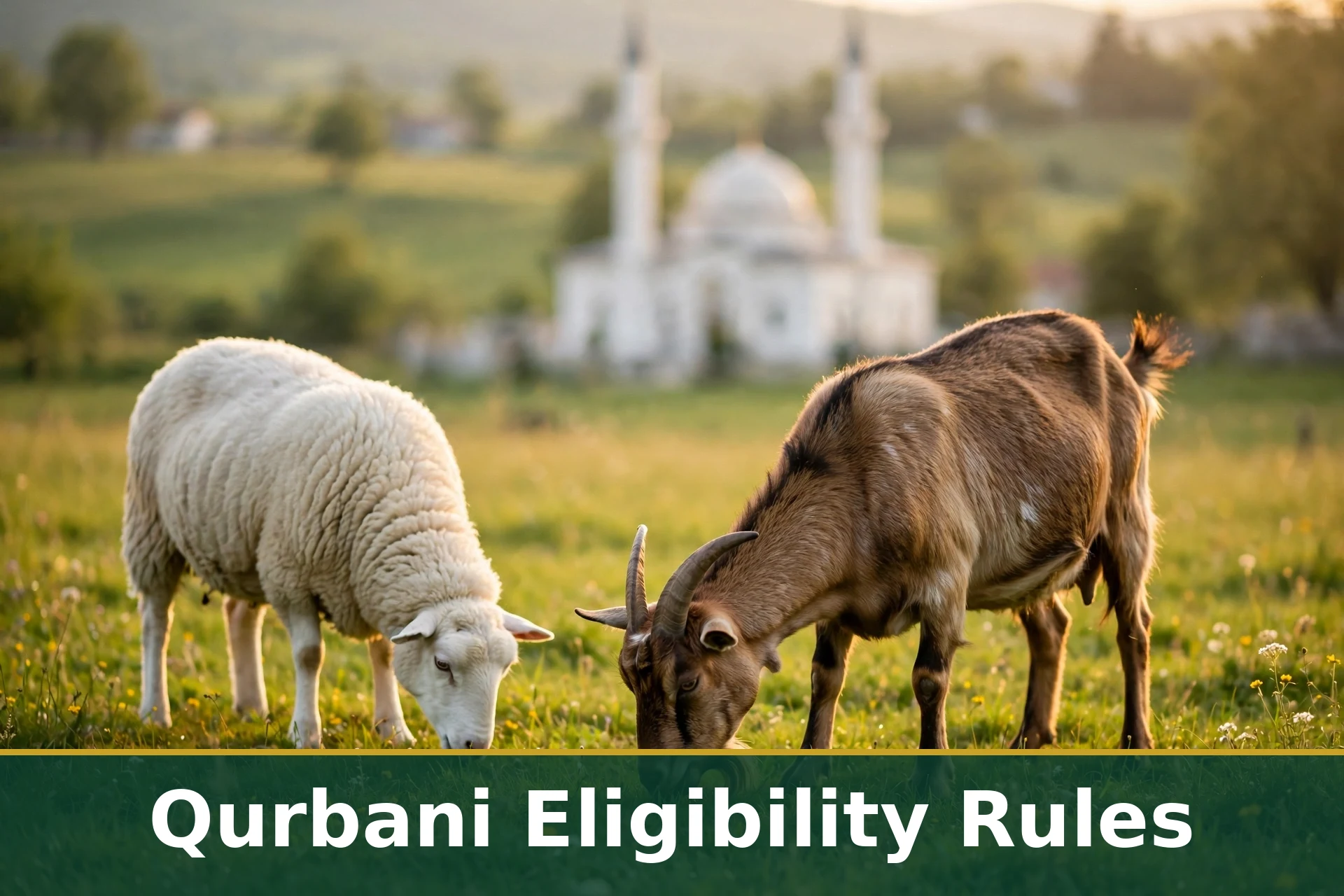
Qurbani/Udhiya: Eligibility, Rules, Nisab, And Distribution
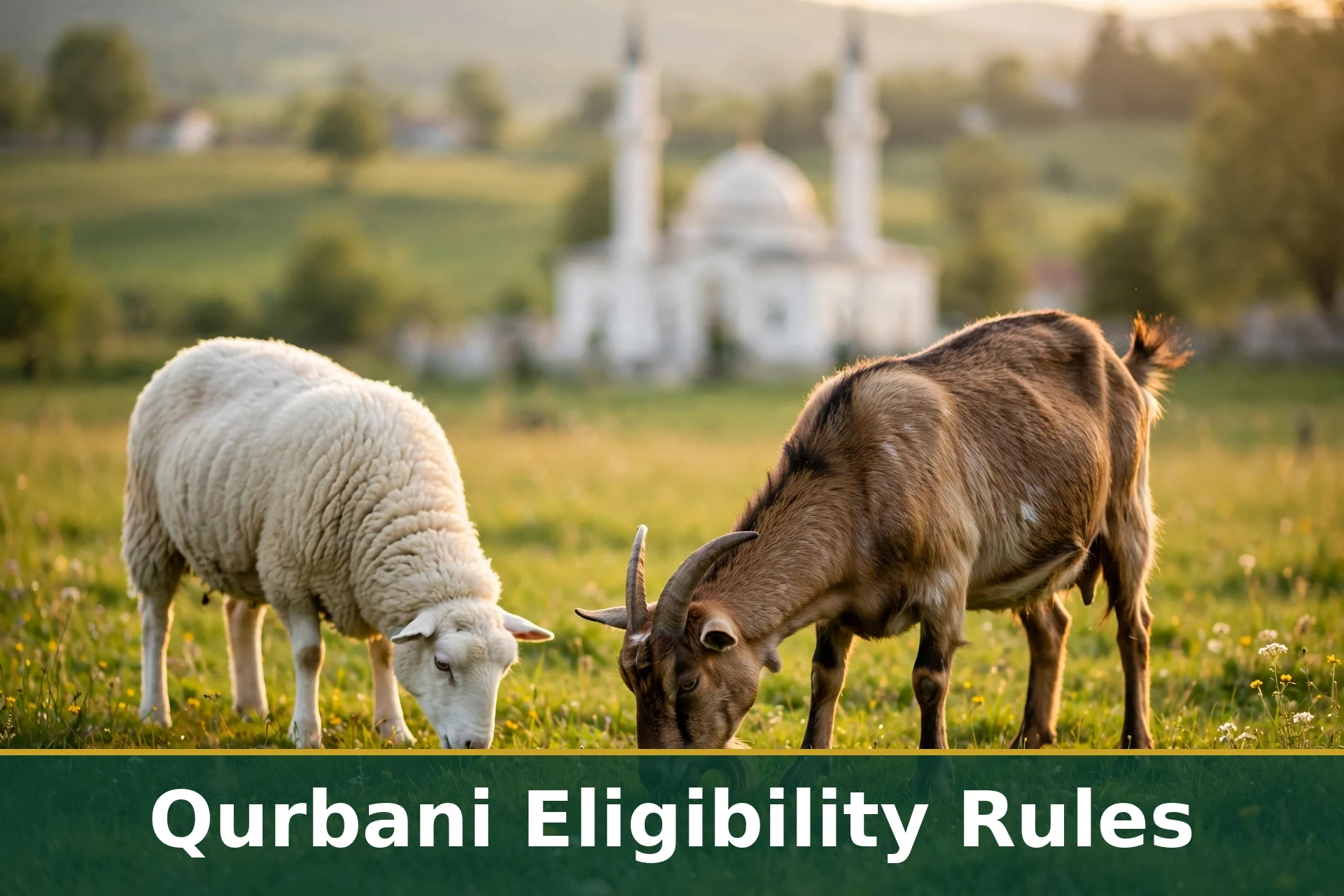
Qurbani, also called Udhiyah, is the sacrifice of an animal for the sake of Allah during Eid al-Adha, offered on the 10th, 11th and 12th of Dhul-Hijjah after the Eid prayer. In the Hanafi school it is wajib (obligatory) for every sane, adult, resident Muslim who holds nisab wealth on those days, while the Shafi’i, Maliki and Hanbali schools regard it as a strongly emphasised Sunnah (Sunnah mu’akkadah). Eid al-Adha 1448 is expected on Sunday 16 May 2027, with the Day of Arafah expected on Saturday 15 May 2027; the exact date depends on the local moon sighting and may shift by one day. The Qurbani rules below cover who must offer it, when to offer it, and how the meat is shared.
Key Points
- Qurbani is offered on the 10th, 11th and 12th of Dhul-Hijjah, after the Eid prayer; the Shafi’i, Maliki and Hanbali schools also allow the 13th.
- In the Hanafi school, Qurbani is wajib for a sane, adult, resident Muslim who possesses nisab on the days of sacrifice. The majority view is that it is Sunnah mu’akkadah, a strongly emphasised Sunnah.
- The nisab is the same as the zakat nisab: 85 grams of gold or 595 grams of silver (612.36 grams in the Hanafi conversion). As of 19 November 2026, that is about US$864 by silver (about US$890 for 612.36 grams) and about US$10,200 by gold.
- A goat or sheep counts for one person. A cow, buffalo or camel counts for seven shares, so seven people can share one large animal.
- Dividing the meat into three equal parts — for the family, for relatives and friends, and for the poor — is recommended, not obligatory.
- A missed Qurbani cannot be made up by sacrificing an animal the following year. The Hanafi position is to give the value of an animal in charity.
What Is Qurbani?
Qurbani is the sacrifice of a lawful animal during the days of Eid al-Adha, done to draw closer to Allah and to remember the obedience of Prophet Ibrahim (AS), who was ready to sacrifice his son Ismail (AS) when Allah commanded him to do so. Allah replaced Ismail (AS) with a ram, and the sacrifice has been part of the worship of Eid al-Adha ever since. The Qur’an describes this act of devotion in Surah al-Hajj (22), where Allah says that it is not the meat or the blood that reaches Him, but the piety of the one who offers it.
It is an act of worship, not a custom: the animal is slaughtered in Allah’s name, and the meat is shared so that the poor also enjoy the days of Eid. To learn more, see what Qurbani means, and for the words said at the sacrifice, see the Qurbani dua.
When Is Qurbani Offered?
Qurbani is offered on the 10th, 11th and 12th of Dhul-Hijjah, after the Eid prayer. The Shafi’i, Maliki and Hanbali schools allow the sacrifice on the 13th of Dhul-Hijjah as well.
An animal sacrificed before the Eid prayer does not count as Qurbani. It counts as ordinary charity (sadaqah), and the person must offer another sacrifice in its place. This is the teaching of the hadith of Jundub ibn Sufyan (RA), reported in Sahih al-Bukhari (5545): “Whoever slaughtered before the prayer, let him slaughter another in its place.”
Eid al-Adha 1448 is expected on Sunday 16 May 2027, with the Day of Arafah expected on Saturday 15 May 2027. These dates are expected, not certain: they depend on the moon sighting, and the date in Pakistan may shift by one day. For the confirmed dates each year, see our Eid al-Adha dates guide and our guide to the first ten days of Dhul-Hijjah. The Hajj, which takes place in the same month, is explained in our Hajj guide.
Who Has to Offer Qurbani?
The scholars differ on whether Qurbani is obligatory, and both views must be stated honestly. In the Hanafi school, Qurbani is wajib — obligatory — for every sane, adult, resident Muslim who possesses nisab wealth on the days of sacrifice. In the Shafi’i, Maliki and Hanbali schools, Qurbani is Sunnah mu’akkadah — a strongly emphasised Sunnah — for the person who can afford it, but not wajib. Neither view should be presented as the only ruling.
The Prophet (SAW) warned those who can afford the sacrifice but leave it without excuse, in a hadith reported in Sunan Ibn Majah (3123) and graded hasan by al-Albani: “Whoever can afford it but does not offer a sacrifice, let him not come near our prayer place.” The warning shows how seriously the sacrifice is taken, even on the view that it is a Sunnah.
Women are addressed by the same ruling as men; there are no separate rules for women. Children are not obliged to offer Qurbani.
A narration that an udhiyah should be performed by each household every year (Sunan Ibn Majah 3125) is graded weak by al-Albani, so it should not be presented as an established rule.
What Is the Nisab for Qurbani?
The threshold for Qurbani is nisab — wealth above a person’s basic needs — not simply having a monthly salary. A person who earns a salary but, after meeting their needs and paying their debts, does not hold nisab wealth, is not in the position described by the ruling. Conversely, a person who holds savings, gold, silver or trade goods above their needs that reach nisab is addressed by the ruling, whether or not they receive a monthly salary.
The nisab is the same threshold as for zakat: 85 grams of gold or 595 grams of silver (612.36 grams in the Hanafi conversion). The value of that threshold in money changes every day, because the prices of gold and silver change every day. The figures below were checked on 19 November 2026 using live spot prices (Kitco), and they must be re-checked on the day you decide: as of 19 November 2026, the silver nisab is about US$864 for 595 grams (about US$890 for the 612.36-gram conversion), and the gold nisab is about US$10,200 for 85 grams. If you hold wealth above your needs and debts that reaches the nisab on the days of sacrifice, you are addressed by the ruling; if you do not, any sacrifice you offer is voluntary charity. No fixed figure in pounds, Canadian dollars or Australian dollars is given here; those equivalents must be converted at the live rate on the day you check.
Which Animals Count, and How Many Shares?
Only certain animals may be offered for Qurbani: a goat, a sheep, a cow, a buffalo or a camel. The animal must be healthy and free of obvious defects, and it must have reached the required age for its kind. A goat or sheep counts for one person only. A cow, buffalo or camel counts for seven shares, so up to seven people can share one large animal.
Shares are counted, not guessed by meat weight: each share is one-seventh of the animal. A husband and wife may each take a share in the same animal, and a share may be offered on behalf of another person with their permission.
How Should Qurbani Meat Be Divided?
The recommended way to divide Qurbani meat is into three equal parts: one part for the family, one part for relatives and friends, and one part for the poor. This three-thirds division is recommended (mustahabb), not obligatory. A person who keeps more, or gives away more, has still performed a valid Qurbani, as long as the sacrifice itself was valid. Part of the meat may also be given to non-Muslim neighbours.
The butcher must not be paid with the meat or the hide of the animal. He should be paid separately, in money, for his work. The hide may be kept for personal use, or it may be sold, and if it is sold the money should be given to the poor.
The Takbir of Tashriq
During the days of Eid al-Adha, the Takbir of Tashriq is recited after the obligatory prayers, from Fajr on the 9th of Dhul-Hijjah until Asr on the 13th, in the Hanafi window. Other schools differ slightly on the exact window. The words are:
Arabic:
اللَّهُ أَكْبَرُ، اللَّهُ أَكْبَرُ، لَا إِلَهَ إِلَّا اللَّهُ، وَاللَّهُ أَكْبَرُ، اللَّهُ أَكْبَرُ، وَلِلَّهِ الْحَمْدُ
Transliteration: Allaahu Akbar, Allaahu Akbar, laa ilaaha illallaah, wallaahu Akbar, Allaahu Akbar, wa lillaahil-hamd.
Translation: “Allah is the Greatest, Allah is the Greatest. There is no god but Allah, and Allah is the Greatest, Allah is the Greatest, and to Allah belongs all praise.”
What If I Missed Qurbani Last Year?
A missed Qurbani cannot be made up by sacrificing an additional animal the following year. The time for the sacrifice is the days of Eid al-Adha, and once those days have passed, that year’s sacrifice cannot be performed later. The Hanafi position is that a person who missed an obligatory Qurbani should give the value of an animal in charity. That is the correct way to make up for it, not a late sacrifice. Do not take a loan for it: Qurbani is for those who can afford it.
Frequently Asked Questions
Who has to offer Qurbani?
In the Hanafi school, Qurbani is wajib for every sane, adult, resident Muslim who possesses nisab on the days of sacrifice. The Shafi’i, Maliki and Hanbali schools regard it as Sunnah mu’akkadah, a strongly emphasised Sunnah, for those who can afford it. Women are addressed by the same ruling as men, and children are not obliged.
What is the nisab for Qurbani?
The nisab is the same as for zakat: 85 grams of gold or 595 grams of silver (612.36 grams in the Hanafi conversion). As of 19 November 2026, that is about US$864 by silver (about US$890 for 612.36 grams) and about US$10,200 by gold. The figures move with metal prices daily, so re-check them on the day you decide.
On which days is Qurbani offered?
Qurbani is offered on the 10th, 11th and 12th of Dhul-Hijjah, after the Eid prayer. The Shafi’i, Maliki and Hanbali schools also allow the 13th. An animal sacrificed before the Eid prayer counts as ordinary charity, not Qurbani.
How many people can share one animal?
A goat or sheep counts for one person only. A cow, buffalo or camel counts for seven shares, so up to seven people can share one large animal. Each share is one-seventh of the animal.
How should Qurbani meat be divided?
The recommended division is into three equal parts: one for the family, one for relatives and friends, and one for the poor. This is a recommendation, not an obligation. The butcher must not be paid with meat or the hide.
What if I missed Qurbani last year?
A missed Qurbani cannot be made up by sacrificing an animal the following year. The Hanafi position is to give the value of an animal in charity.
Sources: Sahih al-Bukhari; Sunan Ibn Majah; SeekersGuidance Zakat Calculator; Awqatly; The Zakat Calculator; The Holy Qur’an (Surah al-Hajj 22).