Dua e Hajat, Dua e Salatul Hajat
Salatul Hajat is a voluntary two-rakah prayer offered when a Muslim needs help from Allah, and Dua e Hajat is the supplication recited after it. This page gives the method of Salatul Hajat, the dua with its English translation, and notes on the narration’s authenticity.
Key points: Perform wudu, pray two rakahs, praise Allah and send blessings on the Prophet, peace be upon him, then recite Dua e Hajat. The method below follows the narration attributed to Abdullah ibn Abi Awfa cited on this page.
How Is Salatul Hajat Prayed?
Abdullah ibn Abi Awfa says about the Salatul-Hajat that the Messenger of Allah said,
Anyone who wishes to make a dua with Allah or a specific individual should do two rakats of ritual washing before doing so.
let them do ritual washings and then pray for two rakats.”
Then they should praise Allah and send blessings (Durood) to the
Prophet (peace and blessings be upon him).”
What Is Dua e Hajat in Arabic?
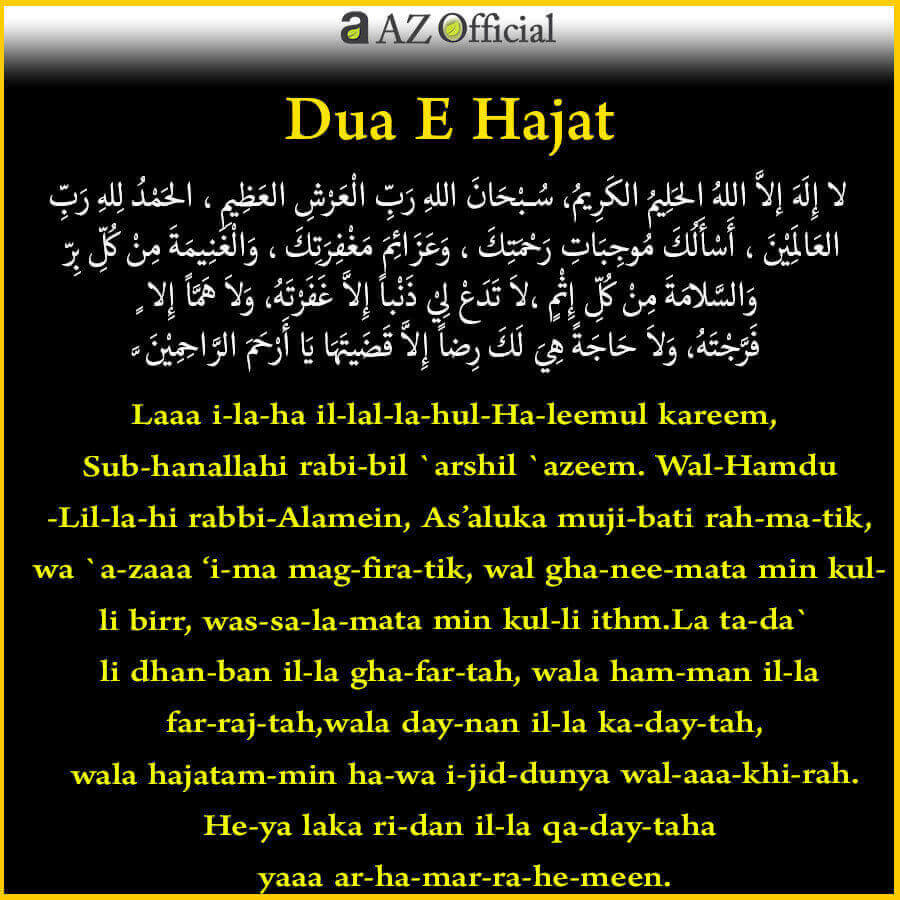
لَا إِلَهَ إِلّا الْلّهُ الْحَلِيمُ الْكَرِيمُ، سُبْحَانَ الْلّهِ رَبِّ الْعَرْشِ الْعَظِيمِ، الْحَمْدُ لِلّهِ رَبِّ الْعَالَمِينَ، أَسْأَلُكَ مُوجِبَاتِ رَحْمَتِكَ، وَعَزَائِمَ مَغْفِرَتِكَ، وَالْغَنِيمَةَ مِنْ كُلِّ بِرٍّ، وَالسّلَامَةَ مِنْ كُلِّ إِثْمٍ، لَا تَدَعْ لِي ذَنْبًا إِلّا غَفَرْتَهُ، وَلَا هَمًّا إِلّا فَرّجْتَهُ، وَلَا دَيْنًا إِلّا قَضَيْتَهُ، وَلَا حَاجَةً مِنْ حَوَائِجِ الدُّنْيَا وَالْآخِرَةِ هِيَ لَكَ رِضًا إِلّا قَضَيْتَهَا يَا أَرْحَمَ الرّاحِمِينَ.
Transliteration: La ilaha illallahul-Haleemul Kareem, Subhanallahi Rabbil ‘Arshil ‘Azeem, alhamdu lillahi Rabbil ‘alameen, as’aluka mujibati rahmatik, wa ‘aza’ima maghfiratik, wal-ghanimata min kulli birr, was-salamata min kulli ithm, la tada’ li dhanban illa ghafartah, wa la hamman illa farrajtah, wa la daynan illa qadaitah, wa la hajatan min hawa’ijid-dunya wal-akhirah, hiya laka ridan illa qadaitaha, ya Arhamar-Rahimeen.
What Is the English Translation of Dua e Hajat?
Allah, the Merciful and Wise, is the only god. Allah,
the High and Mighty, is the only god.
Glory to Allah, the Master of the Great Throne. Allah, the Lord of the worlds,
deserves all the praise. I ask you (O Allah) for everything that will bring you mercy
and forgiveness, make me rich in all good things, and set me free from all sin.
Do not leave a vice of mine (O Allah) unless you forgive it,
nor a worry unless you make a way for it, nor a need that makes you
happy unless you meet it, O Most Merciful One.
Abu Dawood said that this dua means, “When something got serious,
the Prophet (PBUH) went to prayer.”
It means that anyone can ask God for help at any time because God is the
most merciful and kind.
One of the most important prayers is called Salatul Haajat. It is a voluntary call to God.
It’s celebrated so that each person can finish their own Haajah (need).
It is just one way to ask the Almighty for what you deserve.
Ahmad is cited on this page for a report about a person who performs wudu properly and prays two rakahs, and then asks Allah for what he needs.
A note on authenticity: scholars differ on the grading of the Salatul Hajat narration, and some grade it as weak. The method above is presented as described in the narration cited here, not as an established Sunnah with a fixed wording.
What Are the Benefits of Dua e Hajat?
Some people recite Dua e Hajat regularly, including after prayers and on Fridays, seeking Allah’s help and protection. Everyone has their own way of talking to Allah and telling Him what they want.
Always remember that his blessing is not to be taken lightly.
I’d like to point out that we must always say “Alhamdulillah”
to Allah, the Most Powerful, no matter what.
You’ve probably heard the phrase “As you sow, so shall you reap,”
which means that you have to do good things over and over again to get good results.
If you want to hurt someone, bad things will also happen to you.
How Do You Perform Salatul Hajat?
For these prayers, called namaz, there is a certain way they should be done.
Here is a quick guide.
- The person praying must start to make a Wudhu.
In Islam, Wudhu is a cleansing ritual that is an integral part of being clean and pure.
Then, with the intention of Nafl Salaat, two rakats are done. - After the salat is done, the Durood Shareef and prayer to Allah SWT begin.
In Islam, it is a good thing to say as much Tasbeeh and Durood Shareef as you can. - After all of this is done.
This helps people get what they want or keep things secret.
What Is the Dua e Hajat Routine for Marriage?
The following Monday routine is a popular practice shared for marriage, not a fixed Sunnah with set repetitions.
- If you want to get married,
it’s best to say Salat ul Haajat on a Monday.
After saying the Isha prayer, a person must take an ablution, or a bath to clean themselves,
and then go to a quiet place to pray. - Start by saying one salaam and a 4-rakah prayer. Also, say what the prayer is for at this time.
- In the first rakah, say Surah Fatiha ten times,
and then say Surah Ikhlas ten times.
During the second rakah,
the same surahs were read 20 times.
Say the same surahs 30 times in the third rakah. And finally,
both surahs should be read 40 times during the fourth rakah. - Salaam, then move on to the next step in silence.
- Recite Surah Ikhlas 75 times. Then, 75 times, say “Istaghfar.” Lastly,
say Darood Shareef 75 times. - Lastly, say your prayer for marriage.
- This Monday routine is a popular practice, not a fixed Sunnah, and it does not guarantee a result.
See also: Dua After Adhan and Dua Yunus.
Frequently Asked Questions About Dua e Hajat
What is Dua e Hajat?
Dua e Hajat is the supplication of need, recited after Salatul Hajat, the voluntary two-rakah prayer offered when a Muslim asks Allah for help with a need.
How do you pray Salatul Hajat?
Perform wudu, pray two rakahs with the intention of Nafl prayer, praise Allah, send blessings on the Prophet, peace be upon him, then recite Dua e Hajat.
What is the English meaning of Dua e Hajat?
It asks Allah for everything that brings His mercy and forgiveness, for richness in all good things, and freedom from all sin, and that no sin, worry or need be left except that Allah deals with it, O Most Merciful One.
Is the Salatul Hajat narration authentic?
Scholars differ on the authenticity of the specific Salatul Hajat narration cited on this page, and some grade it as weak. The method here is presented as described in that narration.