Dua e Hajat, Dua e Salatul Hajat
Salatul Hajat is a voluntary two-rakah prayer offered when a Muslim needs help from Allah, and Dua-e-Hajat is the supplication recited after it. The method comes from a narration of Abdullah ibn Abi Awfa (RA) in Jami’ at-Tirmidhi, but scholars differ on the grading of that narration, and some grade it weak — so this guide gives the exact wording, the honest grading, and the authentic Qur’anic basis for asking Allah, without promising a guaranteed result.
Key Points
- Salatul Hajat is a voluntary two-rakah prayer of need, followed by praise, blessings on the Prophet (SAW), and Dua-e-Hajat.
- The method is reported in Jami’ at-Tirmidhi 479, on the authority of Abdullah ibn Abi Awfa (RA).
- Imam al-Tirmidhi called the narration gharib and noted criticism of its chain; al-Albani graded it very weak.
- The dua asks Allah for mercy, forgiveness, a share of every good deed, and safety from every sin.
- Allah promises in the Qur’an that He is near and responds to the one who calls upon Him (2:186; 40:60).
- There is no fixed number of repetitions and no fixed day for Salatul Hajat in authentic sources.
- No dua guarantees a specific outcome by a set date — keep making dua and keep taking the practical steps your need requires.
What Is Salatul Hajat?
Hajat is the Arabic word for a need. Salatul Hajat, the prayer of need, is a voluntary prayer a Muslim offers when facing a difficulty, a decision, an illness, a debt, a marriage matter, or any need of this world or the next. It is not one of the five daily prayers, and it is not a fixed Sunnah with a set time, like the prayer for rain or the eclipse prayer. Its idea is simple and deeply Islamic: when you need something, turn to Allah first — with ablution, with prayer, with praise, and with a direct request. The Qur’an gives that idea its foundation. Allah says:
Arabic:
وَإِذَا سَأَلَكَ عِبَادِي عَنِّي فَإِنِّي قَرِيبٌ ۖ أُجِيبُ دَعْوَةَ الدَّاعِ إِذَا دَعَانِ ۖ فَلْيَسْتَجِيبُوا لِي وَلْيُؤْمِنُوا بِي لَعَلَّهُمْ يَرْشُدُونَ
Transliteration: Wa idhaa sa’alaka ‘ibaadee ‘annee fa’innee qareeb, ujeebu da’watad-daa’ee idhaa da’aan, falyastajeeboo lee walyu’minoo bee la’allahum yarshudoon.
Translation: And when My servants ask you, [O Muhammad], concerning Me — indeed I am near. I respond to the invocation of the supplicant when he calls upon Me. So let them respond to Me [by obedience] and believe in Me that they may be [rightly] guided. (Qur’an 2:186, full verse, Saheeh International.)
And Allah says in another verse:
Arabic:
وَقَالَ رَبُّكُمُ ادْعُونِي أَسْتَجِبْ لَكُمْ
Transliteration: Wa qaala Rabbukumud’oonii astajib lakum.
Translation: And your Lord says, “Call upon Me; I will respond to you.” (Qur’an 40:60, opening phrase only, labelled as such, Saheeh International.)
These verses are the reason Salatul Hajat exists in practice: prayer first, then asking, then trust in Allah’s answer in the way and at the time He knows is best.
How Is Salatul Hajat Prayed?
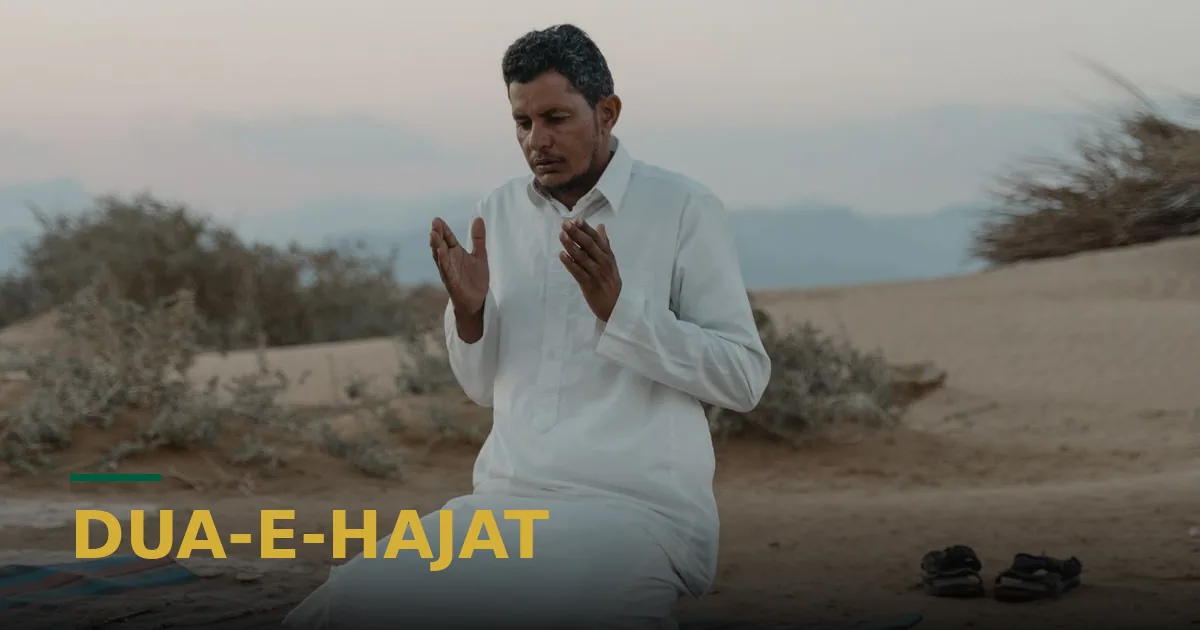
Abdullah ibn Abi Awfa (RA) reported that the Messenger of Allah (SAW) said: “Whoever has a need from Allah, or from one of the sons of Adam, then let him perform wudu, performing it well, then pray two rak’ah, then praise Allah and say salat upon the Prophet (SAW). Then let him say…” — followed by the dua given below (Jami’ at-Tirmidhi 479). In practice, the steps are: perform wudu properly; pray two rakahs with the intention of a voluntary prayer; praise Allah; send blessings on the Prophet (SAW); recite Dua-e-Hajat; then ask Allah for your own need in your own words and in any language. There is no set surah to recite in the two rakahs, no fixed time of day, and no fixed number of repetitions. Any routine that fixes a particular day, a particular count of surah repetitions, or a promised result — such as the Monday routine with counts of ten, twenty, thirty and forty sometimes shared online — has no basis in this narration and should not be presented as part of the prayer.
What Is Dua-e-Hajat in Arabic?
Here is the dua exactly as it appears in the narration, with its transliteration and translation:
Arabic:
لَا إِلَهَ إِلَّا اللَّهُ الْحَلِيمُ الْكَرِيمُ، سُبْحَانَ اللَّهِ رَبِّ الْعَرْشِ الْعَظِيمِ، الْحَمْدُ لِلَّهِ رَبِّ الْعَالَمِينَ، أَسْأَلُكَ مُوجِبَاتِ رَحْمَتِكَ، وَعَزَائِمَ مَغْفِرَتِكَ، وَالْغَنِيمَةَ مِنْ كُلِّ بِرٍّ، وَالسَّلَامَةَ مِنْ كُلِّ إِثْمٍ، لَا تَدَعْ لِي ذَنْبًا إِلَّا غَفَرْتَهُ، وَلَا هَمًّا إِلَّا فَرَّجْتَهُ، وَلَا حَاجَةً هِيَ لَكَ رِضًا إِلَّا قَضَيْتَهَا، يَا أَرْحَمَ الرَّاحِمِينَ
Transliteration: Laa ilaaha illallaahul-Haleemul-Kareem, Subhaanallaahi Rabbil-‘Arshil-‘Azeem, Alhamdu lillaahi Rabbil-‘Aalameen, As’aluka moojibaati rahmatik, wa ‘azaa’ima maghfiratik, wal-ghaneemata min kulli birr, was-salaamata min kulli ithm, laa tada’ lee dhanban illaa ghafartah, wa laa hamman illaa farrajtah, wa laa haajatan hiya laka ridan illaa qadaitahaa, yaa Arhamar-Raahimeen.
Translation: None has the right to be worshipped but Allah, the Forbearing, the Generous. Glorious is Allah, Lord of the Magnificent Throne. All praise is due to Allah, Lord of the worlds. I ask You for that which warrants Your mercy, and that which will determine Your forgiveness, and the spoils of every righteous deed, and safety from every sin; do not leave a sin of mine without forgiving it, nor a worry without relieving it, nor a need that pleases You without granting it, O Most Merciful of those who show mercy. (Jami’ at-Tirmidhi 479.)
Readers should note two things about this wording. First, the dua asks for broad, good things — mercy, forgiveness, a share of every good deed, safety from sin — and then asks Allah to deal with every sin, worry, and need that pleases Him. Second, this exact wording does not include a line about debt, and it does not include the phrase “of the needs of this world and the Hereafter”. Those lines appear in some circulating versions of the dua, but they are not part of the Tirmidhi narration, so they are not printed here as part of it.
Is the Salatul Hajat Narration Authentic?
Scholars differ, and the honest answer is that the chain is weak. Imam al-Tirmidhi himself described the hadith as gharib and pointed out that there is criticism of its chain: the narrator Fa’id ibn Abdur-Rahman is graded weak in hadith, and Imam Ahmad called him matruk, meaning his narrations are generally not accepted. Al-Albani graded this specific hadith as very weak (da’if jiddan). A parallel version of the same narration appears in Sunan Ibn Majah 1384, with the same weakness. What does that mean in practice? It means Salatul Hajat should not be described as an established Sunnah with a fixed wording, and no one should promise that praying it guarantees a particular outcome. At the same time, the broader practice — performing wudu, praying two rakahs, praising Allah, sending blessings on the Prophet (SAW), and then asking Allah for a need — rests on the general Qur’anic command to call upon Allah and on many authentic narrations about dua, so scholars who permit the prayer do so on that broader basis, with the grading stated openly. This guide follows that approach: the wording is given, the grading is given, and the reader is not misled.
When and How Often Can You Pray It?
There is no fixed time for Salatul Hajat in the narration. A Muslim may pray it whenever a need arises, at any permissible time for voluntary prayer — avoiding the three disliked times for prayer (at sunrise, at midday when the sun is at its height, and at sunset). The last third of the night is a blessed time for dua generally, but it is not a condition of this prayer. There is no fixed number of repetitions for the dua itself: recite it once with focus, or repeat it as you wish, and then speak your own need to Allah plainly. What matters is sincerity, humility, and patience — not a count, a day of the week, or a formula. If the need is marriage, work, health, debt, or a family matter, name it clearly to Allah after the dua, and then take the practical steps that the matter requires: apply, consult, treat, budget, or reconcile, as the case may be. Dua and effort belong together.
What Are the Benefits of Dua-e-Hajat?
The benefit of this dua is not a guaranteed result but a right way of asking. Its words train the heart before the request: they begin with the oneness of Allah and His beautiful names, move to praise and thanks, and only then ask — for mercy, forgiveness, a share of every good deed, and safety from sin — before finally naming the need. That order is itself a lesson in how to make dua. Regularly turning to Allah in need also builds reliance on Him, patience when the answer is delayed, and gratitude when it comes in a form different from the one expected. None of this is a promise that a specific need will be met by a specific date. Allah answers in His wisdom: sometimes by giving what was asked, sometimes by giving something better, and sometimes by averting a harm the asker could not see. A guide that promises otherwise is not helping its reader.
Frequently Asked Questions
What is Dua-e-Hajat?
The supplication recited after Salatul Hajat, the voluntary two-rakah prayer of need, as reported in Jami’ at-Tirmidhi 479.
How do you pray Salatul Hajat?
Perform wudu properly, pray two rakahs as a voluntary prayer, praise Allah, send blessings on the Prophet (SAW), recite Dua-e-Hajat, then ask Allah for your need in your own words.
What is the English meaning of Dua-e-Hajat?
“None has the right to be worshipped but Allah, the Forbearing, the Generous. Glorious is Allah, Lord of the Magnificent Throne. All praise is due to Allah, Lord of the worlds. I ask You for that which warrants Your mercy, and that which will determine Your forgiveness, and the spoils of every righteous deed, and safety from every sin; do not leave a sin of mine without forgiving it, nor a worry without relieving it, nor a need that pleases You without granting it, O Most Merciful of those who show mercy.”
Is the Salatul Hajat narration authentic?
Scholars differ. Imam al-Tirmidhi called it gharib and noted criticism of its chain; al-Albani graded it very weak. It is presented here with its grading, not as an established Sunnah.
Can I pray Salatul Hajat for marriage?
Yes — for any lawful need, including marriage. There is no fixed Monday routine or repetition count in the narration.
Does Dua-e-Hajat guarantee my need will be met?
No. Allah promises to respond (Qur’an 2:186 and 40:60), but the form and timing of the answer are with Him.
Sources: The Holy Qur’an; Jami’ at-Tirmidhi; Sunan Ibn Majah
Related reading
- Dua Yunus
- dua for rizq
- dua after Adhan
- 7 prayers to get married soon
- dua for newly married couple
- Istikhara dua