Surah Al-Mulk Benefits That Every Muslim Should Be Aware
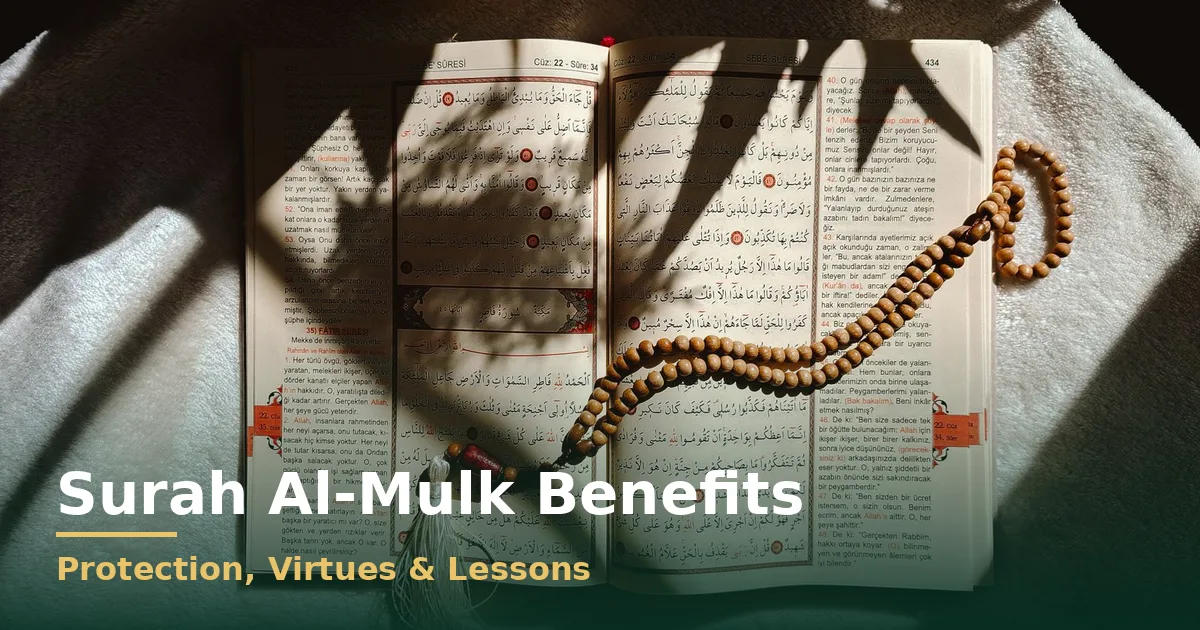
Surah Al-Mulk is the 67th chapter of the Qur’an: 30 verses revealed in Makkah, whose name means “The Kingdom” or “The Sovereignty”. Its benefits, as reported in hadith, are that it intercedes for the one who recites it until he is forgiven, that the Prophet (peace and blessings be upon him) called it a protector and deliverer, and that he would not sleep until he had recited it. This guide gives the verified hadith with their references, the surah’s key lessons, and a simple nightly routine — so you can recite it with understanding, not just habit.
What Is Surah Al-Mulk?
Surah Al-Mulk is the 67th surah of the Qur’an and the first surah of the 29th juz. It has 30 verses and was revealed in Makkah. Its name comes from its opening verse:
Arabic:
تَبَارَكَ الَّذِي بِيَدِهِ الْمُلْكُ وَهُوَ عَلَىٰ كُلِّ شَيْءٍ قَدِيرٌ
Transliteration: “Tabaarakalladhee biyadihil-mulku wa huwa ‘alaa kulli shay’in qadeer.”
Translation: “Blessed is He in whose hand is dominion, and He is over all things competent.” (Qur’an 67:1, Sahih International)
The whole surah turns on that one idea: all kingdom, all power and all control belong to Allah alone. Everything else — wealth, status, health, life itself — is a trust He gives and takes. The surah then proves that sovereignty through creation, death and life, the heavens, the earth, and the fate of those who denied their Lord.
What Are the Virtues Reported in Hadith?
- It intercedes for its reciter until he is forgiven. Abu Hurayrah (may Allah be pleased with him) reported that the Prophet (peace and blessings be upon him) said:
Arabic: إِنَّ سُورَةً مِنَ الْقُرْآنِ ثَلَاثُونَ آيَةً شَفَعَتْ لِرَجُلٍ حَتَّى غُفِرَ لَهُ، وَهِيَ سُورَةُ تَبَارَكَ الَّذِي بِيَدِهِ الْمُلْكُ
Transliteration: “Inna sooratan minal-Qur’aani thalaathoona aayatan shafa’at lirajulin hattaa ghufira lah, wa hiya sooratu Tabaarakalladhee biyadihil-mulk.”
Translation: “There is a surah of the Qur’an, thirty verses, which interceded for a man until he was forgiven, and it is Surah Tabarak alladhi bi-yadihil-mulk.” (Sunan Abi Dawud 1400; Jami’ at-Tirmidhi 2891, graded hasan.) - It is a protector and deliverer. Ibn Abbas (may Allah be pleased with him) reported that a Companion pitched his tent over a grave without realising it was a grave, and heard a person inside reciting Surah Al-Mulk to its end. When he told the Prophet (peace and blessings be upon him), he said: “It is the preventer, it is the deliverer — it delivers him from the punishment of the grave.” (Jami’ at-Tirmidhi 2890.) Scholars note this report’s chain has been discussed; the hope it describes is real, and it is Allah who grants protection, with the surah as the means. A related report from Ibn Mas’ud (may Allah be pleased with him) describes the surah as “the protector” that prevents the punishment of the grave for the one who recites it at night — this report stops at the Companion, so it is quoted as his teaching, not as a direct statement of the Prophet.
- The Prophet would not sleep without it. Jabir (may Allah be pleased with him) reported: “The Prophet (peace and blessings be upon him) would not sleep until he had recited Alif-Lam-Mim Tanzil (Surah As-Sajdah) and Tabarak alladhi bi-yadihil-mulk (Surah Al-Mulk).” (Jami’ at-Tirmidhi 2892.) That nightly practice is the simplest reason to make the surah part of your own night.
What Does Surah Al-Mulk Teach?
The surah is short, but its lessons cover the whole of faith. The second verse states the purpose of life: “[He] who created death and life to test you [as to] which of you is best in deed — and He is the Exalted in Might, the Forgiving.” (Qur’an 67:2, Sahih International.) Life is a test, and the measure is not how much you do but how good your deeds are.
Then the surah points at the sky: seven heavens, one above another, with no flaw for you to find (67:3–4). Look again and again — the perfection of creation is itself the proof of its Creator. Later verses remind us that the earth was made manageable for us, that we walk its paths and eat of its provision (67:15), and that our hearing, sight and hearts are gifts from Allah for which we give little thanks (67:23). The surah ends by asking the question that answers itself: if your water were to sink away into the earth, who could bring you flowing water? (67:30, meaning.) Only Allah.
How Can You Build a Nightly Al-Mulk Habit?
The Sunnah points to night-time recitation, so attach it to something you already do. Read it after Isha prayer, or in bed before sleeping, even if you read slowly. Start by reading the Arabic with its translation for a few verses each night until you understand the whole surah — understanding is what turns recitation into reflection. If you cannot read Arabic yet, listen to a recitation while following the translation, and learn the verses a few at a time. Many people pair it with Surah As-Sajdah, as the Prophet (peace and blessings be upon him) did, and with the dua for sleeping and Ayat al-Kursi as part of a short nightly routine. Children can start with the first verse and add one verse a week.
What Does the Surah Say About the Afterlife?
Surah Al-Mulk does not leave the afterlife vague. It describes the punishment prepared for those who denied their Lord, and the moment they are asked, “Did no warner come to you?” — and they admit that a warner did come, but they denied him (67:6–9, meaning). Then comes the verse of hope for the other side: “Indeed, those who fear their Lord unseen will have forgiveness and great reward.” (Qur’an 67:12, Sahih International.) The surah holds both sides together on purpose: warning and hope, fear and forgiveness. That balance is the surah’s emotional centre. It is also why the surah pairs so well with the nightly routine — it is the last thing you think about before sleep, and the first thing you remember about the purpose of the next day. If you find the verses about punishment frightening, read them alongside verse 2 (life as a test of good deeds) and verse 12 (forgiveness for those who fear Allah unseen): the surah’s message is not despair, but a call to turn back while there is time.
What Are Common Misunderstandings About Surah Al-Mulk?
First, the surah is a means, not a magic shield. Its virtues come from Allah’s permission — reciting it while ignoring its message, or while persisting in wrongdoing without repentance, is not what the hadith describe. Second, the reward is tied to reciting it regularly and with reflection, not to owning a copy or playing it as background sound while doing something else. Third, no specific number of repetitions is reported in the authentic hadith — once a night, with understanding, is the practice the reports point to. If you want to go deeper into the Qur’an’s short powerful chapters, see our guides to Surah Al-Kahf benefits and Surah Yaseen benefits.
Frequently Asked Questions
How many verses are in Surah Al-Mulk?
Thirty verses. It is the 67th chapter of the Qur’an, revealed in Makkah, and the first surah of the 29th juz.
What are the benefits of reciting Surah Al-Mulk every night?
The hadith report that it intercedes for its reciter until he is forgiven (Abu Dawud 1400; Tirmidhi 2891), that the Prophet called it a protector and deliverer (Tirmidhi 2890), and that he would not sleep until he had recited it (Tirmidhi 2892).
Does Surah Al-Mulk protect from the punishment of the grave?
The hadith in Tirmidhi 2890 describes it as the preventer and deliverer from the punishment of the grave, and Ibn Mas’ud called it “the protector”. Protection is from Allah, with the surah as the means.
When should I recite Surah Al-Mulk?
At night, before sleeping — that is the practice reported from the Prophet (peace and blessings be upon him) in Tirmidhi 2892. Reciting it after Isha is the easiest way to keep it up.
Do I need to memorise Surah Al-Mulk to get its benefits?
No. The hadith speak of reciting it, and reciting from the mushaf counts. Memorising it makes nightly recitation easier, but understanding it matters more than speed.
What is the main lesson of Surah Al-Mulk?
That all sovereignty belongs to Allah alone, and that death and life were created to test which of us is best in deeds (Qur’an 67:2).
Key Points
- Surah Al-Mulk is the 67th surah: 30 verses, revealed in Makkah, meaning “The Kingdom”.
- It interceded for a man until he was forgiven (Abu Dawud 1400; Tirmidhi 2891).
- The Prophet called it the preventer and the deliverer from the punishment of the grave (Tirmidhi 2890).
- He would not sleep until he had recited it, along with Surah As-Sajdah (Tirmidhi 2892).
- Its central lesson: life is a test of who is best in deeds (Qur’an 67:2).
- Recite it nightly with understanding — once a night, after Isha or before sleep, is the reported practice.
Sources: The Holy Qur’an (Sahih International); Jami’ at-Tirmidhi; Sunan Abi Dawud; IslamQA.