Dua for Breaking the Fast: The Iftar Dua with Arabic and Meaning
What Is the Dua for Breaking the Fast?
The dua for breaking the fast is the short supplication the Prophet Muhammad (SAW) used to say when he broke his fast at sunset. It is the iftar dua every fasting Muslim should know by heart: “Dhahabaz-zama’u wabtallatil-‘urooqu wa thabatal-ajru in shaa’ Allah.” In English it means, “The thirst has gone, the veins are moistened, and the reward is confirmed, if Allah wills.” It is reported in Sunan Abi Dawud 2357 and graded hasan (good, sound enough to act upon) by Shaykh al-Albani. It takes only a few seconds to say, yet it turns an ordinary meal into an act of worship, because it remembers Allah at the very moment the fast ends. This guide gives you the dua in Arabic with full transliteration and translation, explains exactly when to say it, clears up the confusion about a second, weaker dua many of us learned first, and shows the Sunnah way to break your fast.
Key Points
- The authentic iftar dua is “Dhahabaz-zama’u wabtallatil-‘urooqu wa thabatal-ajru in shaa’ Allah” — Sunan Abi Dawud 2357, graded hasan.
- Say it AFTER the first sip or bite, because its words are in the past tense: the thirst HAS gone.
- The widely known “Allahumma laka sumtu wa ‘alaa rizqika aftartu” is weak (da’if, Abu Dawud 2358) — do not present it as the Prophet’s Sunnah.
- The Prophet (SAW) broke his fast with fresh dates before Maghrib prayer, then dry dates, then water (Abu Dawud 2356, sahih).
- Dua at the time of breaking the fast is among the supplications that are not rejected (Jami at-Tirmidhi 3598, hasan) — so make your own personal duas before you eat.
What Is the Authentic Iftar Dua in Arabic?
The authentic iftar dua is recorded in the chapter of Sunan Abi Dawud called “The Saying At The Time Of Breaking The Fast.” Ibn Umar (may Allah be pleased with him) reported that when the Prophet (SAW) broke his fast, he said:
Arabic:
ذَهَبَ الظَّمَأُ وَابْتَلَّتِ الْعُرُوقُ وَثَبَتَ الْأَجْرُ إِنْ شَاءَ اللَّهُ
Transliteration: Dhahabaz-zama’u wabtallatil-‘urooqu wa thabatal-ajru in shaa’ Allah
Translation: “The thirst has gone, the veins are moistened, and the reward is confirmed, if Allah wills.” (Sunan Abi Dawud 2357, graded hasan by al-Albani; Sunnah.com renders “al-‘urooq” as “the arteries”.)
Read the meaning slowly and you will see why this dua is so beautiful. The first two phrases describe what your body feels in that moment — the dryness of thirst is gone and the veins are moist again after a sip of water. The third phrase lifts your heart beyond the body: the reward of the fast is confirmed, and it rests with Allah’s will. It is a dua of gratitude and hope in a single breath, and that is why it is worth memorising exactly as it was taught, word for word. If you are preparing for Ramadan, add it to your Ramadan Countdown preparations and practise it a few times before the month begins, so it comes naturally at the table.
When Should You Say the Iftar Dua — Before or After Eating?
Say the iftar dua AFTER you have taken the first sip of water or the first bite of a date. The wording itself tells you why: “the thirst HAS gone” and “the veins ARE moistened” speak about something that has just happened. The hadith says the Prophet (SAW) said it “when he broke his fast,” and the scholars explain that this means just after breaking it, not before. So the order at sunset is simple. First, when the sun has set and the time of Maghrib has entered, break your fast at once — do not delay. Take a date or a sip of water, then say “Dhahabaz-zama’u…” with a present heart. After that, pray Maghrib, and then sit down to your full meal. This is also the moment to make your own personal duas. The minutes just before you break the fast are a precious time for asking Allah for what you need, for your family, your health, and your forgiveness. Make those duas BEFORE you eat, while you are still fasting, and then say the reported iftar dua just after the first bite.
What About “Allahumma Laka Sumtu”? The Dua Many People Learned First
Many Muslims first learned a different iftar dua: “Allahumma laka sumtu wa ‘alaa rizqika aftartu.” It appears on iftar cards, posters, and timetables in homes across the world, and its meaning is lovely. But honesty requires us to say plainly what the scholars of hadith established: its chain of narration is weak, and it should not be presented as the words of the Prophet (SAW).
Arabic:
اللَّهُمَّ لَكَ صُمْتُ وَعَلَى رِزْقِكَ أَفْطَرْتُ
Transliteration: Allaahumma laka sumtu wa ‘alaa rizqika aftartu
Translation: “O Allah, for You I have fasted, and with Your provision I have broken my fast.” (Sunan Abi Dawud 2358, graded da’if — weak — by al-Albani.)
The narration comes through Mu’adh ibn Zuhrah, who was from the generation after the Companions and did not hear the Prophet (SAW) himself, so the chain is broken (mursal). That is why al-Albani graded it weak. This does not make its meaning wrong — asking Allah in your own words at iftar is always allowed, and the words themselves are a fine personal dua. What matters is not to teach it as a Sunnah from the Prophet (SAW) when the sound narration gives us “Dhahabaz-zama’u” instead. If you grew up saying “Allahumma laka sumtu,” there is no need for guilt; simply learn the authentic dua alongside it, give the authentic one first place, and keep the other only as your own words, not as a reported Sunnah.
How Did the Prophet Break His Fast? The Sunnah of Dates and Water
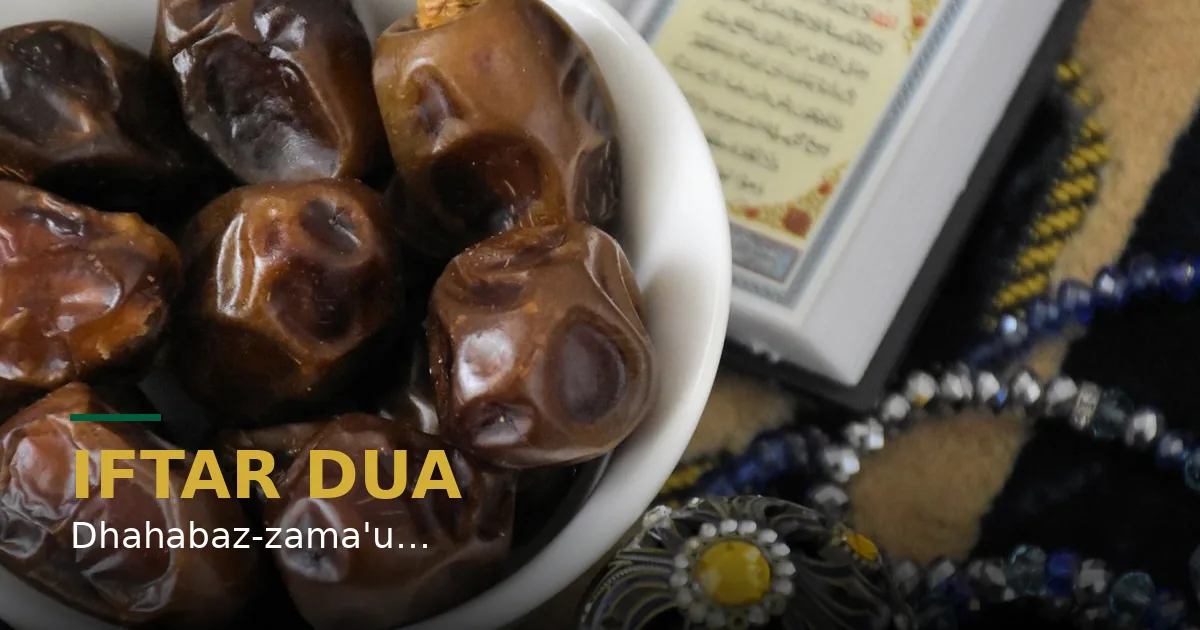
Before the dua comes the Sunnah of WHAT to break the fast with. Anas ibn Malik (may Allah be pleased with him) reported that the Messenger of Allah (SAW) used to break his fast before praying with some fresh dates; if there were no fresh dates, he had a few dry dates, and if there were no dry dates, he took some mouthfuls of water (Sunan Abi Dawud 2356; also Jami at-Tirmidhi 696; classed sahih by al-Albani). Notice the order and the timing. Fresh dates first, then dry dates, then water — and all of it BEFORE the Maghrib prayer, not after. The Sunnah is to hasten to break the fast the moment the sun sets, take something light, pray, and then eat the main meal. There is no authentic narration that fixes a number of dates for iftar, so one, two, or three dates are all fine; the odd-number practice people mention belongs to the morning of Eid al-Fitr, not to daily iftar. Keep it simple: a date, a sip of water, the dua, and the prayer. If you want the full etiquette of eating in Islam, see our guide on the dua before and after eating.
Why Is Dua at Iftar Time So Special?
Iftar is not only the end of hunger; it is one of the times when dua is answered. The Prophet (SAW) said: “There are three whose supplication is not rejected: the fasting person when he breaks his fast, the just leader, and the supplication of the oppressed person; Allah raises it up above the clouds and opens the gates of heaven to it.” (Jami at-Tirmidhi 3598, graded hasan.) A longer version of the same report is found in Jami at-Tirmidhi 2526, though Tirmidhi himself noted that the chain of that version is not strong — so we rely on 3598 here. The lesson is the same either way: the fasting person holds a special nearness to Allah at the moment of breaking the fast. Use those minutes well. Ask for forgiveness, for your parents, for your children, for provision, and for the acceptance of your fast. Keep your duas sincere and permissible, ask with certainty that Allah hears you, and avoid turning the moment into noise or argument at the table. A quiet, focused dua before the first bite is worth more than a long list said without a present heart.
What Should You Say Before Eating at Iftar?
Before you take the first bite, say Bismillah — “In the name of Allah” — just as before any meal.
Arabic:
بِسْمِ اللَّهِ
Transliteration: Bismillaah
Translation: “In the name of Allah.”
That is all that is reported for the start of the meal. There is no separate long dua to say before eating at iftar beyond Bismillah. If you forget and remember halfway through, say “Bismillahi awwalahu wa aakhirahu” (In the name of Allah, at its beginning and at its end) — a practice taught for meals generally. After you have finished eating, the dua after eating taught in our dua before and after eating guide completes the meal with gratitude.
What Are Common Mistakes to Avoid at Iftar?
First, do not delay breaking the fast after sunset out of habit or distraction; the Sunnah is to hasten. Second, do not say “Dhahabaz-zama’u” BEFORE eating as if it were a dua for the fast to come — its words describe the fast already broken. Third, do not teach the weak “Allahumma laka sumtu” dua as the Prophet’s words; keep the authentic dua in first place. Fourth, do not turn iftar into overeating. The Prophet (SAW) broke his fast lightly and prayed before the main meal, and a heavy meal straight after a day of fasting leaves the body sluggish for Taraweeh. If you pray Taraweeh, our Taraweeh dua guide will help you through the night prayers. Finally, do not forget the people around you: feeding a fasting person at iftar carries its own reward, and the simplest shared date at sunset is one of the finest moments of Ramadan. For what breaks the fast and what does not, see our list of 14 things that break your fast.
Frequently Asked Questions
What is the dua for breaking the fast?
The authentic dua is “Dhahabaz-zama’u wabtallatil-‘urooqu wa thabatal-ajru in shaa’ Allah” — “The thirst has gone, the veins are moistened, and the reward is confirmed, if Allah wills.” (Sunan Abi Dawud 2357, hasan.)
When do you say the iftar dua — before or after eating?
After the first sip of water or first bite of a date. Its words are in the past tense — the thirst HAS gone — so it is said just after breaking the fast, not before.
Is “Allahumma laka sumtu wa ‘alaa rizqika aftartu” authentic?
No. It is recorded in Sunan Abi Dawud 2358 but graded da’if (weak) by al-Albani because its chain is broken. Its meaning is fine as your own words, but it should not be presented as the Prophet’s Sunnah. Say the authentic “Dhahabaz-zama’u” dua instead.
What did the Prophet (SAW) eat first at iftar?
Fresh dates before Maghrib prayer; if none were available, dry dates; if none, a few sips of water (Sunan Abi Dawud 2356, sahih). No authentic narration fixes a number of dates for iftar.
Is dua accepted at the time of breaking the fast?
Yes. The Prophet (SAW) said there are three whose supplication is not rejected, among them the fasting person when he breaks his fast (Jami at-Tirmidhi 3598, hasan). Make your personal duas in the minutes before you eat.
Can I say the iftar dua in English if I cannot read Arabic?
Yes — Allah understands every language, and saying it in English with understanding is better than Arabic without understanding. But try to learn the Arabic too; it is one short line, and saying the Prophet’s own words carries a special sweetness.
Sources
Sources: Sunnah.com; Islam Question and Answer; Quran.com