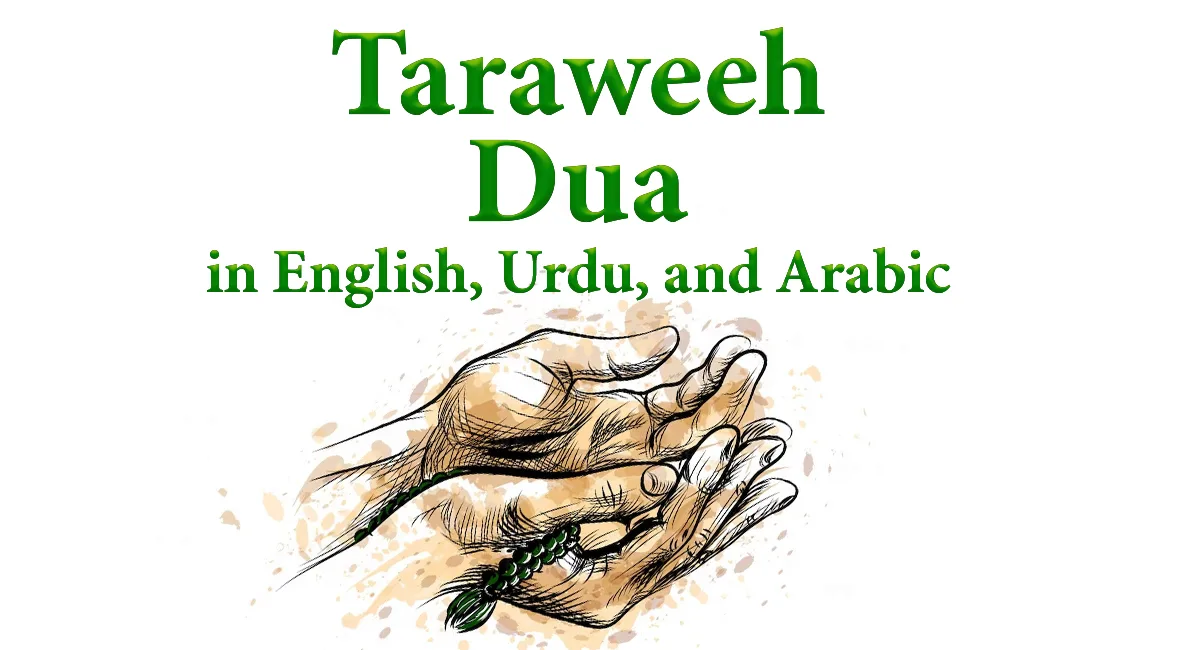
Taraweeh Dua in English, Urdu & Arabic (Full Text)
The Taraweeh dua is the supplication recited during the breaks in Taraweeh, the night prayer of Ramadan. It is recited after every four rak’ahs, while the congregation rests before the next set. This page gives the dua in Arabic, with a complete transliteration and English translation, and an Urdu translation as well. It also explains how many rak’ahs Taraweeh is, and how to pray it.
Key Points
- Taraweeh is the Ramadan night prayer; the dua is recited in the breaks after every four rak’ahs.
- The break dua is customary, not a prescribed Sunnah; no fixed dua is prescribed for the breaks.
- The Prophet (peace be upon him) prayed 8 rak’ahs + 3 Witr on Ramadan nights (Sahih al-Bukhari 2013).
- 20 rak’ahs is the established congregational practice from Umar’s (RA) time; mosques pray 8 or 20 — follow your mosque.
- Taraweeh is prayed two rak’ahs at a time, behind the imam, with Witr afterwards.
What Is Taraweeh?
Taraweeh is the night prayer of Ramadan. The word comes from “tarwihah”, meaning rest, because the congregation rests between sets of rak’ahs. Muslims gather in the mosque each evening in Ramadan to pray Taraweeh and listen to the Qur’an being recited. It is a Sunnah prayer, prayed after Isha, and it is one of the most valued acts of worship in the month. The prayer is offered in sets of two rak’ahs, and after every four rak’ahs there is a short break — and it is in that break that the Taraweeh dua is recited.
How Many Rak’ahs Is Taraweeh — 8 or 20?
The question of how many rak’ahs Taraweeh is causes more confusion than it should. The Prophet Muhammad (peace be upon him) prayed eight rak’ahs plus three of Witr on Ramadan nights, as Aisha (RA) reported in Sahih al-Bukhari 2013. That narration describes what the Prophet himself prayed; it does not fix Taraweeh at eight rak’ahs for everyone. In the time of Umar (RA), the congregational Taraweeh was established at twenty rak’ahs, a practice reported in Imam Malik’s al-Muwatta, and twenty became the established practice of the congregations.
Today, mosques pray either eight or twenty rak’ahs, and both have a basis. The right approach is to follow your local mosque and not to declare one number the only correct one. Taraweeh is prayed in sets of two rak’ahs, so the shortest possible Taraweeh is two rak’ahs, and the congregation completes its chosen number — eight or twenty — in those sets of two.
The Taraweeh Dua
After every four rak’ahs, the congregation pauses, and the supplication below is commonly recited. It is important to be honest about its status: this dua is a customary South Asian practice for the breaks between sets of four. No fixed dua is prescribed for the breaks in the Sunnah, and these words are not a hadith — they are not the wording of the Prophet (peace be upon him). Reciting them in the break is a custom, not an obligation, and a person who does not recite them has missed nothing from the prayer itself.
Arabic:
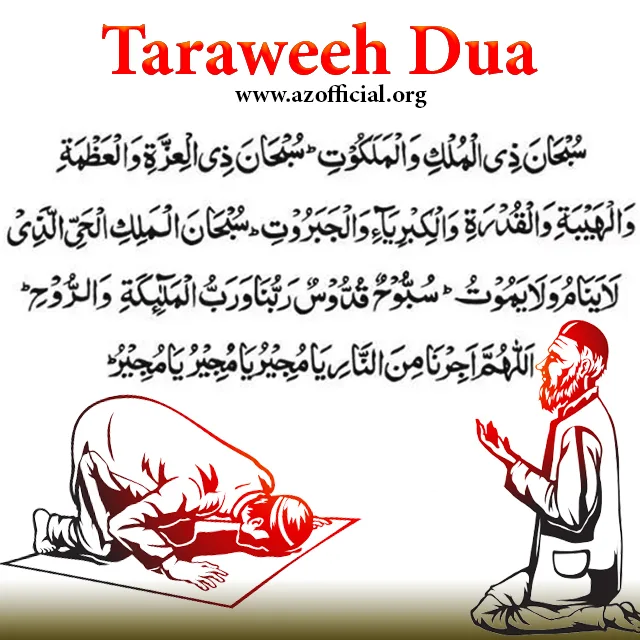
سُبْحَانَ ذِي الْمُلْكِ وَالْمَلَكُوتِ، سُبْحَانَ ذِي الْعِزَّةِ وَالْعَظَمَةِ وَالْهَيْبَةِ وَالْقُدْرَةِ وَالْكِبْرِيَاءِ وَالْجَبَرُوتِ، سُبْحَانَ الْمَلِكِ الْحَيِّ الَّذِي لَا يَنَامُ وَلَا يَمُوتُ، سُبُّوحٌ قُدُّوسٌ رَبُّنَا وَرَبُّ الْمَلَائِكَةِ وَالرُّوحِ، اللَّهُمَّ أَجِرْنَا مِنَ النَّارِ، يَا مُجِيرُ يَا مُجِيرُ يَا مُجِيرُ
Transliteration:
Subhaana dhil-mulki wal-malakoot, subhaana dhil-‘izzati wal-‘azhamati wal-haybati wal-qudrati wal-kibriyaa’i wal-jabaroot, subhaanal-malikil-hayyil-ladhee laa yanaamu wa laa yamoot, subboohun quddoosun rabbunaa wa rabbul-malaa’ikati war-rooh, allaahumma ajirnaa minan-naar, yaa mujeeru yaa mujeeru yaa mujeer.
Translation:
“Glory be to the Possessor of the kingdom and the unseen dominion. Glory be to the Possessor of might, greatness, awe, power, pride and overwhelming majesty. Glory be to the King, the Ever-Living, who neither sleeps nor dies. Most Glorious, Most Holy, our Lord and the Lord of the angels and the Spirit. O Allah, protect us from the Fire. O Protector, O Protector, O Protector.”
Taraweeh Dua in Urdu
پاک ہے (وہ اﷲ) زمین و آسمان کی بادشاہی والا۔ پاک ہے (وہ اﷲ) عزت و بزرگی، ہیبت و قدرت اور عظمت و رُعب والا۔ پاک ہے بادشاہ (حقیقی، جو) زندہ ہے، سوتا نہیں اور نہ مرے گا۔ بہت ہی پاک (اور) بہت ہی مقدس ہے ہمارا پروردگار اور فرشتوں اور روح کا پروردگار۔ اِلٰہی ہم کو دوزخ سے پناہ دے۔ اے پناہ دینے والے! اے پناہ دینے والے! اے پناہ دینے والے!
How to Pray Taraweeh
Taraweeh is offered as a normal congregational prayer. Make the intention for two rak’ahs, and follow the imam as you would in any other prayer. After every four rak’ahs, the congregation rests and the Taraweeh dua above is recited, along with salutations upon the Prophet. After the Taraweeh rak’ahs are complete — eight or twenty, as your mosque prays — three rak’ahs of Witr are offered in congregation. Some people prefer to pray Witr at home later in the night, and that is also fine.
- It is offered as a normal congregational prayer with the intention of 2 rak’ahs. Follow the imam as you follow him in other prayers.
- After 4 rak’ahs, the Taraweeh dua and salutations are recited.
- After the Taraweeh rak’ahs, three rak’ahs of Witr prayer are offered in congregation.
Frequently Asked Questions
What is the Taraweeh dua?
The Taraweeh dua is the supplication recited during the breaks in Taraweeh, after every four rak’ahs. It begins ‘Subhaana dhil-mulki wal-malakoot’ – ‘Glory be to the Possessor of the kingdom and the unseen dominion.’
When is the Taraweeh dua recited?
It is recited in the short break after every four rak’ahs of Taraweeh, while the congregation rests before the next set.
How many rak’ahs is Taraweeh – 8 or 20?
The Prophet (peace be upon him) prayed 8 rak’ahs plus 3 Witr on Ramadan nights (Sahih al-Bukhari 2013). The 20-rak’ah congregational practice was established in Umar’s (RA) time. Mosques today pray 8 or 20 – both have a basis, so follow your local mosque.
Is the Taraweeh dua from the Prophet (SAW)?
No. The ‘Subhana dhil-mulki…’ supplication is a customary practice for the breaks between sets of four rak’ahs. No fixed dua is prescribed for the breaks in the Sunnah, and these words are not a hadith.
Do I have to recite the Taraweeh dua?
No. It is a custom, not an obligation. A person who does not recite it during the break has missed nothing from the prayer itself.
What is recited after Taraweeh?
After Taraweeh, three rak’ahs of Witr are prayed in congregation. Some people pray Witr at home later in the night instead.
Read More: Dua for Getting to Ramadan
Tahajjud Prayer and Its Benefits & Significance
How Can We Prepare for Ramadan?
Ramadan Countdown
Benefits and Rewards of Laylat ul Qadr
Sources
Sources: Sahih al-Bukhari; Imam Malik, al-Muwatta