Anxiety Dua The Perfect Dua To Calm Your Mind
The best dua for anxiety is the Prophet’s dua for worry and grief: “O Allah, I seek refuge in You from worry and grief” (Sahih al-Bukhari 6369). Alongside it, the dua of Yunus (AS) from the Qur’an is one of the most loved supplications for times of distress. There is no single “perfect” dua that fixes anxiety. These are the best-known Prophetic supplications for worry and grief, and they are a source of comfort and help from Allah — not a cure, and not a replacement for professional help when anxiety is severe.
Key Points
- The Prophet’s dua for worry and grief is in Sahih al-Bukhari 6369.
- The dua of Yunus (AS) is in the Qur’an, 21:87.
- Dua is comfort and refuge, not a guaranteed cure for anxiety.
- Severe or persistent anxiety deserves professional help alongside dua.
What Is Anxiety?
Anxiety is worry or fear about what may happen, often with physical signs such as a racing heart, restlessness and poor sleep. Everyone feels anxious sometimes — before an exam, a difficult conversation or an uncertain result. It becomes a problem when it is severe, when it lasts a long time, or when it starts to affect daily life: work, study, sleep and relationships. That is the point at which dua should be joined by practical help, including a doctor or mental-health professional.
The Prophet’s Dua for Worry and Grief (Sahih al-Bukhari 6369)
Anas ibn Malik (RA) reported that the Prophet (SAW) used to say this dua very often. It asks Allah for refuge from the things that weigh on a worried heart:
Arabic:
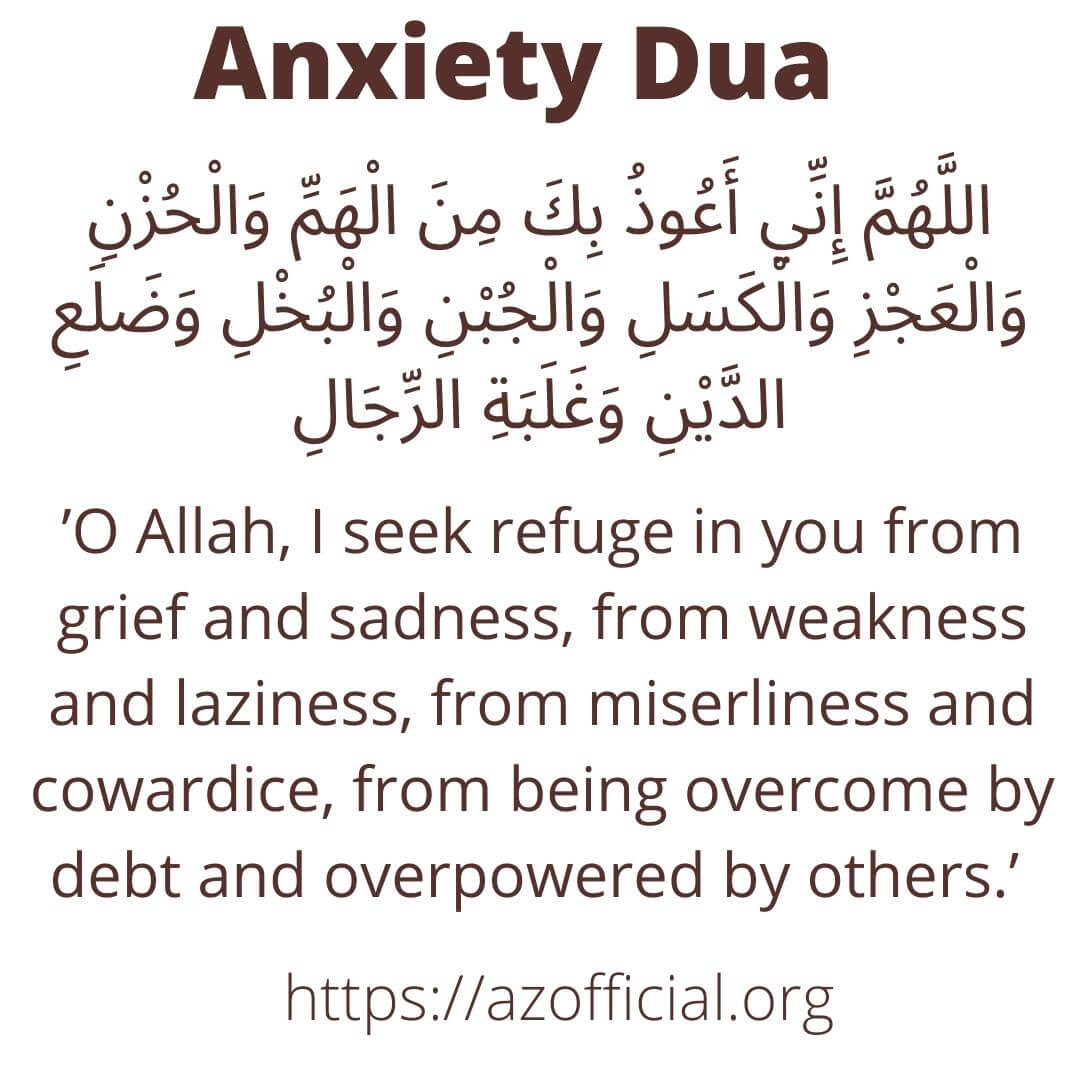
اللَّهُمَّ إِنِّي أَعُوذُ بِكَ مِنَ الْهَمِّ وَالْحَزَنِ، وَالْعَجْزِ وَالْكَسَلِ، وَالْبُخْلِ وَالْجُبْنِ، وَضَلَعِ الدَّيْنِ، وَغَلَبَةِ الرِّجَالِ
Transliteration: Allaahumma innee a’oodhu bika minal-hammi wal-hazan, wal-‘ajzi wal-kasal, wal-bukhli wal-jubn, wa dala’id-dayni wa ghalabatir-rijaal
Translation: “O Allah, I seek refuge in You from worry and grief, from incapacity and laziness, from miserliness and cowardice, from the burden of debt, and from being overpowered by people.”
Two words in this dua describe the two directions of worry. Hamm is worry about the future — what might happen. Hazan is grief about the past — what has already happened. The dua covers both, and it also covers the things that often follow worry: feeling unable to act, putting things off, and feeling overwhelmed by debt or by other people. Say it in the morning and evening, and whenever worry rises.
You may also come across a morning-and-evening version of this dua reported from Abu Umamah (Sunan Abi Dawud 1555). It is graded weak (da’if) by al-Albani and others, so it is not the basis for this guide; the dua above, from Sahih al-Bukhari, is the authentic one to rely on.
The Dua of Yunus (Qur’an 21:87)
When Yunus (AS) found himself in the darkness of the great fish, he called upon Allah with a short dua that combines three things: affirming Allah’s oneness, glorifying Him, and admitting one’s own wrongdoing:
Arabic:
لَا إِلَٰهَ إِلَّا أَنتَ سُبْحَانَكَ إِنِّي كُنتُ مِنَ الظَّالِمِينَ
Transliteration: Laa ilaaha illaa Anta subhaanaka innee kuntu minaz-zaalimeen
Translation: “There is no god but You, glory be to You; indeed, I was among the wrongdoers.”
Allah says in the next verse that He answered Yunus (AS) and saved him from his distress (Qur’an 21:88). Jami’ at-Tirmidhi 3505 reports the Prophet (SAW) saying that no Muslim supplicates with this dua but Allah answers him. That is a report of its virtue, and it should be presented as such — not turned into a guaranteed cure for anxiety. For a full guide to this supplication, see our post on Dua Yunus.
What Helps Alongside Dua
Dua is one part of dealing with anxiety, not the whole of it. These things help alongside it:
- Regular prayer. Keeping the five daily prayers gives the day structure and brings the heart back to Allah again and again.
- Qur’an recitation with understanding. Reading the Qur’an with its translation, even a little each day, brings comfort. It is not a treatment in itself, but it steadies the heart.
- Sleep and routine. Anxiety is worse when the body is exhausted. A regular sleep pattern and a simple daily routine help more than people expect.
- Talking to someone trusted. Speaking honestly to a family member, a friend or a counsellor can make a worry smaller. Keeping it inside makes it grow.
- Professional help when needed. If anxiety is severe or persistent, see a doctor or mental-health professional. The Prophet (SAW) encouraged seeking treatment: “Seek treatment, for Allah has not created a disease without creating its cure” (Sunan Abi Dawud). That is an encouragement to seek help, not a promise that any particular anxiety will go away.
If your anxiety is tied to exams or study, our guide to the dua for studying may also help, and our duas for depression, stress and difficulty cover related supplications.
A Kind Note About Professional Help
Dua supports wellbeing; it does not replace professional help. If anxiety is severe, persistent, or affects your daily life — your sleep, your work, your studies or your relationships — speak to a doctor or a mental-health professional. Asking for help is not a lack of faith. Dua and professional help go together, and both are means Allah has given us.
Frequently Asked Questions
What is the best dua for anxiety?
The best-known dua for anxiety is the Prophet’s dua for worry and grief: “O Allah, I seek refuge in You from worry and grief, from incapacity and laziness, from miserliness and cowardice, from the burden of debt, and from being overpowered by people” (Sahih al-Bukhari 6369). The dua of Yunus (Qur’an 21:87) is also widely recited in times of distress.
Can dua cure anxiety?
No. Dua brings comfort and help from Allah, but it is not a medical cure, and it does not guarantee that anxiety will go away. Dua is a source of refuge and strength. If anxiety is severe or persistent, it deserves professional help alongside dua.
When should I recite the dua for worry and grief?
You can recite it whenever worry comes, and regularly in the morning and evening. Anas ibn Malik (RA) reported that the Prophet (SAW) used to say it very often, so making it a daily habit is the best way to keep it close.
What is the dua of Yunus (AS)?
The dua of Yunus (AS) is: “Laa ilaaha illaa Anta subhaanaka innee kuntu minaz-zaalimeen” — “There is no god but You, glory be to You; indeed, I was among the wrongdoers” (Qur’an 21:87). Yunus (AS) called upon Allah with it from the darkness of the great fish, and Allah answered him and saved him from his distress (21:88).
Should I see a doctor for anxiety?
Yes, if anxiety is severe, persistent, or affects your daily life. Dua and professional help go together. The Prophet (SAW) encouraged seeking treatment, and speaking to a doctor or mental-health professional is a sensible and faithful step.
Sources: Sahih al-Bukhari; The Holy Qur’an (Surah al-Anbiya 21); Jami’ at-Tirmidhi; Sunan Abi Dawud