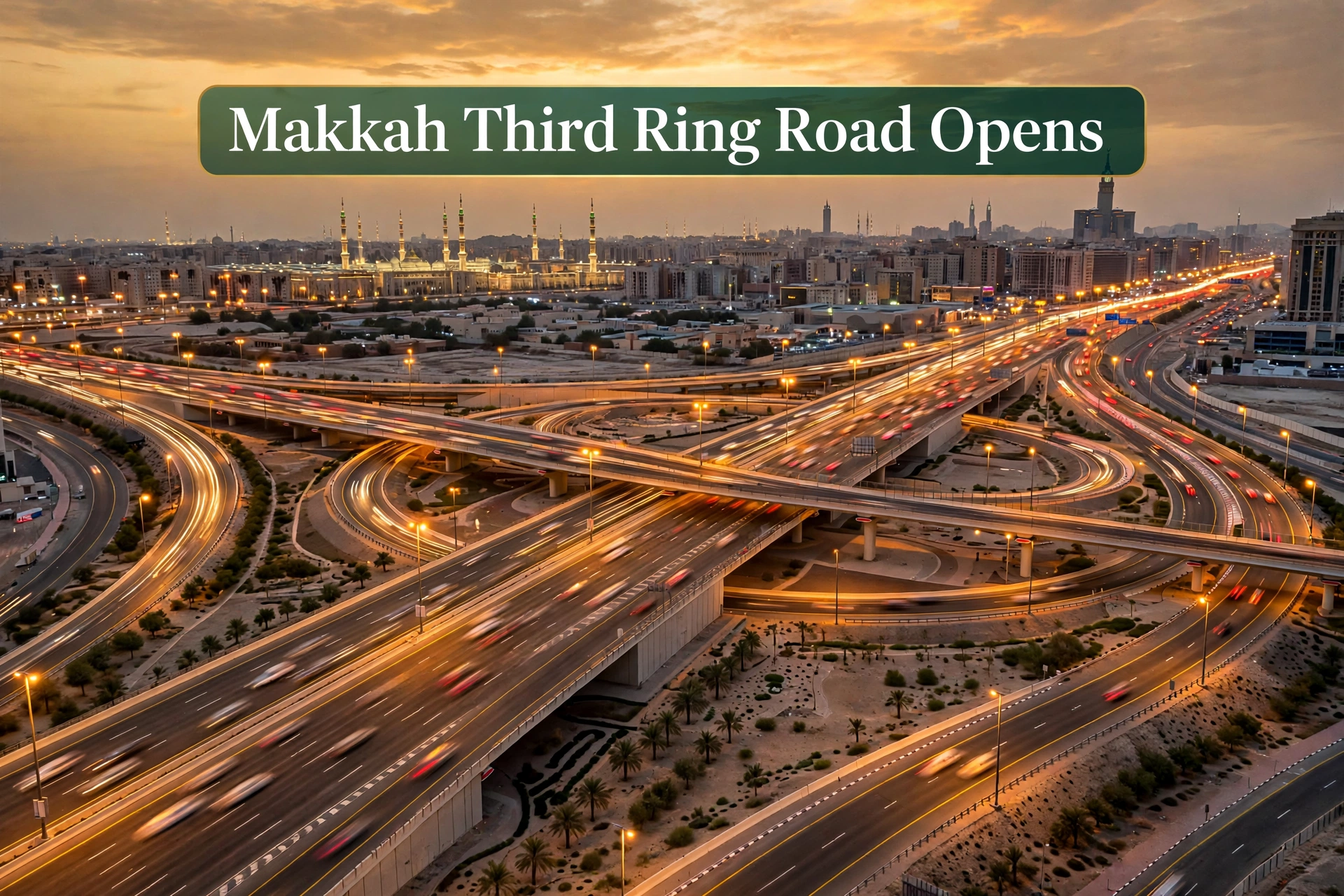
Makkah’s Third Ring Road Opens — and How to Use the Haramain Train
The Royal Commission for Makkah City and Holy Sites opened traffic on the western link of Makkah’s Third Ring Road on Monday, 27 October 2026. The new link cuts the route from the Prince Miteb intersection to the Grand Mosque from 16.5 km to 6.5 km, and the route to the Jamarat facility in Mina from 12 km to 4 km. The Commission estimates travel times on the affected routes are up to about 90% shorter. Below is what opened, what it changes, and a practical guide to the Haramain High Speed Railway, which connects Makkah and Madinah.
Key Points
- The western link of Makkah’s Third Ring Road opened to traffic on 27 October 2026, announced by the Royal Commission for Makkah City and Holy Sites.
- Prince Miteb intersection to the Grand Mosque: 16.5 km down to 6.5 km. Prince Miteb intersection to the Jamarat facility in Mina: 12 km down to 4 km.
- Travel times on the affected routes are up to about 90% shorter, according to the Commission’s estimate — no minute figures were published, so this article gives none.
- The road can carry up to 170,000 vehicles per day in both directions.
- The Haramain High Speed Railway remains the fastest way between Makkah and Madinah: about 450 km in about 2 hours 20 minutes. Book at the official portal sar.hhr.sa — fares vary by date and class, so check the live price before travel.
What Opened on 27 October 2026
The Royal Commission for Makkah City and Holy Sites announced the opening of traffic on the extension of the Third Ring Road completion project on Monday, 27 October 2026. It is the western link of the Third Ring Road, one of four ring roads around Makkah. The Commission’s project indicators, as reported by Saudi Gazette and Gulf News, are: the Prince Miteb (Mut’ab) intersection to the Grand Mosque falls from 16.5 km to 6.5 km; the Prince Miteb intersection to the Jamarat facility in Mina falls from 12 km to 4 km; and travel times on the affected routes are up to about 90% shorter. The road’s capacity is up to 170,000 vehicles per day in both directions.
The “up to about 90%” figure deserves care. It is the Commission’s estimate and it reflects congestion avoided, not only fewer kilometres — so it cannot be converted into a fixed number of minutes saved. No minute figures were published, and this article does not invent any.
Background: A Decade of Work
The Third Ring Road has been under construction for more than a decade; in 2019 about 14 km of it was reported complete. The October opening followed work a month earlier: on 26–27 September 2026 the Commission opened an extra 1.5 km of the same corridor — from the Prince Mutib intersection to the Grand Mosque via the Prince Sultan intersection — plus the remaining stretch of Prince Saud Al-Faisal Road. The Commission has not said whether further sections will open in 2026, nor the length or lane count of the new link, so this article states neither.
What the Road Does Not Change
Entry rules for Makkah, Umrah permits on the Nusuk app, and the restrictions on non-Muslims entering Makkah are not affected by the road opening. The new link changes how drivers reach the Grand Mosque and Mina; it changes nothing about who may enter or what permit is needed.
Haramain High Speed Railway: A Practical Guide
The Makkah station of the Haramain High Speed Railway sits on the Third Ring Road, so the road and the railway serve the same journey. The railway is the fastest way between Makkah and Madinah: about 450 km, at speeds of up to 300 km/h, in about 2 hours 20 minutes direct. It is owned by Saudi Arabia Railways (SAR) and operated by a Spanish-led consortium headed by Renfe. In 2025 the railway carried about 8.53 million passengers, averaging 96 trips a day, according to the Al Madinah Chamber’s economic bulletin as reported by the Saudi Press Agency.
The five stations, in order from Makkah to Madinah
- Makkah — Ar Rusayfah district, on the Third Ring Road, about 3.5 km from Masjid al-Haram; open 06:30–00:30; 4,750 parking spaces.
- Jeddah — Al Sulaymaniyah / An Nassim; open 07:30–23:30; 6,120 parking spaces.
- Jeddah Airport (KAIA) — inside Terminal 1; open 06:30–00:30.
- King Abdullah Economic City (KAEC) — Hejaz Gate, Rabigh; open 07:30–23:30.
- Madinah — Al Hadra district, about 9 km from the city centre and about 7 km from the Prophet’s Mosque; open 06:30–00:30; 1,000 parking spaces.
Station distances are given as reported: the Makkah station is about 3.5 km from the Haram, and the Madinah station about 9 km from the city centre (about 7 km from the Prophet’s Mosque). Plan a taxi or shuttle transfer at both ends.
Booking and fares
Book at the official portal sar.hhr.sa, or through the HHR app, Nusuk, the call centre, or station counters. There is no fixed timetable to memorise — the official site is a search tool by date, and services increase in busy periods (more than 140 trips a day ran in the last ten nights of Ramadan 2026). Fares vary by date and class, and published fares disagree between guides, so this article states no fixed fare: check the live price at sar.hhr.sa before travel.
Practical tips
Arrive 30–45 minutes early for security and boarding, and book early for Ramadan and Hajj, when trains sell out days ahead. Since 1 October 2026, Madinah Bus express route 300 links Madinah station directly with the central bus station near the Prophet’s Mosque; Makkah Bus (SR 4 flat fare) connects Makkah station to the Haram area.
What is changing: more trains are coming
In February 2026, Renfe’s operation-and-maintenance contract was extended by five years, to 2038, and Talgo was contracted to build 20 new trains (13 cars, more than 400 passengers each) to join the 35 already running since 2018. Saudi Arabia Railways says delivery begins in 2028 and completes by 2031, taking total fleet capacity to 30 million seats a year. Note the wording: the 2038 extension is the Renfe operation-and-maintenance contract; it is not a statement that all 55 trains are contracted to 2038.
Before You Travel: Check Current Travel Advice
Travel advice for Saudi Arabia changed during October 2026, so check your own government’s current guidance before booking. As of 8 November 2026, the UK Foreign, Commonwealth and Development Office advises against all but essential travel to most of Saudi Arabia, including Jeddah, and notes a heightened threat to airports; the US State Department lists the country at Level 3 (Reconsider Travel); and Australia’s Smartraveller service, updated on 4 November 2026, urges travellers to postpone all non-essential trips, including for religious purposes. Advice can change quickly, and travelling against official advice can affect travel insurance, so check the latest guidance and your insurance before you travel.
Frequently Asked Questions
When did Makkah’s Third Ring Road open?
Traffic opened on the western link of the Third Ring Road on Monday, 27 October 2026, as announced by the Royal Commission for Makkah City and Holy Sites.
How much time does the new road save?
The Commission estimates travel times on the affected routes are up to about 90% shorter. No minute figures were published, so no fixed time saving can be stated. The distance from the Prince Miteb intersection to the Grand Mosque fell from 16.5 km to 6.5 km, and to the Jamarat facility in Mina from 12 km to 4 km.
Does the new road change Umrah permits or entry rules for Makkah?
No. Entry rules for Makkah, Umrah permits on Nusuk, and the restrictions on non-Muslims entering Makkah are not affected by the road opening.
How long does the Haramain train take from Makkah to Madinah?
About 2 hours 20 minutes direct, over about 450 km, at speeds of up to 300 km/h. Book at the official portal sar.hhr.sa; fares vary by date and class, so check the live price.
How do I get from Makkah station to the Haram?
Makkah station is in the Ar Rusayfah district, about 3.5 km from Masjid al-Haram. Makkah Bus (SR 4 flat fare) connects the station to the Haram area, and taxis and shuttles run from the station.
Sources: Saudi Gazette; Gulf News; Arab News; Saudi Press Agency; Talgo; International Railway Journal; UK Foreign, Commonwealth and Development Office; Australia Smartraveller
Related reading: our full Hajj guide, the step-by-step Hajj rites, the travel dua for a safe journey, and the new religious-services system at the Two Holy Mosques.