Best Travel Dua – For a Safe Journey
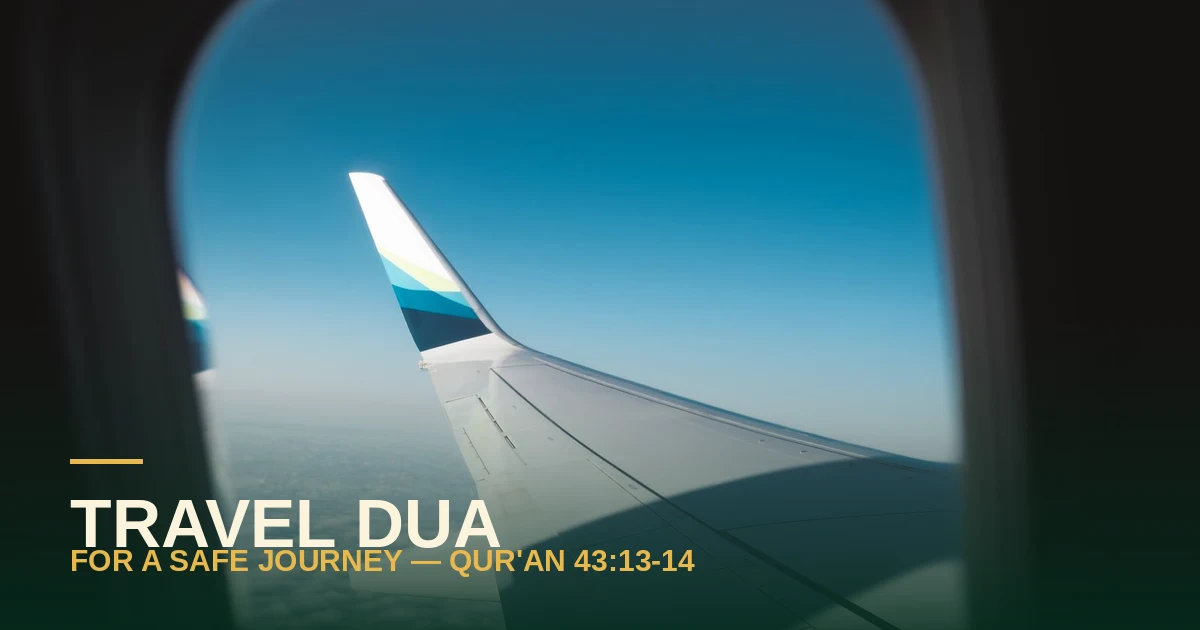
What is the best dua for a safe journey? It is the verse from Surah Az-Zukhruf: “Subhaanal-ladhii sakhkhara lanaa haadhaa wa maa kunnaa lahuu muqriniin, wa innaa ilaa rabbinaa lamunqalibuun” — “Exalted is He who has subjected this to us, and we could never have [done] it [by ourselves]. And indeed we, to our Lord, will [surely] return” (Qur’an 43:13-14), which the Prophet Muhammad (peace and blessings be upon him) recited whenever he set out on a journey. Alongside it, the dua for leaving home, the dua for a safe journey in Sahih Muslim, and the dua for returning home cover a journey from the front door to the return.
This guide gives all of them in Arabic with transliteration and English and Urdu translation.
Key Points
- The dua for travelling is from the Qur’an (43:13-14): Subhaanal-ladhii sakhkhara lanaa haadhaa wa maa kunnaa lahuu muqriniin, wa innaa ilaa rabbinaa lamunqalibuun (Jami’ at-Tirmidhi 3446)
- The dua when leaving home is: Bismillaahi tawakkaltu ‘alallaahi wa laa hawla wa laa quwwata illaa billaah (Sunan Abi Dawud 5095)
- The dua for a safe journey asks Allah to make the travel easy and to shorten its distance (Sahih Muslim 1342)
- The dua on returning home is: Aayiboona taa’iboona ‘aabidoona li-rabbinaa haamidoon (Sahih al-Bukhari 1797)
- The traveller’s supplication is one of three duas answered without doubt, along with the dua of the oppressed and a parent’s dua for a child (Jami’ at-Tirmidhi 3448)
- Travel with companions when you can — the Prophet (peace and blessings be upon him) advised against travelling alone at night (Sahih al-Bukhari 2998)
What Is the Dua for Travelling?
The main dua for travelling is the verse the Prophet (peace and blessings be upon him) recited whenever he mounted his camel to set out on a journey. It is from Surah Az-Zukhruf:
Arabic:
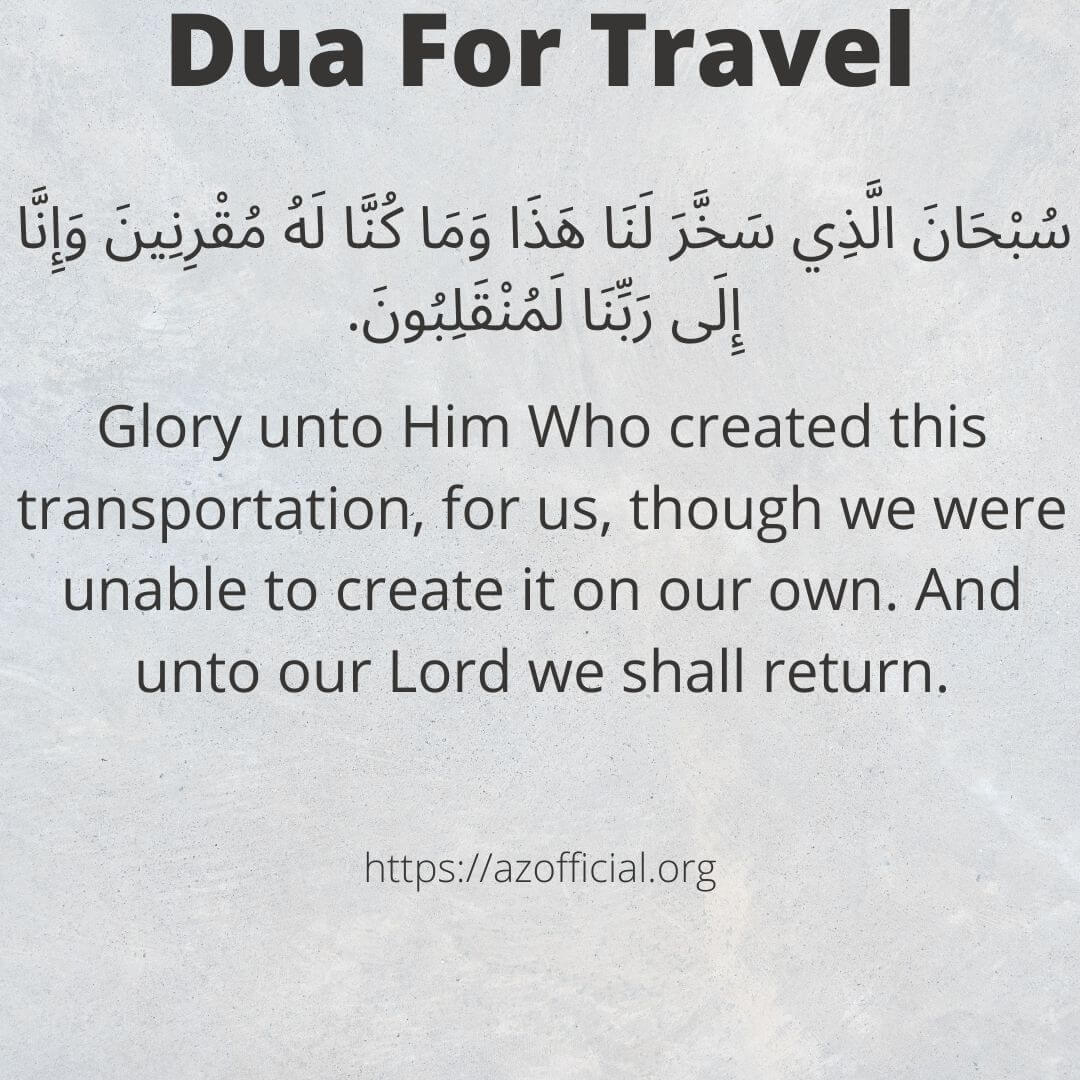
سُبْحَانَ الَّذِي سَخَّرَ لَنَا هَٰذَا وَمَا كُنَّا لَهُ مُقْرِنِينَ وَإِنَّا إِلَىٰ رَبِّنَا لَمُنقَلِبُونَ
Transliteration: Subhaanal-ladhee sakhkhara lanaa haadhaa wa maa kunnaa lahu muqrineen, wa innaa ilaa rabbinaa lamunqaliboon.
Translation: “Exalted is He who has subjected this to us, and we could never have [done] it [by ourselves]. And indeed we, to our Lord, will [surely] return.” (Saheeh International; Qur’an 43:13-14)
Urdu: پاک ہے وہ ذات جس نے اس (سواری) کو ہمارے قابو میں کر دیا، اور ہم اسے قابو میں لانے والے نہ تھے۔ اور بے شک ہم اپنے رب کی طرف لوٹنے والے ہیں۔
According to the narration in Jami’ at-Tirmidhi (3446), the Prophet (peace and blessings be upon him) would recite this verse when he mounted his camel, then say Alhamdulillah three times and Allahu Akbar three times, and then add:
Arabic:
سُبْحَانَكَ إِنِّي ظَلَمْتُ نَفْسِي فَاغْفِرْ لِي فَإِنَّهُ لَا يَغْفِرُ الذُّنُوبَ إِلَّا أَنْتَ
Transliteration: Subhaanaka innee zalamtu nafsee faghfir lee, fa-innahu laa yaghfirudh-dhunooba illaa ant.
Translation: “Glory be to You, I have wronged myself, so forgive me, for none forgives sins except You.” (Jami’ at-Tirmidhi 3446)
What Is the Dua When Leaving Home?
Before the journey even begins, there is a short dua for stepping out of the front door. The Prophet (peace and blessings be upon him) taught it as the way to place the whole trip in Allah’s care:
Arabic:
بِسْمِ اللَّهِ تَوَكَّلْتُ عَلَى اللَّهِ وَلَا حَوْلَ وَلَا قُوَّةَ إِلَّا بِاللَّهِ
Transliteration: Bismillaahi tawakkaltu ‘alallaahi wa laa hawla wa laa quwwata illaa billaah.
Translation: “In the name of Allah, I place my trust in Allah, and there is no might nor power except with Allah.” (Sunan Abi Dawud 5095; Jami’ at-Tirmidhi 3426)
Urdu: اللہ کے نام سے، میں اللہ پر بھروسہ کرتا ہوں، اور اللہ کے سوا نہ کوئی طاقت ہے نہ کوئی قوت۔
The narration in Sunan Abi Dawud (5095) adds that when a person says this dua on leaving home, it is said to him: “You are guided, sufficed and protected” — and the devil moves away from him. It is a short dua, but it covers the whole journey: guidance for the road, sufficiency for every need, and protection from harm.
What Dua Did the Prophet Recite for a Safe Journey?
When the Prophet (peace and blessings be upon him) set out on a journey, he would also ask Allah directly to make the travel easy. This dua is reported in Sahih Muslim (1342), and it is one supplication in two parts. The first part asks for the journey itself to be made easy:
Arabic:
اللَّهُمَّ هَوِّنْ عَلَيْنَا سَفَرَنَا هَذَا وَاطْوِ عَنَّا بُعْدَهُ
Transliteration: Allaahumma hawwin ‘alaynaa safaranaa haadhaa watwi ‘annaa bu’dah.
Translation: “O Allah, make this journey of ours easy for us and shorten its distance for us.” (Sahih Muslim 1342)
Urdu: اے اللہ! ہمارا یہ سفر ہمارے لیے آسان کر دے اور اس کی دوری کو ہمارے لیے سمیٹ دے۔
The same supplication goes on to ask Allah to be the traveller’s companion on the road and the guardian of the family left behind:
Arabic:
اللَّهُمَّ أَنْتَ الصَّاحِبُ فِي السَّفَرِ وَالْخَلِيفَةُ فِي الْأَهْلِ
Transliteration: Allaahumma antas-saahibu fis-safar, wal-khaliifatu fil-ahl.
Translation: “O Allah, You are the Companion in travel and the Guardian over the family.” (Sahih Muslim 1342)
Urdu: اے اللہ! تو سفر میں ساتھی ہے اور اہل و عیال کا نگہبان ہے۔
What Should You Say When You Return Home?
The journey is not complete until you are home. The Prophet (peace and blessings be upon him) would say this dua when returning from a journey, including after Hajj and Umrah:
Arabic:
آيِبُونَ تَائِبُونَ عَابِدُونَ لِرَبِّنَا حَامِدُونَ
Transliteration: Aayiboona taa’iboona ‘aabidoona li-rabbinaa haamidoon.
Translation: “We return, repenting, worshipping and praising our Lord.” (Sahih al-Bukhari 1797; Sahih Muslim 1344)
Urdu: ہم لوٹنے والے ہیں، توبہ کرنے والے ہیں، عبادت کرنے والے ہیں، اپنے رب کی حمد کرنے والے ہیں۔
Returning home is a blessing in itself, and the dua turns the homecoming into an act of worship. The Prophet (peace and blessings be upon him) would say these words when coming back from a journey, and the same words are said by pilgrims returning from Hajj — a reminder that every journey, long or short, ends with praise for the One who brought us back safely.
Why Is the Traveller’s Dua Special?
A journey is a time when dua is especially likely to be answered. The Prophet (peace and blessings be upon him) said: “Three supplications are answered without doubt: the supplication of the oppressed, the supplication of the traveller, and the supplication of a parent for his child.” (Jami’ at-Tirmidhi 3448, classed hasan)
That is why travellers are encouraged to use the quiet hours of a journey for dua — for themselves, for their families and for the people they are travelling to meet. Travel with companions when you can: the Prophet (peace and blessings be upon him) said, “If people knew what I know about travelling alone, no rider would travel alone at night.” (Sahih al-Bukhari 2998)
How Can You Use These Duas on Every Journey?
The duas are short, so the best way to learn them is to use them on your next journey — even a short one. A few practical steps help:
- Say the leaving-home dua at the door, before you pick up your bags.
- Recite the travel dua as soon as you board — car, bus, train or plane. The duas apply to travel by any means of transport.
- Use the journey for dua. The traveller’s supplication is answered, so remember your family, your parents and your own needs while you travel.
- Teach the duas to your children before a family trip, so they grow up saying them on every journey.
- If your journey includes an overnight stay, keep up the duas for sleeping and waking up as well — the same habit of beginning and ending each day with Allah’s name.
Four short duas cover a whole journey: the dua at the door, the verse of travel as you set out, the request for an easy journey on the road, and the words of praise on the way home. Learn them, say them on every journey — long or short — and use the quiet hours of travel for dua, because the traveller’s supplication is one of the three that are answered without doubt.
Frequently Asked Questions
What is the dua for travelling?
The dua for travelling is from the Qur’an (43:13-14): Subhaanal-ladhee sakhkhara lanaa haadhaa wa maa kunnaa lahu muqrineen, wa innaa ilaa rabbinaa lamunqaliboon — ‘Exalted is He who has subjected this to us, and we could never have [done] it [by ourselves]. And indeed we, to our Lord, will [surely] return.’ It is reported in Jami’ at-Tirmidhi (3446).
What dua should I read before leaving home?
Before leaving home, say: Bismillaahi tawakkaltu ‘alallaahi wa laa hawla wa laa quwwata illaa billaah — ‘In the name of Allah, I place my trust in Allah, and there is no might nor power except with Allah.’ It is reported in Sunan Abi Dawud (5095) and Jami’ at-Tirmidhi (3426).
Is there a dua for a safe journey by plane or car?
The same duas apply to travel by any means of transport. The Prophet (peace and blessings be upon him) taught these duas for travel in general, and scholars apply them to every kind of journey — by car, bus, train or plane, just as they were once said on a camel.
What should I say when I return from a journey?
When you return home, say: Aayiboona taa’iboona ‘aabidoona li-rabbinaa haamidoon — ‘We return, repenting, worshipping and praising our Lord.’ It is reported in Sahih al-Bukhari (1797) and Sahih Muslim (1344).
Is the traveller’s dua answered?
Yes. The Prophet (peace and blessings be upon him) said that three supplications are answered without doubt: the supplication of the oppressed, the supplication of the traveller, and the supplication of a parent for his child (Jami’ at-Tirmidhi 3448, classed hasan).
Can I recite the travel dua before a flight or a car journey?
Yes — the duas were taught for travel in general, and scholars apply them to every kind of journey: car, bus, train or plane, just as they were once said on a camel. Say the leaving-home dua at the door and the travel dua as soon as you board.
Sources: The Holy Qur’an; Jami’ at-Tirmidhi; Sunan Abi Dawud; Sahih al-Bukhari; Sahih Muslim.