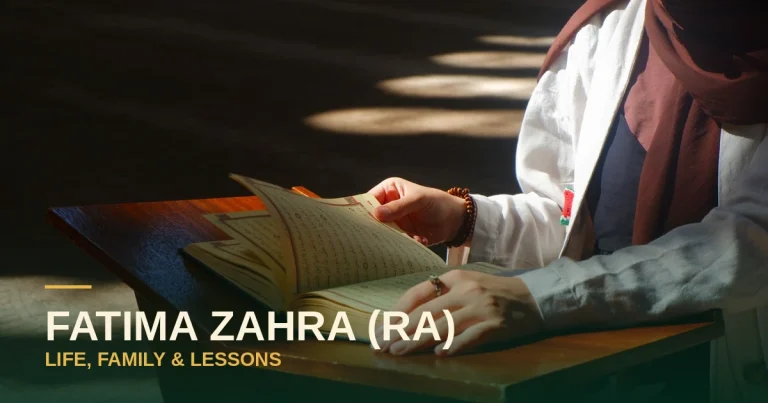
Fatima Zahra (RA): Special Qualities & Lessons
The Fatima Zahra qualities that made her an example for Muslim women are love for her father, generosity, courage, seeking help, and standing for justice. Fatima (RA), the youngest daughter of the Prophet (SAW) and Khadijah (RA), the wife of Ali (RA) and the mother of Hasan and Hussain (RA), lived a short life — she passed away about six months after her father, aged around 28–29 — but her character left a lasting example. This post looks at her five special qualities, with the authentic hadith and verses behind them. For her life story, see our post on the life of Fatima Zahra (RA).
Key Points
- Youngest daughter of the Prophet (SAW) and Khadijah (RA).
- Wife of Ali (RA), mother of Hasan and Hussain (RA).
- ‘Fatima is a part of me’ (Sahih al-Bukhari 3714).
- Known as Umm Abiha for caring for her father.
- Her qualities were love, generosity, courage, seeking help, and standing for justice.
Who Was Fatima Zahra (RA)?
Fatima (RA) was the daughter of the Prophet (SAW) and Khadijah (RA), the wife of Ali (RA), and the mother of Hasan and Hussain (RA). She was the youngest of the Prophet’s four daughters. She was known as Az-Zahra, ‘the radiant one’, and as Umm Abiha, ‘mother of her father’, for how she cared for him after Khadijah (RA) passed away. She passed away about six months after the Prophet (SAW), aged around 28–29. Her mother Khadijah (RA) is one of the wives of the Prophet (SAW). For the full story of her life, see our post on the life of Fatima Zahra (RA).
1. Love for Her Father
Fatima’s (RA) love for her father showed in how she cared for him. After Khadijah (RA) passed away, she looked after her father at home, and he called her Umm Abiha — ‘mother of her father’. When Aishah (RA) was asked who among people was most beloved to the Messenger of Allah (SAW), she answered: ‘Fatimah.’ (Jami’ at-Tirmidhi 3874)
The Prophet (SAW) himself said of her:
Arabic:
فَاطِمَةُ بَضْعَةٌ مِنِّي، فَمَنْ أَغْضَبَهَا أَغْضَبَنِي
Transliteration: Faatimatu bad’atun minnee, fa man aghdabahaa aghdabanee
Translation: “Fatima is a part of me; whoever angers her, angers me.” (Sahih al-Bukhari 3714)
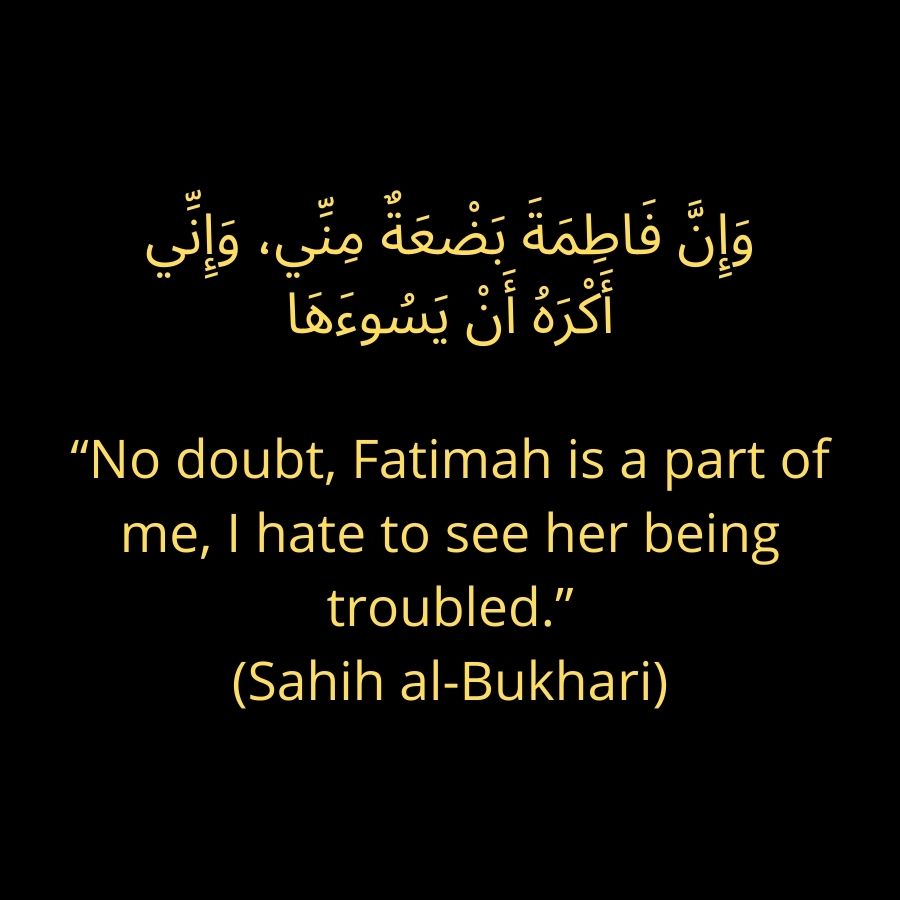
The card above gives a variant wording of the same narration. That love went both ways: the Prophet (SAW) would stand to greet her when she visited, kiss her, and seat her beside him. Her love for him was not only feeling — it was service, in the home and in the hard times.
2. Generosity
Fatima (RA) gave from what she loved, even when she had little. The Qur’an describes those who give food, in spite of love for it, to the needy, the orphan and the captive. A narration reported in the books on the reasons for revelation (asbab al-nuzul) connects these verses with a three-day fast observed by Ali (RA) and Fatima (RA) after Allah healed Hasan and Hussain (RA) of an illness, during which they gave their food away each night to a poor person, an orphan and a captive. This is a reported narration, not a settled historical fact, but it is the story the verses are associated with. The full two verses are:
Arabic:
وَيُطْعِمُونَ الطَّعَامَ عَلَىٰ حُبِّهِ مِسْكِينًا وَيَتِيمًا وَأَسِيرًا، إِنَّمَا نُطْعِمُكُمْ لِوَجْهِ اللَّهِ لَا نُرِيدُ مِنكُمْ جَزَاءً وَلَا شُكُورًا
Transliteration: Wa yut’imoonat-ta’aama ‘alaa hubbihi miskeenan wa yateeman wa aseeraa, innamaa nut’imukum liwajhillaahi laa nureedu minkum jazaa’an wa laa shukooraa
Translation: “And they give food, in spite of love for it, to the needy, the orphan, and the captive, [saying], ‘We feed you only for the sake of Allah. We wish not from you reward or gratitude.'” (Qur’an 76:8–9)
The same spirit showed when she married: she gave her bridal gown to a poor woman, in the spirit of the Qur’an’s teaching to spend from what you love. Generosity, for Fatima (RA), was a habit, not an occasion.
3. Courage
Fatima (RA) grew stronger through hardship. She was raised in poverty and faced difficulty throughout her life, but hardship did not weaken her — it made her braver.
When she was still a young girl, ‘Uqbah ibn Abi Mu’ayt threw camel intestines on the Prophet (SAW) while he prayed at the Ka’bah. Fatima (RA) came and removed them, standing by her father when others would have been ashamed to be seen with him. (Sahih al-Bukhari 240)
Her courage also showed when she spoke up. When Ali (RA) considered marrying the daughter of Abu Jahl, Fatima (RA) went to her father and told him her concerns, and the Prophet (SAW) addressed the matter in public, defending his daughter. The narration of that event is the same hadith quoted above (Sahih al-Bukhari 3714).
4. Seeking Help
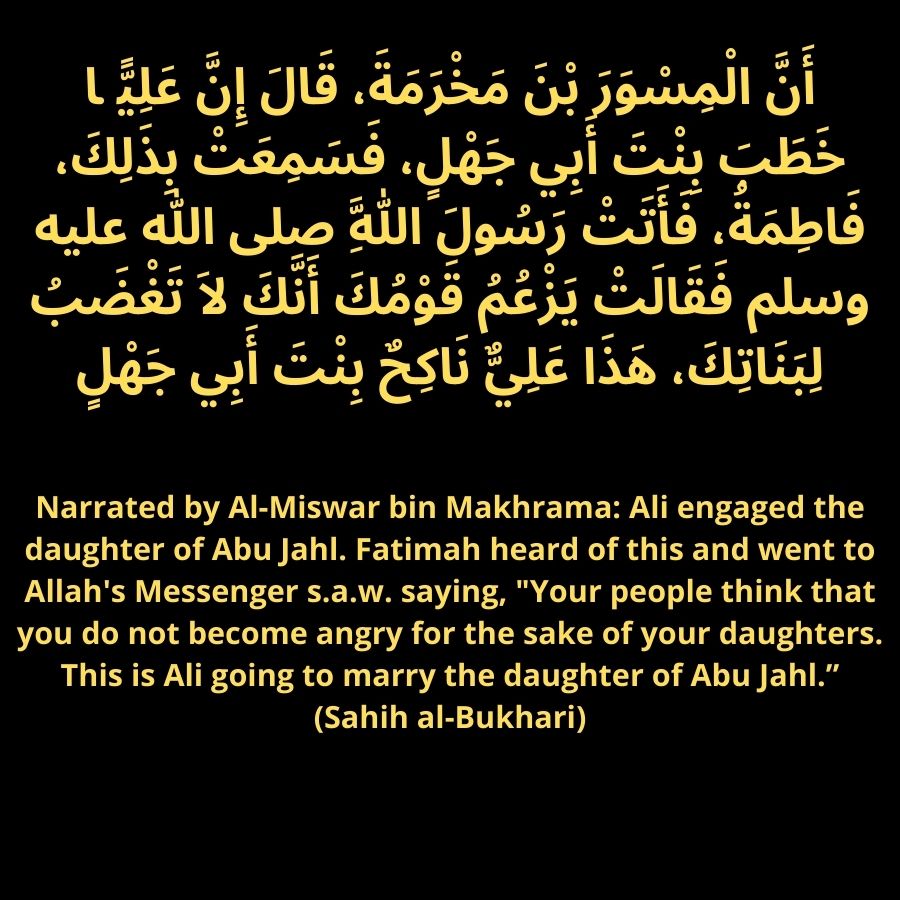
The card above gives the narration of that event, in which Fatima (RA) told the Prophet (SAW) about Ali’s (RA) plan. The Prophet’s (SAW) words in reply — ‘Fatima is a part of me’ — are quoted in the box above.
Fatima (RA) was not afraid to ask for help. When Ali (RA) considered the marriage, she went to her father and asked him to intervene — and he did. Ali (RA) decided not to go ahead with the marriage.
Many of us keep our problems to ourselves, thinking that asking for help is a sign of weakness. Fatima’s (RA) example shows the opposite: seeking help is human, and it takes courage to admit we need it. When you need help, ask Allah first, and ask the people who can help you. The dua for rizq is one way to ask Allah for what you need.
5. Standing for Justice
After the Prophet’s (SAW) passing, Fatima (RA) asked Abu Bakr (RA) for her share of the inheritance, including the land of Fadak. He declined, citing the Prophet’s (SAW) words: ‘We prophets do not leave inheritance; what we leave is charity.’ (Sahih al-Bukhari 3092)
Fatima (RA) stood up for what she believed was her right, and she did so calmly and with dignity. This is a sensitive historical matter, and Muslims have differed over it. What is clear is her example: to stand for justice, even when the outcome is not in your favour, and to do so without bitterness.
Standing for justice does not mean being harsh. It means speaking the truth, claiming your rights through the proper channels, and accepting the outcome with patience.
Fatima Zahra Qualities: Lessons for Today
These Fatima Zahra qualities are a guide for every Muslim, not only for women. Love your parents and serve them; give from what you love, even when you have little; be brave when others are silent; ask for help when you need it; and stand for justice with dignity. Regular reading of the Qur’an, such as Surah al-Kahf, helps keep these qualities alive. Her life was short, but her example endures.
Frequently Asked Questions
Who was Fatima Zahra (RA)?
Fatima (RA) was the youngest daughter of the Prophet (SAW) and Khadijah (RA), the wife of Ali (RA), and the mother of Hasan and Hussain (RA). She was known as Az-Zahra (‘the radiant one’) and as Umm Abiha (‘mother of her father’). She passed away about six months after the Prophet (SAW), aged around 28–29.
What are Fatima’s special qualities?
Her five special qualities are love for her father, generosity, courage, seeking help, and standing for justice. Each is covered in this post, with the hadith and verses behind it.
Why is Fatima called Umm Abiha?
Umm Abiha means ‘mother of her father’. She was given this title because, after her mother Khadijah (RA) passed away, she cared for her father as a mother would care for a child — looking after him at home and standing by him when he was attacked.
What did the Prophet (SAW) say about Fatima?
He said: ‘Fatima is a part of me; whoever angers her, angers me.’ (Sahih al-Bukhari 3714). When Aishah (RA) was asked who was most beloved to the Messenger of Allah (SAW), she answered: ‘Fatimah.’ (Jami’ at-Tirmidhi 3874)
What can Muslim women learn from Fatima?
To love and serve their parents, to give generously, to be brave, to ask for help when needed, and to stand for justice with dignity. Her example is for every Muslim, not only for women.
How is this post different from her life story?
This post is about her qualities — love, generosity, courage, seeking help, and standing for justice. For the story of her life, from her childhood to her marriage and her passing, see our post on the life of Fatima Zahra (RA).
Sources
Sources: Sahih al-Bukhari; Jami’ at-Tirmidhi; The Holy Qur’an (Surah al-Insan 76)