Masjid Al-Nimrah: The Mosque of the Farewell Sermon at Arafat
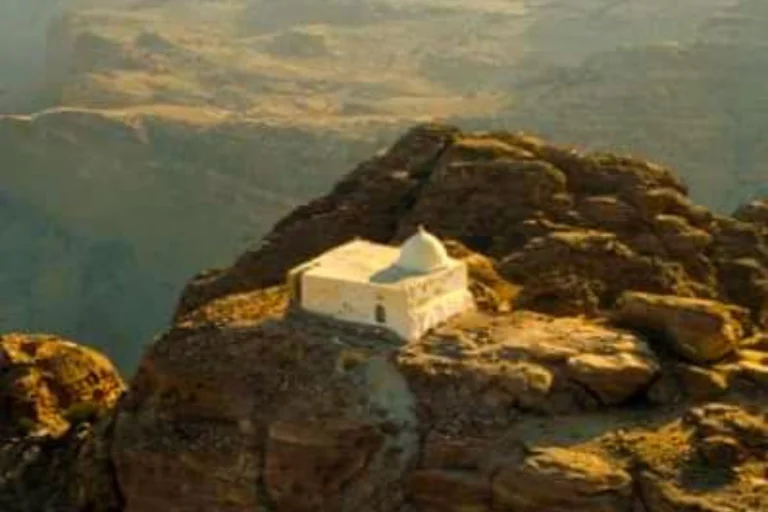
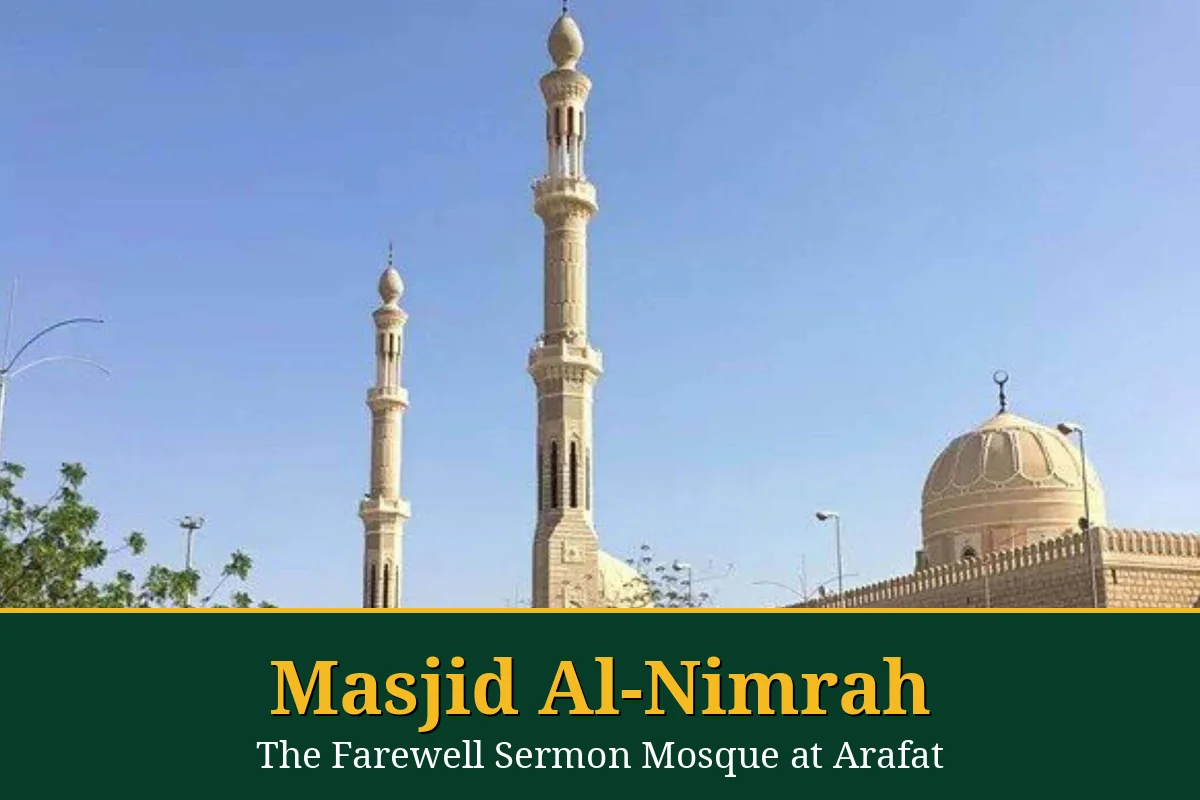
Masjid Al-Nimrah is the great mosque at the western edge of the plain of Arafat in Makkah, beside Wadi Uranah. It marks the place where the Prophet Muhammad (PBUH) stayed on the Day of Arafat during his Farewell Hajj in 10 AH, close to where he delivered the Farewell Sermon and led the combined Dhuhr and Asr prayers. Every year, the official sermon of the Day of Arafat is still delivered from this mosque, followed by the same combined prayers.
Key Points
- Masjid Al-Nimrah stands at the western edge of Arafat, next to Wadi Uranah, and takes its name from the nearby hill of Namirah.
- On 9 Dhul Hijjah 10 AH, the Prophet (PBUH) camped at Namirah, then delivered the Farewell Sermon in Wadi Uranah and prayed Dhuhr and Asr combined and shortened.
- The mosque was first built in the second century AH, in the Abbasid era, at the site of the sermon and prayer.
- Part of the mosque lies outside the boundary of Arafat, in Wadi Uranah; signboards inside mark where Arafat begins.
- On the Day of Arafat each year, the Hajj sermon is delivered from Masjid Al-Nimrah and broadcast around the world.
Where Is Masjid Al-Nimrah?
Masjid Al-Nimrah — also written Masjid Nimra or Masjid Namirah — stands in Wadi Uranah at the western edge of the plain of Arafat, east of Makkah. Historical sources say it took its name from a small mountain, or hill, called Namirah to its west. In older books it is also called Masjid Ibrahim al-Khalil.
Its exact position matters for Hajj: Wadi Uranah is not part of Arafat. The mosque sits right on this boundary line, which is why part of the building is inside Arafat and part of it is outside, as explained below.
What Happened Here on the Day of Arafat in 10 AH?
During the Farewell Hajj, the Prophet Muhammad (PBUH) arrived at Namirah on the 9th of Dhul Hijjah, 10 AH, and a tent was pitched for him there. When the sun had passed its zenith, he rode his she-camel al-Qaswa to the bottom of Wadi Uranah, where the companions had gathered around him. Seated on his camel, he addressed them with the sermon known as Khutbat al-Wida — the Farewell Sermon — before more than 100,000 companions, laying down lasting principles on the sanctity of life and property, justice, equality and the rights of women.
After the sermon, he led the Dhuhr and Asr prayers there, combined and shortened to two rak’ahs each, with one adhan and two iqamahs, as described in the long narration of Jabir ibn Abdullah (Sahih Muslim 1218). He then moved into the plain of Arafat itself and performed Wuquf — the standing at Arafat — until sunset.
The Verse Revealed on That Day
It was on this day, at Arafat, that Allah revealed the words of the Qur’an:
الْيَوْمَ أَكْمَلْتُ لَكُمْ دِينَكُمْ وَأَتْمَمْتُ عَلَيْكُمْ نِعْمَتِي وَرَضِيتُ لَكُمُ الْإِسْلَامَ دِينًا
Transliteration: Al-yawma akmaltu lakum deenakum wa atmamtu ‘alaykum ni’matee wa radeetu lakum-ul-Islaama deenaa.
Translation: “This day I have perfected for you your religion and completed My favour upon you and have approved for you Islam as religion.” (Qur’an 5:3)
Umar ibn al-Khattab (RA) narrated that this verse was revealed on a Friday, on the Day of Arafah, while the Prophet (PBUH) was standing at Arafat (Sahih al-Bukhari 45).
Why Part of the Mosque Is Outside Arafat
The Prophet (PBUH) said that all of Arafat is a place of standing, but pilgrims should rise up from Batn Uranah — the middle of the Uranah valley (Sahih Muslim 1218). Because the mosque was built at the valley’s edge and was expanded over the centuries, it now straddles the boundary: its front part, on the Makkah side, lies in Wadi Uranah outside Arafat, while its rear part lies within Arafat.
Signboards inside the mosque mark this boundary for pilgrims. Pilgrims who attend the sermon and the combined prayers in the mosque on the Day of Arafat then move into the part within Arafat — or elsewhere inside its boundaries — to perform Wuquf, the essential rite of the day.
When Was Masjid Al-Nimrah Built?
The mosque was first built in the middle of the second century AH, in the early Abbasid era, at the place where the Prophet (PBUH) had delivered the sermon and led the prayer. It was renovated and enlarged many times over the centuries, under the Abbasids, Mamluks and Ottomans, and most extensively in the Saudi era.
Today it is one of the largest mosques in the Makkah region, with halls and courtyards that hold hundreds of thousands of worshippers. For most of the year it is quiet; its great moment comes on a single day — the 9th of Dhul Hijjah.
Masjid Al-Nimrah on the Day of Arafat Today
Every Hajj, the pattern of the Farewell Hajj is followed at Masjid Al-Nimrah. The appointed imam delivers the Arafat sermon from the mosque’s minbar shortly after midday, and the sermon is translated and broadcast live to Muslims around the world. The combined and shortened Dhuhr and Asr prayers follow, with one adhan and two iqamahs, just as the Prophet (PBUH) prayed them at this site.
For pilgrims performing Hajj, hearing the sermon in this mosque and then spending the afternoon in Wuquf within Arafat is the heart of the Hajj day. Pilgrims can read our complete Hajj guide and our step-by-step guide to the 7 Hajj steps to prepare for the day.
Where is Masjid Al-Nimrah located?
Masjid Al-Nimrah stands in Wadi Uranah, at the western edge of the plain of Arafat, east of Makkah. It is named after the nearby hill of Namirah.
Did the Prophet Muhammad (PBUH) deliver the Farewell Sermon inside this mosque?
No mosque stood there at the time. On the Day of Arafat in 10 AH the Prophet (PBUH) camped at Namirah and delivered the Farewell Sermon seated on his camel at the bottom of Wadi Uranah, nearby. The mosque was built at the site later, in the second century AH.
Is Masjid Al-Nimrah inside Arafat?
Only partly. Its front part lies in Wadi Uranah, which is outside the boundary of Arafat, while its rear part lies inside Arafat. Signboards inside the mosque mark the boundary.
What happens at Masjid Al-Nimrah on the Day of Arafat?
The official Hajj sermon is delivered from its minbar shortly after midday, followed by the Dhuhr and Asr prayers combined and shortened, following the practice of the Prophet (PBUH) at this site.
Why is Masjid Al-Nimrah also called Masjid Nimra or Namirah?
Nimra, Namirah and Nimrah are different spellings of the same Arabic name, Masjid Namirah, taken from the hill of Namirah beside the mosque.
Sources: Sahih Muslim; Sahih al-Bukhari; Hajj and Umrah Planner; Islamweb