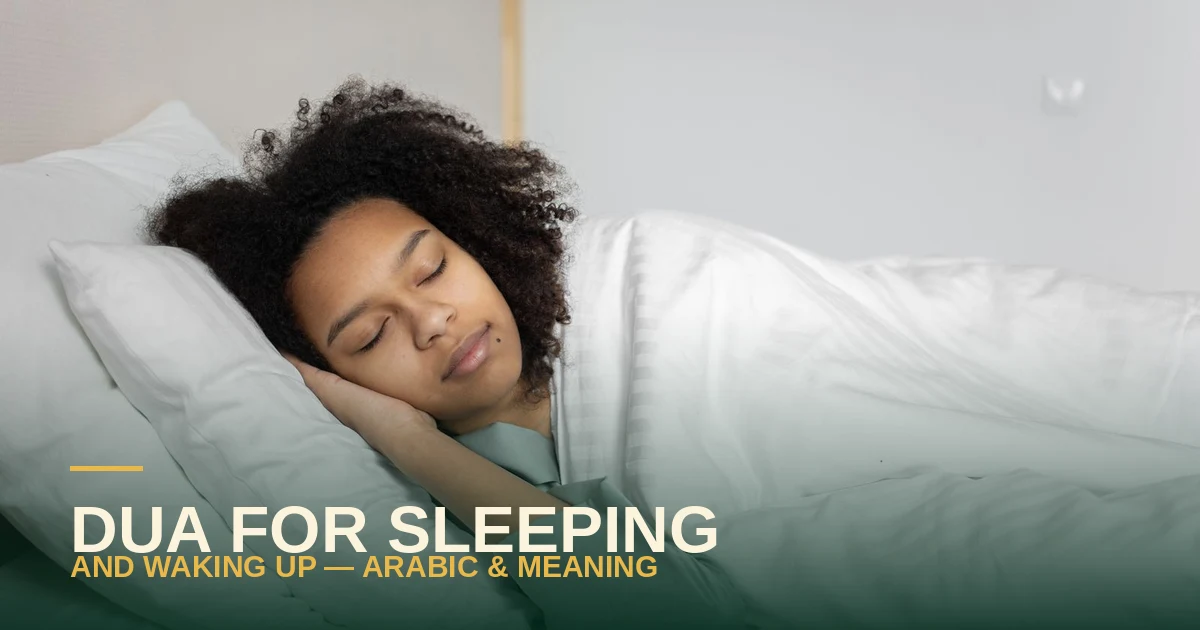
Dua For Sleeping And For Waking Up
What is the dua for sleeping? It is “Bismika Allaahumma amuutu wa ahyaa” — “In Your name, O Allah, I die and I live” (Sahih al-Bukhari 6324). And the dua on waking up is “Alhamdu lillaahil-ladhii ahyaanaa ba’da maa amaataanaa wa ilayhin-nushuur” — “All praise is for Allah, who gave us life after He caused us to die, and to Him is the resurrection” (Sahih al-Bukhari 6325). Sleep is one of the signs of Allah’s mercy: a short rest that restores the body and clears the mind.
This guide gives both duas in Arabic with transliteration and English and Urdu translation, together with the Sunnah habits that go with them.
Key Points
- Dua before sleeping: Bismika Allaahumma amuutu wa ahyaa — “In Your name, O Allah, I die and I live.” (Sahih al-Bukhari 6324)
- Dua on waking up: Alhamdu lillaahil-ladhii ahyaanaa ba’da maa amaataanaa wa ilayhin-nushuur — “All praise is for Allah, who gave us life after He caused us to die, and to Him is the resurrection.” (Sahih al-Bukhari 6325)
- Before sleeping, the Prophet (peace and blessings be upon him) would dust his bed, lie on his right side and place his hand under his cheek. (Sahih al-Bukhari 6320, 6311)
- Reciting Ayat al-Kursi at bedtime is described in a narration in Sahih al-Bukhari (2311) as a protection through the night.
- The last two verses of Surah Al-Baqarah are enough for the one who recites them at night (Sahih al-Bukhari 5009)
- Sleep is like a small death and waking is like a small resurrection — so the duas of the night and the morning both begin by remembering Allah.
What Is the Dua for Sleeping?
The dua taught by the Prophet (peace and blessings be upon him) for going to sleep is short and easy to memorise:
Arabic:
بِاسْمِكَ اللَّهُمَّ أَمُوتُ وَأَحْيَا
Transliteration: Bismika Allaahumma amootu wa ahyaa.
Translation: “In Your name, O Allah, I die and I live.” (Sahih al-Bukhari 6324)
Urdu: اے اللہ! تیرے نام سے میں مرتا ہوں اور تیرے نام سے ہی زندہ ہوتا ہوں۔
The words carry a deep meaning: sleep is a kind of death, because the sleeper loses awareness of the world, and waking is a return to life. Saying this dua is a way of placing the whole night in Allah’s hands.

What Is the Dua for Waking Up?
The dua on waking up is the first praise of the new day:
Arabic:
الْحَمْدُ لِلَّهِ الَّذِي أَحْيَانَا بَعْدَ مَا أَمَاتَنَا وَإِلَيْهِ النُّشُورُ
Transliteration: Alhamdu lillaahil-ladhee ahyaanaa ba’da maa amaatanaa wa ilayhin-nushoor.
Translation: “All praise is for Allah, who gave us life after He caused us to die, and to Him is the resurrection.” (Sahih al-Bukhari 6325)
Urdu: تمام تعریفیں اللہ کے لیے ہیں جس نے ہمیں موت کے بعد زندگی بخشی اور اسی کی طرف (سب کو) اٹھنا ہے۔
The Prophet (peace and blessings be upon him) would also rub the sleep from his face when he woke at night and recite the last verses of Surah Aal-e-Imran (Sahih al-Bukhari 183). The waking dua itself is a reminder that every morning is a gift: we were given life again after the sleep that resembled death, and one day we will all return to Allah.

What Sunnah Habits Go With the Sleeping Dua?
The duas are part of a small set of bedtime habits taught by the Prophet (peace and blessings be upon him). Together they turn an ordinary night into an act of worship:
- Dust the bed. “When one of you goes to his bed, let him dust it with the edge of his lower garment,” the Prophet (peace and blessings be upon him) said, “for he does not know what has come onto it after he left.” (Sahih al-Bukhari 6320)
- Lie on your right side. The Prophet (peace and blessings be upon him) would lie on his right side and place his right hand under his cheek when he went to sleep. (Sahih al-Bukhari 6311)
- Perform wudu before bed. “When you go to bed, perform ablution as you do for prayer,” the Prophet (peace and blessings be upon him) advised, then lie on your right side. (Sahih al-Bukhari 247)
- Recite Ayat al-Kursi. A narration in Sahih al-Bukhari (2311) describes reciting Ayat al-Kursi at bedtime as a protection that stays with the reciter until morning. (for the full verse, see our guide to Ayat al-Kursi)
- Recite the last two verses of Surah Al-Baqarah. “Whoever recites the last two verses of Surah Al-Baqarah at night, they will suffice him.” (Sahih al-Bukhari 5009)
- Recite the three Quls. The Prophet (peace and blessings be upon him) would recite Surah Al-Ikhlas, Surah Al-Falaq and Surah An-Nas into his cupped hands, blow into them and wipe over his body before sleeping. (Sahih al-Bukhari 5017)
There is also a longer bedtime dua, taught by the Prophet (peace and blessings be upon him) to Al-Bara’ ibn ‘Azib (may Allah be pleased with him):
Arabic:
اللَّهُمَّ أَسْلَمْتُ نَفْسِي إِلَيْكَ وَفَوَّضْتُ أَمْرِي إِلَيْكَ وَوَجَّهْتُ وَجْهِي إِلَيْكَ وَأَلْجَأْتُ ظَهْرِي إِلَيْكَ رَغْبَةً وَرَهْبَةً إِلَيْكَ لَا مَلْجَأَ وَلَا مَنْجَا مِنْكَ إِلَّا إِلَيْكَ آمَنْتُ بِكِتَابِكَ الَّذِي أَنْزَلْتَ وَبِنَبِيِّكَ الَّذِي أَرْسَلْتَ
Transliteration: Allaahumma aslamtu nafsee ilayk, wa fawwadtu amree ilayk, wa wajjahtu wajhee ilayk, wa alja’tu zahree ilayk, raghbatan wa rahbatan ilayk, laa malja’a wa laa manjaa minka illaa ilayk, aamantu bi-kitaabikalladhee anzalt, wa bi-nabiyyikalladhee arsalt.
Translation: “O Allah, I submit myself to You, entrust my affair to You, turn my face to You and lean my back on You, out of hope in You and fear of You. There is no refuge or escape from You except to You. I believe in Your Book which You revealed and in Your Prophet whom You sent.” (Sahih al-Bukhari 6313)
Urdu: اے اللہ! میں اپنی جان تیرے حوالے کرتا ہوں، اپنا معاملہ تیرے سپرد کرتا ہوں، اپنا چہرہ تیری طرف پھیرتا ہوں اور اپنی پیٹھ تیرے سہارے لگاتا ہوں، تیری رحمت کی امید اور تیرے عذاب کے خوف سے۔ تیرے سوا کوئی پناہ گاہ نہیں۔ میں تیری کتاب پر ایمان لایا جو تو نے نازل کی اور تیرے نبی پر جو تو نے بھیجا۔
How Can You Make These Duas a Daily Habit?
The duas are short, so the best way to learn them is to repeat them every night for a week until they come naturally. A few practical steps help:
- Recite the sleeping dua aloud for the first few nights, reading from this page or a card by the bed, until you know it by heart.
- Teach the duas to your children at bedtime — children learn them quickly when they hear them every night.
- Pair the dua with wudu and dusting the bed, so the whole routine becomes one habit rather than several separate ones.
- Read a portion of the Qur’an before sleep when you can. Many families read Surah Al-Kahf on Thursday night, and any short surah on other nights.
- Before sleeping, take a moment for your own duas in your own words — thanking Allah for the day, asking for protection through the night and for forgiveness for any shortcomings.
If you sometimes struggle to fall asleep, dhikr and dua are a calm way to spend those wakeful minutes rather than reaching for the phone. Reciting the sleeping dua, Ayat al-Kursi and the three Quls slowly, with their meanings in mind, settles the heart and prepares the body for rest.
Two short duas frame the night: one that places the whole night in Allah’s hands, and one that opens the new day with praise. Learn them, say them every night and every morning, and keep the small Sunnah habits that go with them — wudu, dusting the bed, lying on the right side, and the recitations before sleep. The night ends in Allah’s name, and the new day begins with praise.
Frequently Asked Questions
What is the dua before sleeping?
The dua before sleeping is: Bismika Allaahumma amuutu wa ahyaa — ‘In Your name, O Allah, I die and I live.’ It is reported in Sahih al-Bukhari (6324).
What is the dua after waking up?
The dua on waking up is: Alhamdu lillaahil-ladhii ahyaanaa ba’da maa amaataanaa wa ilayhin-nushuur — ‘All praise is for Allah, who gave us life after He caused us to die, and to Him is the resurrection.’ It is reported in Sahih al-Bukhari (6325).
What should I recite before sleeping?
Along with the sleeping dua, the Sunnah recitations before sleep include Ayat al-Kursi (Sahih al-Bukhari 2311), the last two verses of Surah Al-Baqarah (Sahih al-Bukhari 5009), and the three Quls — Surah Al-Ikhlas, Surah Al-Falaq and Surah An-Nas (Sahih al-Bukhari 5017).
Is it Sunnah to sleep on the right side?
Yes. The Prophet (peace and blessings be upon him) would lie on his right side and place his right hand under his cheek when he went to sleep (Sahih al-Bukhari 6311). Dusting the bed before lying down is also Sunnah (Sahih al-Bukhari 6320).
What if I forget the dua before sleeping?
The sleeping and waking duas are Sunnah, so forgetting them on a night does not harm your sleep or your worship. Recite the dua whenever you remember, even after lying down, and keep practising until it becomes a nightly habit.
Should I recite the longer bedtime dua of Al-Bara’ ibn ‘Azib?
Yes — it is the Prophet’s longer bedtime dua, Sahih al-Bukhari 6313; recite it after the short sleeping dua, and it is also the dua to say last before falling asleep.
Sources: Sahih al-Bukhari; Sahih Muslim.