Laylatul Qadr Dua: The Supplication Taught to Aisha (RA)
What Is the Laylatul Qadr Dua?
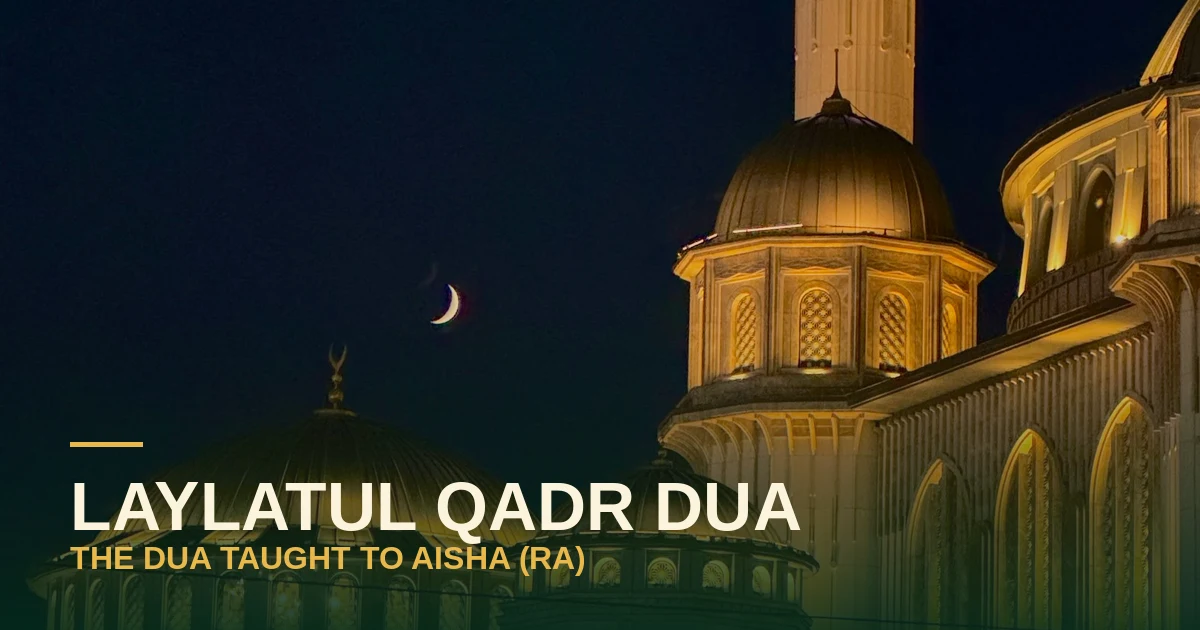
The Laylatul Qadr dua is the short supplication the Prophet Muhammad (SAW) taught his wife Aisha (RA) for the Night of Decree. It is one line: ‘Allahumma innaka ‘afuwwun tuhibbul-‘afwa fa’fu ‘anni’ — ‘O Allah, indeed You are Pardoning, You love pardon, so pardon me.’ Aisha (RA) asked the Prophet (SAW) directly what she should say if she knew which night was Laylatul Qadr, and this was his answer (Jami’ at-Tirmidhi 3513, graded Sahih). It is the only dua the Prophet (SAW) specifically prescribed for this night, which makes it the most important dua of the last ten nights of Ramadan. This guide gives the dua in Arabic with full transliteration and translation, explains what each word means, shows when and how to recite it, and explains what Laylatul Qadr itself is — so that when the night comes, you are ready for it.
Key Points
- The Laylatul Qadr dua is: “Allahumma innaka ‘afuwwun tuhibbul-‘afwa fa’fu ‘anni” — “O Allah, indeed You are Pardoning, You love pardon, so pardon me.”
- The Prophet (SAW) taught it to Aisha (RA) when she asked what to say if she knew when the Night of Qadr was (Jami’ at-Tirmidhi 3513, Sahih).
- Laylatul Qadr is better than a thousand months (Qur’an 97:3) — the night the Quran was sent down.
- Seek it in the odd nights of the last ten nights of Ramadan (Sahih al-Bukhari 2017) — the 21st, 23rd, 25th, 27th and 29th nights.
- In 2027 the last ten nights are expected around 27 February to 8 March (moon-sighting dependent); the 27th night is expected around 5–6 March.
- The dua asks for pardon (‘afw), not just forgiveness — ‘afw means Allah erases the sin entirely, as if it never happened.
What Is Laylatul Qadr?
Laylatul Qadr — the Night of Decree, or the Night of Power — is the night in Ramadan when the Quran was first sent down. Allah describes it in a short surah of five verses, Surah Al-Qadr:
Arabic:
إِنَّا أَنْزَلْنَاهُ فِي لَيْلَةِ الْقَدْرِ، وَمَا أَدْرَاكَ مَا لَيْلَةُ الْقَدْرِ، لَيْلَةُ الْقَدْرِ خَيْرٌ مِنْ أَلْفِ شَهْرٍ، تَنَزَّلُ الْمَلَائِكَةُ وَالرُّوحُ فِيهَا بِإِذْنِ رَبِّهِمْ مِنْ كُلِّ أَمْرٍ، سَلَامٌ هِيَ حَتَّىٰ مَطْلَعِ الْفَجْرِ
Transliteration: Innaa anzalnaahu fee laylatil-qadr. Wa maa adraaka maa laylatul-qadr. Laylatul-qadri khayrun min alfi shahr. Tanazzalul-malaa-ikatu war-roohu feehaa bi-idhni Rabbihim min kulli amr. Salaamun hiya hattaa matla’il-fajr.
Translation: Indeed, We sent the Qur’an down during the Night of Decree. And what can make you know what is the Night of Decree? The Night of Decree is better than a thousand months. The angels and the Spirit descend therein by permission of their Lord for every matter. Peace it is until the emergence of dawn. (Qur’an 97:1–5, Saheeh International.)
A thousand months is more than 83 years — longer than most human lives. The verse does not say the night is EQUAL to a thousand months; it says it is BETTER. Worship on this one night carries more reward than worship across an entire lifetime of ordinary nights. That is why the Prophet (SAW) spent the last ten nights of Ramadan in extra worship, and why Muslims search for this night every year. It is hidden within the last ten nights on purpose: the search itself is part of the worship.
The Dua in Arabic, Transliteration and Translation
When Aisha (RA) asked what to say on this night, the Prophet (SAW) did not give her a long supplication. He gave her one sentence, and its words are worth learning exactly:
Arabic:
اللَّهُمَّ إِنَّكَ عَفُوٌّ تُحِبُّ الْعَفْوَ فَاعْفُ عَنِّي
Transliteration: Allaahumma innaka ‘afuwwun tuhibbul-‘afwa fa’fu ‘annee.
Translation: O Allah, indeed You are Pardoning, You love pardon, so pardon me. (Jami’ at-Tirmidhi 3513, graded Sahih by Darussalam.)
One small note on the wording: some narrations of this hadith include an extra word, ‘Karim’ (Generous), making it ‘Allahumma innaka ‘afuwwun karimun tuhibbul-‘afwa fa’fu ‘anni’ — ‘O Allah, indeed You are Pardoning, Generous, You love pardon, so pardon me.’ That wording appears in brackets in the Tirmidhi text on Sunnah.com. Both wordings are used by Muslims, and both are fine to recite. The version without ‘Karim’ is the one most commonly taught, and it is the one given above.
What Does ‘Afuww’ Mean — and Why Ask for Pardon, Not Just Forgiveness?
The heart of this dua is the name of Allah it uses: Al-‘Afuww, the Pardoning. Arabic has two words that are often both translated as ‘forgiveness’, and the difference between them is the reason this dua is so powerful. Maghfirah (forgiveness) means Allah covers a sin and does not punish for it — the sin is forgiven, but its record remains. ‘Afw (pardon) goes further: it means Allah erases the sin completely, as if it never happened, so that on the Day of Judgement there is nothing to be shown at all. That is why the dua says ‘You love pardon’ — Allah loves to erase sins entirely, not merely to overlook them. When Aisha (RA) asked what to say on the greatest night of the year, the Prophet (SAW) taught her to ask for the greatest thing: complete erasure. The dua also teaches a way of asking: begin with Allah’s name and attribute, then state what He loves, then make the request. ‘You are Pardoning, You love pardon — so pardon me.’ It is a short lesson in how to make dua, as well as a dua in itself.
When Should You Recite the Laylatul Qadr Dua?
Recite it during the last ten nights of Ramadan, especially on the odd nights. The Prophet (SAW) said: ‘Search for the Night of Qadr in the odd nights of the last ten days of Ramadan.’ (Sahih al-Bukhari 2017.)
Arabic:
تَحَرَّوْا لَيْلَةَ الْقَدْرِ فِي الْوِتْرِ مِنَ الْعَشْرِ الْأَوَاخِرِ مِنْ رَمَضَانَ
Transliteration: Taharraw laylatal-qadri fil-witri minal-‘ashril-awaakhiri min Ramadaan.
Translation: Search for the Night of Qadr in the odd nights of the last ten days of Ramadan. (Sahih al-Bukhari 2017.)
The odd nights are the 21st, 23rd, 25th, 27th and 29th nights of Ramadan. The 27th night is the one most scholars point to as the most likely, and many Muslims concentrate their worship on it — but it is not certain, and the Prophet (SAW) did not fix the night to one date. The safe way is to worship on all five odd nights, and to recite this dua on each of them, along with the other nights of the last ten. There is no fixed number of repetitions for the dua: recite it as often as you wish during the night, in your prayers, in sujood, and after your prayers. In 2027, the last ten nights of Ramadan are expected around 27 February to 8 March, with the 27th night expected around 5–6 March — all dates are expected and moon-sighting dependent, never certain in advance. Check your local mosque’s announcement for the exact nights.
How to Spend the Night of Qadr
The dua is the centrepiece, but the night itself is for worship of every kind. Pray Taraweeh and extra voluntary prayers. Recite the Quran, especially Surah Al-Qadr itself. Make long, personal duas — for yourself, your parents, your family, and the whole Ummah — in any language. Ask for pardon with the dua above, and then ask for whatever else you need. Give charity during the last ten nights, since charity given on Laylatul Qadr carries the reward of a thousand months of charity. And remember that the night begins at sunset and ends at Fajr — ‘Peace it is until the emergence of dawn’ (Qur’an 97:5). The best plan is simple: do not leave the night to chance. Decide in advance which nights you will stay up, what you will pray, and what you will ask for. If you cannot stay up the whole night, even a part of it — a few rakahs, the dua, and a sincere request for pardon — is worth more than an ordinary night of sleep. For the full guide to the night’s virtues, see our post on the benefits and rewards of Laylatul Qadr, and for the fast itself, our Ramadan Countdown, sehri dua and iftar dua guides will help you prepare.
What Are Common Mistakes to Avoid?
First, do not treat the 27th night as certain. Many people worship only on the 27th and sleep through the other odd nights — but the Prophet (SAW) told us to search all of them, and scholars differ on which night it is. Second, do not fix a number of repetitions for the dua. No narration says to recite it 100 times or any other count; recite it with a present heart, as often as you wish. Third, do not add the word ‘Karim’ and then claim the other wording is wrong, or the reverse — both wordings are transmitted, and both are acceptable. Fourth, do not spend the night in idle talk, shopping, or social media and then recite the dua once at the end. The night is for worship, and the dua belongs inside that worship, not instead of it. Finally, do not lose hope if you feel you have not worshipped enough. The dua itself is a request for pardon, and Allah loves to pardon — that is the whole point of the night.
Frequently Asked Questions
What is the dua for Laylatul Qadr?
‘Allahumma innaka ‘afuwwun tuhibbul-‘afwa fa’fu ‘anni’ — ‘O Allah, indeed You are Pardoning, You love pardon, so pardon me.’ The Prophet (SAW) taught it to Aisha (RA) (Jami’ at-Tirmidhi 3513, Sahih).
When is Laylatul Qadr in 2027?
It falls in the last ten nights of Ramadan, expected around 27 February to 8 March 2027, most likely on one of the odd nights. The 27th night is expected around 5–6 March. All dates are expected and moon-sighting dependent.
Is Laylatul Qadr definitely the 27th night?
No. The 27th night is the most likely according to many scholars, but it is not certain. The Prophet (SAW) said to search for it in the odd nights of the last ten days (Sahih al-Bukhari 2017), so worship on all five odd nights.
How many times should I recite the Laylatul Qadr dua?
There is no fixed number in any narration. Recite it as often as you wish during the last ten nights, in prayer, in sujood, and after prayer.
What is the difference between ‘afuww’ and forgiveness?
Maghfirah (forgiveness) means Allah covers a sin and does not punish for it. ‘Afw (pardon) means Allah erases the sin completely, as if it never happened. This dua asks for ‘afw — complete erasure.
Can I recite the dua with the word ‘Karim’ added?
Yes. Some narrations include ‘Karim’ (Generous): ‘Allahumma innaka ‘afuwwun karimun tuhibbul-‘afwa fa’fu ‘anni’ — shown in brackets in the Tirmidhi text on Sunnah.com. Both wordings are acceptable.
Sources and References
Sources: The Holy Qur’an; Jami’ at-Tirmidhi; Sahih al-Bukhari