Dua for Pain in Islam: Authentic Dua for Relief and Healing
Pain is a part of life, and Islam teaches Muslims to turn to Allah during times of difficulty while also taking appropriate steps to seek treatment.
If you are looking for a dua for pain, the Prophet Muhammad ﷺ taught a specific supplication for a person experiencing pain in a particular part of the body.
This dua is reported in Sahih Muslim and can be recited while placing the hand on the painful area.
What Is the Authentic Dua for Pain?
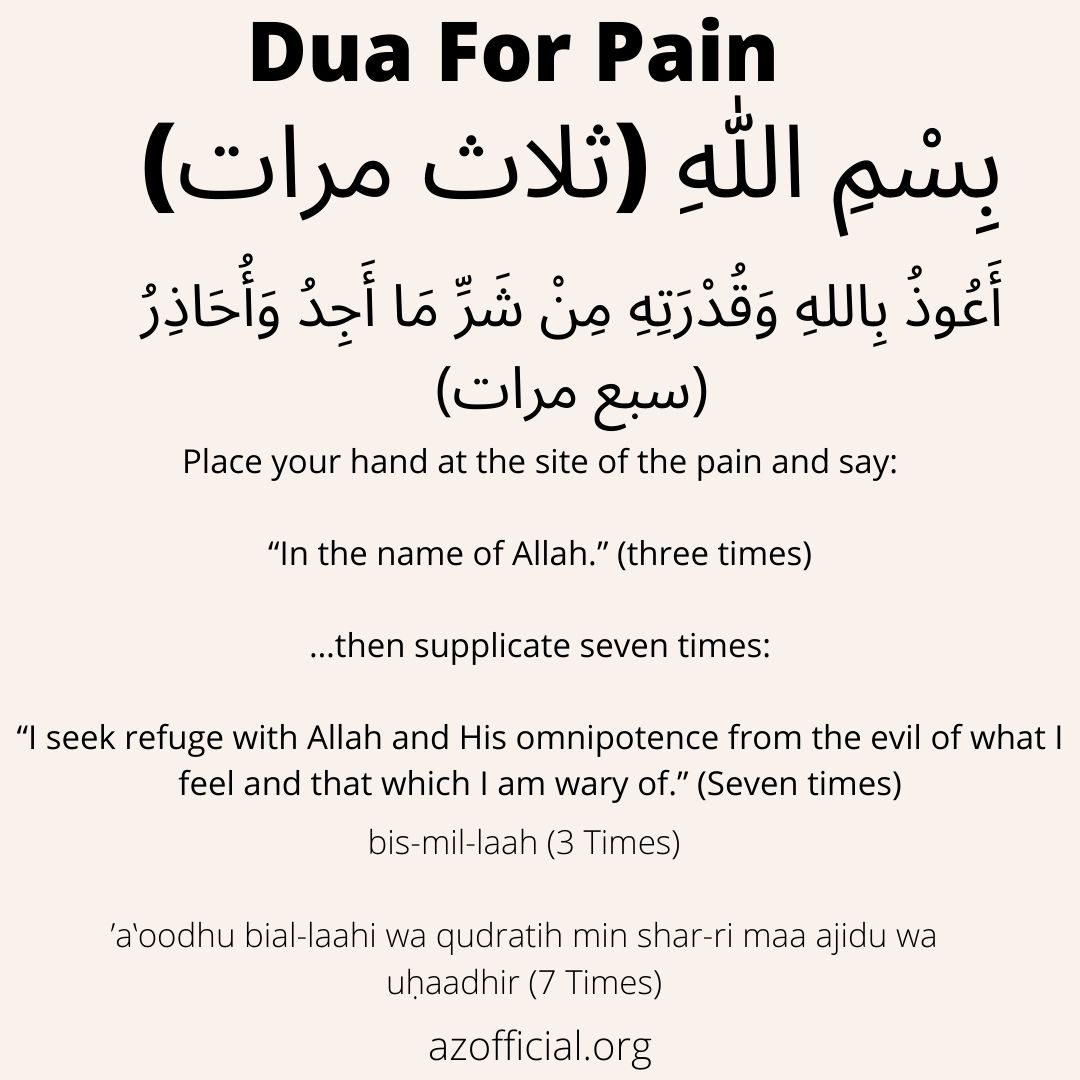
The Prophet Muhammad ﷺ taught a companion who complained of pain to place his hand on the painful area and say:
بِسْمِ اللَّهِ
Bismillah
Then say:
أَعُوذُ بِعِزَّةِ اللَّهِ وَقُدْرَتِهِ مِنْ شَرِّ مَا أَجِدُ وَأُحَاذِرُ
Transliteration
A’udhu bi’izzatillahi wa qudratihi min sharri ma ajidu wa uhadhiru.
English Meaning
“I seek refuge in the might of Allah and His power from the evil of what I find and what I fear.”
The Prophet ﷺ instructed him to say “Bismillah” seven times, followed by the supplication seven times.
Reference: Sahih Muslim 2202
This is one of the strongest authentic duas specifically reported for pain and discomfort.
How to Read the Dua for Pain
The method reported in the hadith is simple:
Step 1: Place Your Hand on the Painful Area
Place your hand on the part of your body where you are experiencing pain.
Step 2: Say “Bismillah” Seven Times
Recite:
بِسْمِ اللَّهِ
Bismillah
seven times.
Step 3: Recite the Dua Seven Times
Then recite:
أَعُوذُ بِعِزَّةِ اللَّهِ وَقُدْرَتِهِ مِنْ شَرِّ مَا أَجِدُ وَأُحَاذِرُ
seven times.
This method is based directly on the narration recorded in Sahih Muslim 2202.
Dua for Pain in Any Part of the Body
The hadith describes a person experiencing pain in his body, and the Prophet ﷺ taught him this method.
Therefore, Muslims can use this Sunnah supplication when experiencing pain such as:
- Headache
- Back pain
- Muscle pain
- Joint pain
- Leg pain
- Arm or hand pain
- Stomach discomfort
- Other physical pain
However, the hadith does not say that this dua is a guaranteed cure for every specific disease or type of pain.
The dua is a means of seeking Allah’s help and protection, while medical treatment should also be sought when necessary.
Dua for Severe Pain and Difficulty
When pain becomes severe, a Muslim can make this authentic dua while continuing to ask Allah for healing and relief.
The Qur’an teaches:
“And when I am ill, it is He who cures me.”
Qur’an 26:80
Read Qur’an 26:80 on Quran.com
This verse reminds Muslims that although doctors, medicines and treatments may be means of recovery, ultimate healing comes from Allah.
Dua for Healing From Illness
Another authentic supplication taught by the Prophet ﷺ is:
اللَّهُمَّ رَبَّ النَّاسِ، أَذْهِبِ الْبَاسَ، اشْفِ أَنْتَ الشَّافِي، لَا شِفَاءَ إِلَّا شِفَاؤُكَ، شِفَاءً لَا يُغَادِرُ سَقَمًا
Transliteration
Allahumma Rabban-nas, adhhib al-ba’s, ishfi antash-Shafi, la shifa’a illa shifa’uka, shifa’an la yughadiru saqaman.
English Meaning
“O Allah, Lord of mankind, remove the harm and cure the sick. You are the One who cures. There is no cure except Your cure, a cure that leaves no illness behind.”
Sahih al-Bukhari 5675; Sahih Muslim 2191
This is a beautiful general dua for healing and can be recited for someone who is sick or experiencing physical suffering.
Dua for Someone Who Is Sick
The Prophet ﷺ also taught a supplication that can be made when visiting a sick person:
أَسْأَلُ اللَّهَ الْعَظِيمَ رَبَّ الْعَرْشِ الْعَظِيمِ أَنْ يَشْفِيَكَ
Transliteration
As’alullaha al-‘Azima Rabbal-‘Arshil-‘Azimi an yashfiyaka.
English Meaning
“I ask Allah, the Mighty, Lord of the Mighty Throne, to cure you.”
This supplication is reported in Sunan Abi Dawud 3106 and Jami` at-Tirmidhi 2083.
Read the narration on Sunnah.com
It is commonly recited for someone who is ill.
Dua for Pain in the Head
There is no need to claim that Islam provides a separate authentic dua specifically called “dua for headache.”
The general Sunnah dua for pain can be used when experiencing a headache:
Bismillah — seven times.
Then:
A’udhu bi’izzatillahi wa qudratihi min sharri ma ajidu wa uhadhiru.
— seven times.
This follows the general instruction reported in Sahih Muslim 2202.
If a headache is severe, persistent, unusual or accompanied by other concerning symptoms, appropriate medical care should also be sought.
Dua for Back Pain
The authentic dua for pain can also be recited when experiencing back pain.
Place your hand over the painful area and follow the method reported in Sahih Muslim 2202.
At the same time, persistent back pain should not automatically be treated as something that can be resolved through dua alone. Medical evaluation may be important, particularly when pain is severe or ongoing.
Dua for Stomach Pain
A Muslim can make the Sunnah dua for pain when experiencing stomach discomfort.
However, there is no authentic basis for claiming that this particular dua specifically cures every stomach condition.
Dua should be combined with appropriate medical care when needed.
Dua for Joint and Muscle Pain
The same authentic dua can be recited for joint or muscle pain.
Islam encourages Muslims to ask Allah for help while taking lawful means to protect and restore their health.
The Prophet ﷺ said:
“Seek treatment, O slaves of Allah, for Allah has not made a disease without appointing a cure for it.”
Sunan Abi Dawud 3855
This hadith demonstrates that seeking medical treatment is consistent with reliance upon Allah.
Can You Make Dua for Pain in Your Own Words?
Yes.
A Muslim can ask Allah for relief, healing and strength in their own language and words.
For example:
“O Allah, relieve my pain, grant me healing, give me patience, and make this hardship a means of goodness and forgiveness for me. Ameen.”
This is a personal dua, not a quotation from the Prophet ﷺ.
It is important not to present personal wording as a hadith or Sunnah supplication.
Does Pain Remove Sins in Islam?
Trials and suffering can be a means through which Allah removes sins from a believer.
The Prophet ﷺ said:
“No fatigue, nor disease, nor sorrow, nor harm, nor distress befalls a Muslim, even if it were the prick he receives from a thorn, but that Allah expiates some of his sins for that.”
Sahih al-Bukhari 5641; Sahih Muslim 2573
This gives Muslims hope when facing illness or pain.
However, this does not mean that a Muslim should refuse medical treatment. Patience, dua and seeking treatment can all exist together.
Dua and Medical Treatment in Islam
Islam encourages Muslims to place their trust in Allah while also taking appropriate lawful means.
A person experiencing pain can:
- Make dua for healing.
- Recite authentic supplications from the Sunnah.
- Pray to Allah for strength and relief.
- Seek appropriate medical advice.
- Take prescribed or recommended treatment.
- Remain patient during hardship.
- Avoid claiming that a specific dua guarantees a particular medical outcome.
Dua is an act of worship and a means of turning to Allah. It should not be presented as a replacement for necessary medical care.
Can You Recite Surah Al-Fatihah for Healing?
Yes. Surah Al-Fatihah is established in authentic hadith as a form of ruqyah.
A companion recited Al-Fatihah over a person who had been bitten or stung, and the Prophet ﷺ approved of what he had done.
The Prophet ﷺ said:
“How did you know that it was a Ruqya?”
Sahih al-Bukhari 5736
This provides evidence for using Qur’anic recitation as ruqyah.
However, Muslims should avoid making unsupported claims that Surah Al-Fatihah is a guaranteed cure for a particular disease or type of pain.
Dua for Pain Before Sleeping
A Muslim experiencing pain at night can make the authentic dua for pain and ask Allah for relief.
There are also various authentic supplications for protection and remembrance before sleeping.
If pain regularly prevents sleep, however, it is important to consider its underlying medical cause rather than relying only on spiritual practices.
When Should You Make Dua for Pain?
You can make dua whenever you experience pain or difficulty.
You can also make dua:
- During Salah
- In sujood
- During the night
- When feeling physically unwell
- When visiting a sick person
- When asking Allah for healing
There is no requirement to wait for a particular time before making a personal dua for relief.
You can also explore more Islamic duas for different situations in our duas collection.
Frequently Asked Questions
What is the authentic dua for pain?
The authentic dua specifically reported for bodily pain is:
Bismillah seven times, followed by:
A’udhu bi’izzatillahi wa qudratihi min sharri ma ajidu wa uhadhiru.
This is reported in Sahih Muslim 2202.
What is the dua for pain in the body?
Place your hand over the painful area, say Bismillah seven times, then recite the Sunnah supplication seven times.
What is the dua for immediate pain relief?
Islam teaches Muslims to seek Allah’s help through dua, but there is no authentic hadith guaranteeing that a particular dua will provide instant relief every time. The Sunnah dua for pain is an established supplication for seeking protection and relief.
Can I make dua for pain in English?
Yes. You can make a personal dua in English or another language. When quoting a specific Prophetic dua, however, it should be identified as the reported wording rather than personal wording.
What Surah is good for pain and healing?
Surah Al-Fatihah is established as a form of ruqyah in authentic hadith. Other Qur’anic passages may also be recited as part of ruqyah, but specific claims about curing particular diseases should have reliable evidence.
Does Islam say pain removes sins?
Yes. Authentic hadith explains that illness, pain, distress and other difficulties can be a means of expiation for a Muslim’s sins.
Should I seek medical treatment while making dua?
Yes. Seeking medical treatment does not contradict tawakkul. Muslims can make dua while also taking appropriate medical means.
Final Thoughts
When experiencing pain, Muslims can turn to Allah through dua, salah, dhikr and patience, while also seeking appropriate medical treatment.
The most directly relevant authentic dua for pain is the supplication taught by Prophet Muhammad ﷺ in Sahih Muslim 2202:
Bismillah — seven times.
Then:
A’udhu bi’izzatillahi wa qudratihi min sharri ma ajidu wa uhadhiru.
— seven times.
Allah is the ultimate source of healing, and Muslims are encouraged to combine tawakkul (reliance upon Allah) with appropriate lawful means.
May Allah relieve the pain of everyone who is suffering, grant them complete healing, patience and strength, and make their difficulties a source of reward and forgiveness. Ameen.
Sources and References
- Sahih Muslim 2202 — Dua for pain
- Sahih al-Bukhari 5675 — Dua for healing
- Sahih Muslim 2191 — Dua for healing
- Sahih al-Bukhari 5641 — Illness and expiation of sins
- Sahih al-Bukhari 5736 — Al-Fatihah as ruqyah
- Sunan Abi Dawud 3855 — Seeking medical treatment
- Qur’an 26:80 — Allah as the Healer