10 Things Every Muslim Needs To Know About The Battle Of Karbala
The Battle of Karbala took place on 10 Muharram 61 AH (10 October 680 CE) at Karbala, in present-day Iraq, where Imam Hussain ibn Ali (RA), the grandson of Prophet Muhammad (peace be upon him), stood with 72 companions against the army of Yazid ibn Muawiya and was martyred. Every Muslim, regardless of school of thought, can draw lessons from Karbala — about truth, courage, sacrifice and standing firm when the odds are impossible. Here are the 10 things every Muslim needs to know about the Battle of Karbala.
Karbala is not only a historical event. It is the moment that defined what it means to stand for truth in Islam. The battle lasted a single day, but the questions it raised — what do you do when the ruler is corrupt, when your family is threatened, when survival means surrender — have not gone away in thirteen centuries. That is why Karbala is remembered every year in Muharram, and why its lessons are taught to children who were not yet born when it happened.
1. When and Where Did the Battle of Karbala Take Place?
The Battle of Karbala took place on 10 Muharram 61 AH, which corresponds to 10 October 680 CE, at Karbala — a desert plain in present-day Iraq, near the Euphrates River. The day, 10 Muharram, is known as Ashura, and it is now commemorated every year by Muslims around the world. The place matters: Karbala was not a city and not a fortress. It was open desert, far from help, and the caravan that stopped there had nowhere to retreat to.
2. Who Was Imam Hussain (RA)?
Imam Hussain ibn Ali (RA) was the grandson of the Prophet Muhammad (peace be upon him), the son of Ali ibn Abi Talib (RA) and Fatima (RA). The Prophet loved him deeply, and the hadith about him is well known:
Arabic:
حُسَيْنٌ مِنِّي وَأَنَا مِنْ حُسَيْنٍ، أَحَبَّ اللَّهُ مَنْ أَحَبَّ حُسَيْنًا
Transliteration: Husaynun minnee wa anaa min Husayn, ahabballaahu man ahabba Husaynaa.
Translation: “Husayn is from me and I am from Husayn. Allah loves whoever loves Husayn.” (Jami’ at-Tirmidhi 3775, graded hasan by al-Albani)
Hussain was not a rebel seeking power. He was the grandson of the Prophet, and the people of Kufa had written to him by the thousand, asking him to come and lead them. He went because he believed the community needed a leader who would not betray its values. When he found that Kufa had abandoned him, he still refused to surrender to Yazid.
3. Why Did Imam Hussain Refuse to Pledge Allegiance to Yazid?
Imam Hussain refused to pledge allegiance to Yazid ibn Muawiya because of his corruption and unjust rule. Yazid had taken power after his father Muawiya, and his rule was marked by open violation of Islamic values — drinking, cruelty and the use of power for personal pleasure. For Hussain, pledging allegiance to such a ruler would have meant endorsing that corruption as the leadership of Islam itself.
His refusal was not for power or personal gain. He had no army and no realistic hope of winning. It was a refusal on principle: some things cannot be accepted, even when refusal costs everything. That is the line Karbala draws, and it is the reason the event is remembered as a stand for truth rather than as a political dispute.
4. Who Stood With Imam Hussain at Karbala?
Only 72 loyal supporters stood with Imam Hussain, including his family and companions. His sons Ali Akbar and the infant Ali Asghar were there. His half-brother Abbas ibn Ali (RA) was there as the flag-bearer. His nephews Qasim and Abdullah ibn Hasan were there. And his companions — the elderly Habib ibn Muzahir, Hurr ibn Yazid who had changed sides that very morning, Zuhayr ibn Qayn, Burayr ibn Khudayr and the rest — were there.
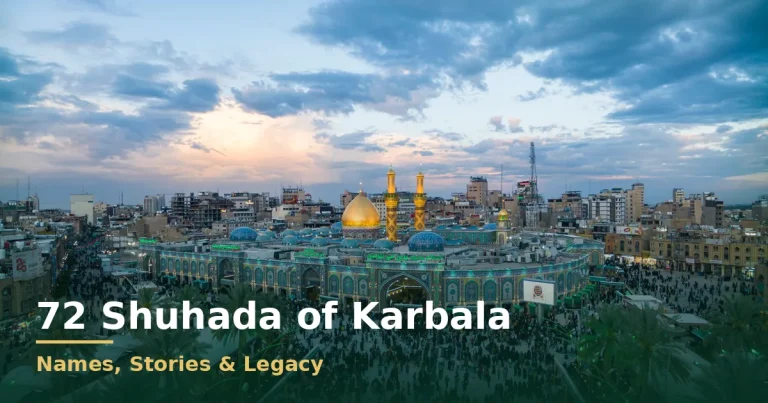
The caravan also included women and children. After the martyrdom of the men, the women and children were taken as prisoners by Yazid’s army and marched to Kufa and Damascus. For the full list of names, see our guide to the 72 Shuhada of Karbala.
5. Why Was Water Blocked for Three Days?
Yazid’s army blocked access to the Euphrates River for three days before the battle. The caravan — men, women and children — had no water in the desert heat. The suffering reached its peak when Ali Asghar, the six-month-old infant son of Imam Hussain, was killed in his father’s arms while his father pleaded for water for him.
The blocking of water was not a military necessity. It was a deliberate cruelty, and it is remembered as one of the worst parts of the tragedy. Abbas ibn Ali (RA) is honoured above all for trying to break through to the river to bring water back for the children — and for being martyred in that attempt. The thirst of Karbala is why water is offered freely at Muharram gatherings to this day.
6. What Happened on the Day of Ashura?
On the morning of 10 Muharram, Imam Hussain addressed his companions and released them from their allegiance: anyone who wished to leave could go, and no blame would follow. Not one of them left. The fighting began, and one by one the companions were martyred — then the family, then Imam Hussain himself.
The Qur’an’s words about martyrs are read at every Karbala remembrance:
Arabic:
وَلَا تَحْسَبَنَّ الَّذِينَ قُتِلُوا فِي سَبِيلِ اللَّهِ أَمْوَاتًا ۚ بَلْ أَحْيَاءٌ عِندَ رَبِّهِمْ يُرْزَقُونَ
Transliteration: Wa laa tahsabannal-ladheena qutiloo fee sabeelillaahi amwaataa, bal ahyaa’un ‘inda Rabbihim yurzaqoon.
Translation: “And never think of those who have been killed in the cause of Allah as dead. Rather, they are alive with their Lord, receiving provision.” (Qur’an 3:169, Saheeh International)
7. What Did Bibi Zainab Do After Karbala?
After the battle, Bibi Zainab bint Ali (RA), the sister of Imam Hussain, carried the story of Karbala forward. As a prisoner in the courts of Kufa and Damascus, she spoke openly about what had happened — who had been killed, why they had refused allegiance, and what Yazid’s army had done. Her speeches are among the most famous in Islamic history, and without them the event might have been buried as a footnote.
Zainab’s role is the answer to a question people ask about Karbala: why do we still know about it? We know because a woman who had lost her brothers, her nephews and her sons refused to be silent. The lesson is not only about the men who died. It is about the woman who made sure the world heard why they died.
8. Is Karbala Only Important for Shia Muslims?
Karbala holds special importance for Shia Muslims, who commemorate it most visibly during Muharram, but Sunni Muslims also respect and mourn Imam Hussain, and its message of truth, courage and sacrifice is universal. The grandson of the Prophet was martyred for refusing corruption — that is not a sectarian story. It is an Islamic story, and a human one.
Mahatma Gandhi is often quoted as saying he learned from Hussain how to achieve victory while being oppressed — that is a widely repeated quotation, and it is cited here as such rather than as a verified verbatim record. Whether or not the exact words are his, the point stands: people far outside Islam have drawn inspiration from Hussain’s stand, because standing for truth against impossible odds is a lesson that belongs to everyone.
9. How Is Karbala Remembered Today?
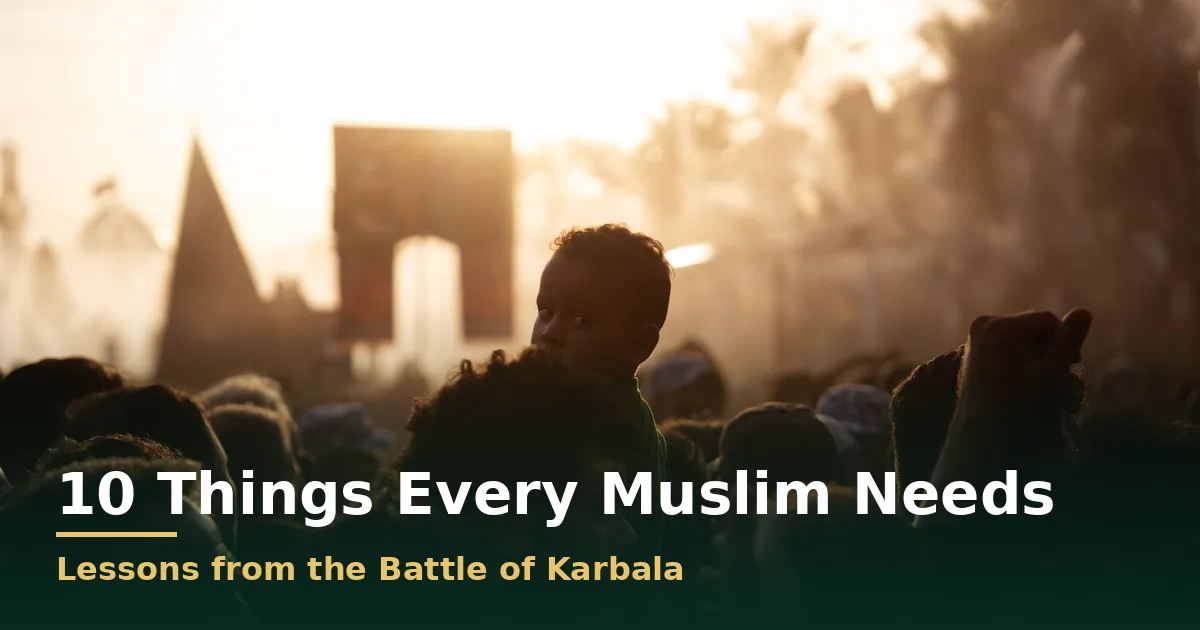
Karbala is remembered every year in Muharram, especially on Ashura (10 Muharram) and on Chehlum (20 Safar), forty days after Ashura, when the survivors returned to Karbala. Majalis (gatherings) are held, the story is retold, and the names of the martyrs are recited. Pilgrims visit Karbala in Iraq — millions of them during Arbaeen — and water is distributed freely in memory of the thirst of the caravan.
For the commemorations themselves, see our guides to the Chehlum of Imam Hussain and the 7th Muharram, and our dua of Ashura for the day of Ashura itself.
10. What Can Muslims Learn From Karbala?
The Battle of Karbala teaches Muslims to never support oppression. Even today, Karbala is a reminder that standing for justice against great odds is the essence of true faith. The lessons are practical, not abstract: refuse to endorse corruption, even when it costs you. Protect your family and your community, even when you cannot protect yourself. Speak the truth when silence would be easier — as Zainab did. And remember that victory is not always survival: Hussain lost the battle and won the argument, because thirteen centuries later, it is his name that is honoured and Yazid’s that is condemned.
The battle teaches one more thing, and it is the most personal of all. Every Muslim will face a smaller Karbala at some point: a moment when doing the right thing costs something — a job, a friendship, a comfort — and doing the wrong thing costs nothing. Karbala is the reminder that the right thing is still the right thing, even when you are the only one doing it.
Frequently Asked Questions
When did the Battle of Karbala take place?
On 10 Muharram 61 AH (10 October 680 CE), the day known as Ashura, at Karbala in present-day Iraq.
Why is Karbala important in Islam?
Imam Hussain (RA) refused allegiance to the corrupt rule of Yazid and was martyred with 72 companions for that stand. Karbala represents the ultimate sacrifice for truth and justice, and its lessons apply to every Muslim.
Who martyred Imam Hussain?
Imam Hussain (RA) was martyred by the forces of Yazid ibn Muawiya at Karbala on 10 Muharram 61 AH, after his caravan had been without water for three days.
How many supporters stood with Imam Hussain?
Only 72 loyal followers stood with Imam Hussain, including his family — his sons, his brother Abbas and his nephews — and companions such as Habib ibn Muzahir and Hurr ibn Yazid.
Is the event only commemorated by Shia Muslims?
Karbala holds special importance for Shia Muslims, but Sunni Muslims also respect and mourn Imam Hussain, and its message of truth, courage and sacrifice is universal.
What happened to the women and children after Karbala?
They were taken as prisoners to Kufa and Damascus. Bibi Zainab (RA) spoke openly in those courts about what had happened, and her speeches are why the story of Karbala survived. Forty days later, on 20 Safar (Chehlum), the survivors returned to Karbala.
Key Points
- The Battle of Karbala took place on 10 Muharram 61 AH (10 October 680 CE) at Karbala, Iraq.
- Imam Hussain (RA) refused to pledge allegiance to Yazid because of his corruption and unjust rule.
- Only 72 loyal supporters stood with Imam Hussain, including Abbas ibn Ali (RA) and Ali Akbar (RA).
- Yazid’s army blocked water from the Prophet’s family for three days.
- Women and children were present in Imam Hussain’s caravan and were taken as prisoners to Kufa and Damascus.
- Karbala’s message of truth, courage and sacrifice is universal, and Zainab bint Ali (RA) carried it forward.
Sources: The Holy Qur’an; Jami’ at-Tirmidhi; Encyclopaedia Britannica; al-islam.org