What is Sadaqah?
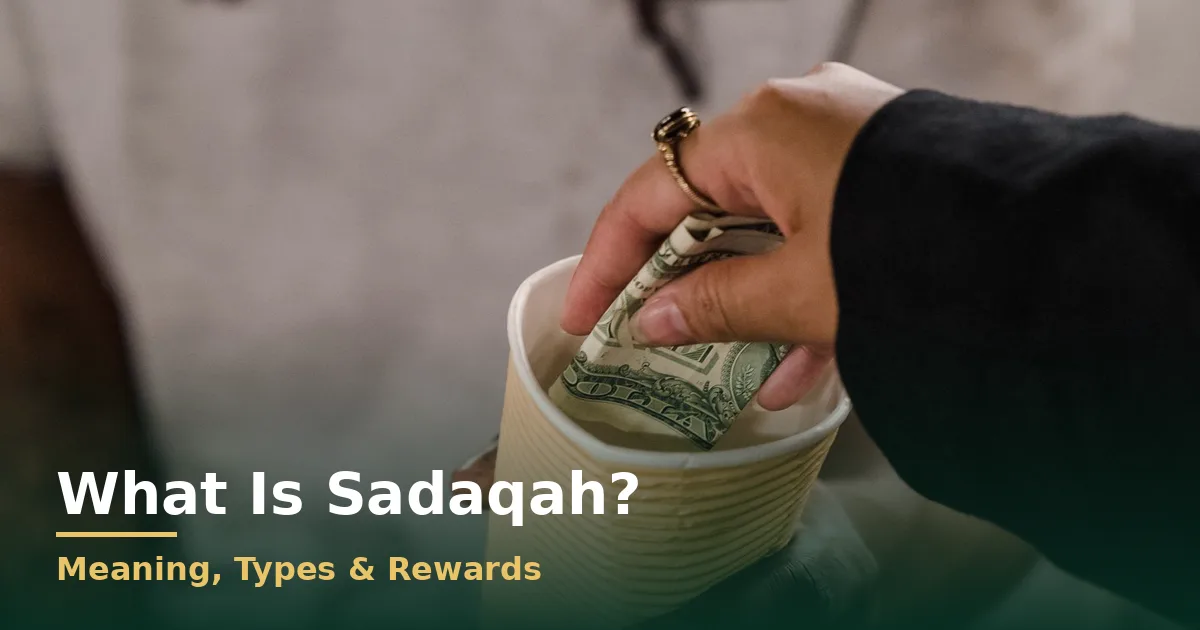
Sadaqah is voluntary charity given for the sake of Allah — money, help, kind words, or any good deed done to benefit someone else without expecting anything back. Unlike zakat, which is an obligatory payment with fixed rules, sadaqah is given whenever and however much you choose, and its reward continues for as long as the good it causes continues. As Rajab begins (expected ~10 December 2026) and Muslims prepare for Ramadan (expected 8 February 2027), this is the season when giving increases — so here is the full meaning of sadaqah, its two types, and its rewards.
What Does the Word Sadaqah Mean?
The word sadaqah comes from the Arabic root s-d-q, the same root as sidq (truthfulness). A sadaqah is a gift that proves the truth of your faith — you give away something you love because you believe Allah’s promise. It is not only money. The Prophet (peace and blessings be upon him) said:
Arabic:
كُلُّ مَعْرُوفٍ صَدَقَةٌ
Transliteration: “Kullu ma’roofin sadaqah.”
Translation: “Every good deed is charity.” (Sahih al-Bukhari 6021)
A smile, a good word, helping someone carry their bags, removing something harmful from the road, teaching someone a useful skill — all of it is sadaqah when done sincerely for Allah. That is why even a person with no money is never unable to give sadaqah.
What Is the Difference Between Sadaqah and Zakat?
This is the most common confusion, so it matters. Zakat is one of the five pillars of Islam: an obligatory payment of 2.5% on qualifying wealth held for a full lunar year above the nisab threshold. It has fixed rules about who must pay and who may receive it. Sadaqah has no fixed amount, no threshold, and no set time. You give what you want, when you want, to whom you want — though the poor, relatives, orphans and travellers are the most deserving. In short: zakat is duty, sadaqah is voluntary generosity. Read our guide to zakat on salary and savings and the nisab in dollars if you need to work out your zakat separately.
What Are the Two Types of Sadaqah?
- Sadaqah (ordinary charity). A one-time good deed whose reward is with Allah: giving money to a person in need, feeding someone, paying for a child’s school books, or helping a neighbour. Its reward is recorded once, and its benefit ends when the act ends.
- Sadaqah Jariyah (ongoing charity). A good deed whose benefit keeps flowing after you, so its reward keeps flowing too. The Prophet (peace and blessings be upon him) taught that when a person dies, their deeds end except for three things: ongoing charity, knowledge that benefits others, and a righteous child who prays for them (Sahih Muslim 1631). Building a well, funding a school, planting a tree, printing Qur’ans, building a masjid, or setting up a water pump are classic examples of sadaqah jariyah. This is the charity people choose when they want their giving to outlive them — for themselves, or on behalf of a deceased parent.
What Does Allah Promise Those Who Give?
Allah describes the reward of giving with a powerful image:
Arabic:
مَّثَلُ الَّذِينَ يُنفِقُونَ أَمْوَالَهُمْ فِي سَبِيلِ اللَّهِ كَمَثَلِ حَبَّةٍ أَنبَتَتْ سَبْعَ سَنَابِلَ فِي كُلِّ سُنبُلَةٍ مِّائَةُ حَبَّةٍ ۗ وَاللَّهُ يُضَاعِفُ لِمَن يَشَاءُ ۗ وَاللَّهُ وَاسِعٌ عَلِيمٌ
Transliteration: “Mathalulladheena yunfiqoona amwaalahum fee sabeelillaahi kamathali habbatin anbatat sab’a sanaabila fee kulli sunbulatin mi’atu habbah, wallaahu yudaa’ifu liman yashaa’, wallaahu waasi’un ‘aleem.”
Translation: “The example of those who spend their wealth in the way of Allah is like a seed [of grain] which grows seven spikes; in each spike is a hundred grains. And Allah multiplies [His reward] for whom He wills. And Allah is all-Encompassing and Knowing.” (Qur’an 2:261, Sahih International)
One seed becomes seven hundred grains — and Allah multiplies further for whom He wills. The Prophet (peace and blessings be upon him) also taught that charity does not decrease wealth, and that giving protects a person: “Protect yourselves from the Fire, even with half a date.” (Sahih al-Bukhari and Sahih Muslim.) Even a tiny gift, given sincerely, counts.
Who Should Receive Sadaqah?
The Qur’an praises giving to “the poor who are restricted in the cause of Allah” and cannot move freely to earn (Qur’an 2:273, meaning). In practice, start closest to home: struggling relatives come first, then neighbours, then the poor in your town, then people in crisis abroad. Orphans, widows, students of sacred knowledge, the sick, and travellers are all named in the Qur’an as deserving recipients. A good rule is to give where you can see the need and trust the hands it passes through — a local masjid fund, a verified charity, or a family you know personally.
When Is the Best Time to Give Sadaqah?
Sadaqah is accepted at any time, but some times carry extra reward. Ramadan is the greatest of them — the Prophet (peace and blessings be upon him) was most generous in Ramadan — and the last ten nights are the best nights of the year to give. The months before it, Rajab and Sha’ban, are when many Muslims begin their giving habit so it is strong by Ramadan. Fridays, the first ten days of Dhul-Hijjah, and times of hardship or calamity are also excellent times. A small regular gift — even a few dollars or pounds a week — is better than a large gift given once and forgotten, because the Prophet (peace and blessings be upon him) said the most beloved deeds to Allah are the most consistent, even if small (Sahih al-Bukhari and Sahih Muslim).
How Can You Give Sadaqah in the USA, UK, Canada and Australia?
Giving is easy today, but a little care protects your gift. Give through registered charities with published accounts, or through your local masjid’s zakat and sadaqah fund. Keep receipts if you claim tax relief — in the USA, UK, Canada and Australia, donations to registered charities are usually tax-deductible, but check your country’s rules. For sadaqah jariyah, choose projects with lasting benefit: water wells, orphan sponsorship, masjid building, or Qur’an education. Avoid sending money through informal middlemen you cannot verify, and never give to anyone who pressures you. If you want your gift to reach a parent’s reward, give sadaqah jariyah in their name — scholars agree the reward reaches the deceased, by Allah’s permission. For duas for your parents, see our dua for parents and our dua for rizq.
What Mistakes Should You Avoid When Giving?
Three mistakes spoil otherwise good charity. First, showing off — giving so others praise you removes the reward, so give quietly whenever you can. Second, reminding the recipient of your favour afterwards, or hurting them with words — the Qur’an warns that this cancels the charity (Qur’an 2:264, meaning). Third, giving what you would not want yourself: old, broken or useless things given as “charity” while keeping the best for yourself. Give what is good, give it kindly, and then forget about it.
Frequently Asked Questions
What is sadaqah in Islam?
Sadaqah is voluntary charity given for Allah’s sake — money, help, kind words or any good deed done to benefit someone else without expecting anything back.
What is the difference between sadaqah and zakat?
Zakat is obligatory: 2.5% on qualifying wealth above the nisab, with fixed rules. Sadaqah is voluntary: any amount, any time, to anyone in need.
What is sadaqah jariyah?
Ongoing charity whose benefit continues after you — such as building a well, funding a school or planting a tree. Its reward continues for as long as people benefit from it, even after the giver’s death.
Does sadaqah have to be money?
No. The Prophet (peace and blessings be upon him) said every good deed is charity (Sahih al-Bukhari 6021) — a smile, a good word, removing harm from the road and helping someone all count as sadaqah.
Can I give sadaqah on behalf of my deceased parents?
Yes. Scholars agree that giving sadaqah, especially sadaqah jariyah, on behalf of a deceased person reaches them in reward, by Allah’s permission.
When is the best time to give sadaqah?
Any time, but Ramadan — especially the last ten nights — carries the greatest reward, and Rajab and Sha’ban are the natural months to begin a regular giving habit before Ramadan.
Key Points
- Sadaqah is voluntary charity for Allah’s sake; zakat is the separate obligatory payment with fixed rules.
- It is not only money — every good deed is charity, including a smile, a good word and helping someone.
- There are two types: ordinary sadaqah and sadaqah jariyah, whose reward continues after death.
- Allah compares giving to a seed growing seven spikes of a hundred grains each (Qur’an 2:261).
- Start with relatives and neighbours, then the poor, orphans, widows and travellers.
- Give quietly, give what is good, and give regularly — small consistent gifts are the most beloved deeds.
Sources: The Holy Qur’an (Sahih International); Sahih al-Bukhari; Sahih Muslim; IslamQA.