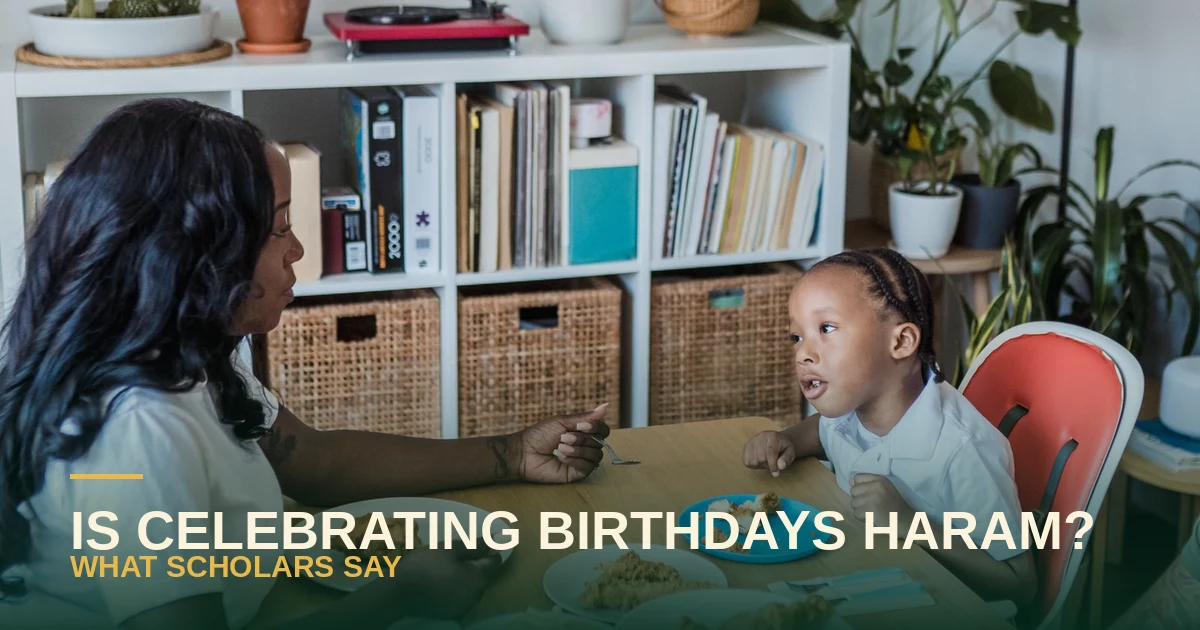
Is Celebrating Birthdays Haram in Islam?
The short answer is that scholars disagree. One group of scholars says celebrating birthdays is not permissible, because it is an innovation in religion and an imitation of non-Muslim customs. Another group of respected scholars says it is permissible as a personal, cultural occasion, provided nothing forbidden happens at it. There is no single ruling all scholars agree on, so this guide sets out what each side says, the evidence each side uses, and what both sides agree on — so you can follow the scholars you trust, with your eyes open. Nothing here is a fatwa; for your own situation, ask a qualified scholar you trust.
Key Points
- Is celebrating birthdays haram? Scholars disagree on celebrating birthdays — this is a genuine difference of opinion, not a settled ruling, and this post explains both sides with attribution. This site issues no fatwa.
- One group of scholars, including IslamQA (Sheikh Muhammad Salih al-Munajjid) and Sheikh Ibn Baz, hold that celebrating birthdays is not permissible: it is an innovation with no basis in the Sunnah, and an imitation of non-Muslim customs.
- Their evidence includes the hadith “Whoever imitates a people is one of them” (Sunan Abi Dawud 4031) and the fact that the Prophet (peace and blessings be upon him) and his Companions never celebrated birthdays.
- Other respected scholars, including Egypt’s Dar al-Ifta (fatwa 4820, 2013) and Sheikh Yusuf al-Qaradawi, hold that marking a birthday is permissible as a personal occasion, as long as nothing forbidden takes place.
- Their evidence includes the Prophet’s (peace and blessings be upon him) own Monday fast — Monday was the day he was born (Sahih Muslim 1162) — and the view that a personal occasion is not a religious festival.
- Both sides agree on the boundaries: no music, no free mixing, no extravagance, no belief that the celebration is a religious duty — and a birthday is a time for gratitude to Allah either way.
Why Do Some Scholars Say Birthdays Are Haram?
The scholars who hold birthdays impermissible give two main reasons, set out by IslamQA (Sheikh Muhammad Salih al-Munajjid, answer 1027):
1. It is an innovation (bid’ah) in religion. The Prophet (peace and blessings be upon him) said: “If somebody innovates something which is not in harmony with the principles of our religion, that thing is rejected” (Sahih al-Bukhari 2697). Neither the Prophet (peace and blessings be upon him) nor his Companions celebrated birthdays — not his own, and not anyone else’s — and Sheikh Ibn Baz (former Grand Mufti of Saudi Arabia) ruled on this basis that celebrating birthdays is an act of bid’ah and is not permissible, whether the birthday is the Prophet’s or anyone else’s (Noor ala al-Darb, vol. 3).
2. It is imitation of the non-Muslims. The Prophet (peace and blessings be upon him) said:
Arabic:
مَنْ تَشَبَّهَ بِقَوْمٍ فَهُوَ مِنْهُمْ
Transliteration: Man tashabbaha biqawmin, fa-huwa minhum.
Translation: “Whoever imitates a people is one of them.” (Sunan Abi Dawud 4031, graded hasan sahih by al-Albani)
Birthday parties with cake, candles and the “Happy Birthday” song are a custom of non-Muslim societies, the argument runs, and adopting a practice distinctive to them falls under this warning. IslamWeb (fatwa 81725, 2001) gives the same ruling: it is forbidden to celebrate birthdays, as this is an imitation of disbelievers, because Muslims did not know this custom before.
A third point is often added: Islam gave Muslims two festivals, and only two. When the Prophet (peace and blessings be upon him) came to Madinah, the people had two days on which they played games, and he said: “Allah has substituted for them something better than them: the day of sacrifice and the day of breaking the fast” (Sunan Abi Dawud 1134). On this view, adding a third recurring celebration goes against that substitution.
Why Do Other Scholars Say Birthdays Are Permissible?
Other respected scholars reach the opposite conclusion, and their view is also grounded in evidence: Egypt’s Dar al-Ifta (fatwa 4820, 2013) answered that there is no legal impediment to celebrating birthdays, describing it as part of remembering the blessing of existence and creation. It held that the hadith of the two Eids does not rule out marking personal occasions such as birthdays, as long as they are not named as religious feasts and as long as nothing prohibited takes place. Sheikh Yusuf al-Qaradawi likewise held that Muslims may celebrate birthdays and turn the occasion into something beneficial, and Egypt’s former Grand Mufti Dr Ali Gomaa held the same permissibility, recommending that Islamic elements be brought into the occasion.
Their strongest evidence is the Prophet’s (peace and blessings be upon him) own practice. He fasted on Mondays, and when asked why, he said:
Arabic:
ذَاكَ يَوْمٌ وُلِدْتُ فِيهِ وَيَوْمٌ بُعِثْتُ أَوْ أُنْزِلَ عَلَىَّ فِيهِ
Transliteration: Dhaaka yawmun wulidtu feehi, wa yawmun bu’ithtu aw unzila ‘alayya feehi.
Translation: “That is the day on which I was born, and the day on which I was commissioned (with prophethood) or revelation was sent down to me.” (Sahih Muslim 1162)
On this reading, the Prophet (peace and blessings be upon him) himself marked the day of his birth — with fasting and gratitude, not with a party — so remembering a birth with gratitude is not forbidden in itself. The permissibility side also draws a line the other side does not: a birthday, they say, is a personal and cultural occasion, not a religious festival, and a private family gathering is not the same as inventing a new Eid.
What Is the Middle Position?
Between the two positions sits a nuanced view found in Hanafi fatwa literature. Darul Iftaa (Hanafi) answers draw a distinction: Recording the date of birth and expressing happiness and gratitude to Allah for life is permissible. There is nothing wrong with noting the day, thanking Allah, and making dua. Celebrating in the customary way — cutting a cake, burning candles, singing “Happy Birthday” — is not permissible, because it is the imitation the hadith warns about. In other words, the question is not only whether you mark the day, but how. A quiet family meal with thanks to Allah and dua for the year ahead looks very different, on every view, from a party built around the customs of non-Muslim celebrations — and several fatwa bodies treat the two differently even while agreeing on the core evidence.
Is It Haram to Attend a Birthday Party or Accept a Gift?
This is where the difference between the views matters most in daily life, and the answers split the same way: On the stricter view (IslamQA, IslamWeb), attending a birthday celebration is not permitted, because attending is taking part in something impermissible. IslamQA’s own advice for someone pressed by friends is to explain the ruling gently and kindly, and to make clear that a gift is accepted for the sake of friendship and love — not because of the birthday. On the permissibility view (Dar al-Ifta Egypt and those who follow it), attending is permissible if the gathering itself involves nothing haram — no music, no free mixing, no alcohol — and accepting a gift or congratulating the person is likewise fine.
A practical point both sides accept: celebrating a birthday does not take a person out of Islam, and it does not cancel the reward of their good deeds. IslamQA states this explicitly — the act is prohibited on its view, but it is not disbelief. So however strongly you hold your own position, the scholars on the other side are not to be accused of kufr, and the question should not become a reason to break family ties.
What Can I Do Instead on a Birthday?
Whatever view you follow, both sides agree that a birthday is a good moment for gratitude and reflection — and there are ways to mark the day that no scholar objects to:
Fast, as the Prophet (peace and blessings be upon him) did on Mondays. If your birthday falls on a Monday, fast it; if not, fast any Monday in gratitude for the day you were born.
Thank Allah and take stock. Another year of life is a blessing and a trust — use the day for self-accounting (muhasabah), repentance and dua for the year ahead.
Give charity. Feeding the poor or giving sadaqah on the day turns a personal occasion into a benefit for others.
Gather the family simply. A family meal with dua and thanks, without music, candles, cake-cutting rituals or imitation of party customs, is acceptable even on stricter views of what counts as “celebrating”.
Make dua for the person. If it is someone else’s birthday, the best gift on every view is a sincere dua for their health, guidance and a long life in obedience to Allah.
We answer other everyday “is it halal?” questions the same way — with the evidence on both sides where scholars differ — for example in our guide to whether gelatin is halal.
Is Celebrating the Prophet’s Birthday (Mawlid) the Same Question?
Not quite — it is a bigger and older debate of its own. The scholars who hold personal birthdays impermissible generally hold the Mawlid impermissible too; Ibn Baz’s ruling covers both together. Egypt’s Dar al-Ifta, on the other hand, holds that commemorating the Prophet’s (peace and blessings be upon him) birth is permissible when it consists of lawful acts — Qur’an recitation, remembrance of Allah, sending blessings on the Prophet (peace and blessings be upon him), studying his life — and points to the same Monday fast as evidence. This post does not settle the Mawlid question; it is noted here only so readers do not confuse the two debates.
Conclusion
Is celebrating birthdays haram? The honest answer is that the scholars have not agreed. The stricter view — held by IslamQA, Ibn Baz and IslamWeb — says no to birthday celebrations, on the evidence of innovation and imitation. The permissibility view — held by Egypt’s Dar al-Ifta, al-Qaradawi and Ali Gomaa — says a personal birthday may be marked with gratitude, as long as nothing forbidden is involved. What both sides agree on is the heart of the matter: a birthday is a day to thank Allah for life, to take stock of the year that has passed, and to pray for the year ahead — and that, on every view, is worth doing.
Frequently Asked Questions
Is celebrating birthdays haram?
Scholars disagree. IslamQA, Sheikh Ibn Baz and IslamWeb hold that it is not permissible — an innovation and an imitation of non-Muslims. Egypt’s Dar al-Ifta (fatwa 4820, 2013), Sheikh Yusuf al-Qaradawi and Dr Ali Gomaa hold it permissible as a personal occasion, as long as nothing forbidden takes place. Follow the scholars you trust, and ask a qualified scholar about your own situation.
Is it haram to wish someone a happy birthday?
On the stricter view, congratulating someone for a birthday is part of the celebration and is avoided. On the permissibility view, a simple greeting or dua is fine. A dua for the person’s health and guidance is acceptable on every view.
Is cutting a birthday cake haram?
Cutting a cake as the centrepiece of a birthday celebration is exactly the customary form the stricter scholars object to, and Hanafi fatwa literature also treats the customary cake-and-candles celebration as impermissible. Eating cake itself is not haram — it is the birthday ritual around it that scholars discuss.
Is it haram to celebrate a child’s birthday?
The same scholarly difference applies to children as to adults. Those who hold birthdays impermissible apply the ruling to children’s parties too, while those who permit them allow a simple family gathering without haram elements. Many families in the stricter view mark a child’s birthday with a family meal, charity and dua instead of a party.
Can I attend my child’s school birthday party?
On the stricter view, no — attending is taking part. On the permissibility view, yes, if the party involves nothing haram. If you follow the stricter view, explain kindly to the teacher and offer an alternative, such as bringing treats for the class on another day.
What did the Prophet (peace and blessings be upon him) do on his birthday?
He did not hold a celebration. He fasted on Mondays, and said Monday was ‘the day on which I was born, and the day on which I was commissioned (with prophethood) or revelation was sent down to me’ (Sahih Muslim 1162). Both sides cite this hadith — one side as proof that he marked the day with worship, the other as proof that he never celebrated it as a festival.
Sources: The Holy Qur’an; Sahih al-Bukhari; Sahih Muslim; Sunan Abi Dawud; IslamQA; IslamWeb; Dar al-Ifta Egypt; Darul Iftaa; Ibn Baz — Noor ala al-Darb.