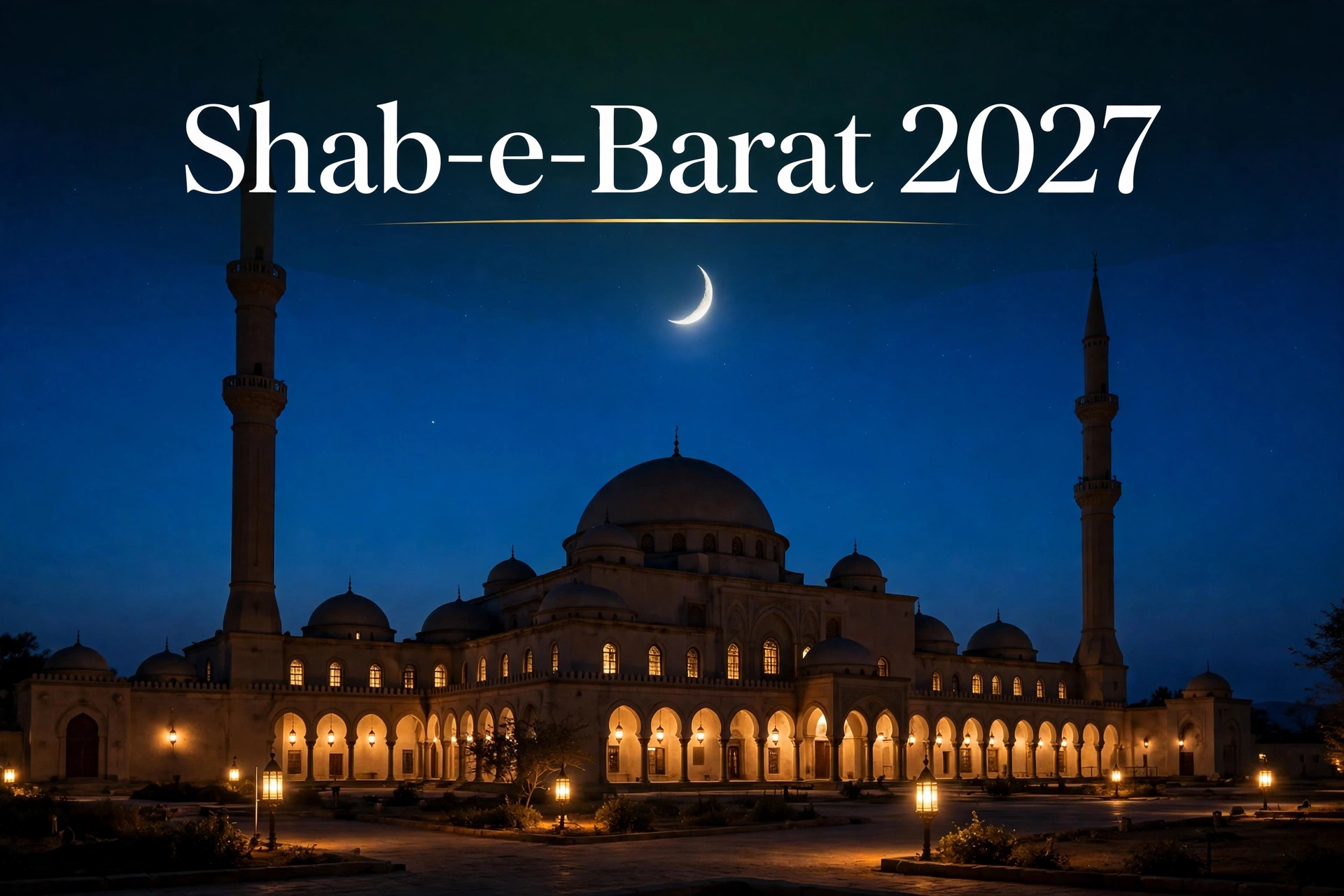
Shab-e-Barat: Date, Significance & What to Do
Shab-e-Barat — the night of the middle of Sha’ban, known in Arabic as Laylat al-Nisf min Sha’ban — is expected on the night of Friday 22 January into Saturday 23 January 2027 (15 Sha’ban 1448), though in Pakistan and India, where the Sha’ban moon may be sighted a day later, it may fall on the night of Saturday 23 into Sunday 24 January. It is a night many Muslims spend in voluntary prayer, Qur’an recitation and seeking forgiveness — but scholars differ over how much virtue is established for this specific night, and no particular prayer or ritual is prescribed for it. This guide explains the date, the evidence, the scholarly positions, and what to do on the night.
Key Points
- Shab-e-Barat is the night of 15 Sha’ban (Laylat al-Nisf min Sha’ban), the “Night of Forgiveness” in South Asian tradition.
- Expected date 2027: the night of Friday 22 January into Saturday 23 January (Umm al-Qura calendar); in Pakistan/India it may be Saturday 23 into Sunday 24 January — follow your local mosque.
- A narration in Sunan Ibn Majah (1388) says Allah forgives His creation on this night except the idolater and the one who harbours hatred — scholars differ over its grading.
- No specific prayer, fast or ritual is prescribed for this night; voluntary prayer, Qur’an and dua are always good.
- The Prophet (SAW) fasted most of Sha’ban (Sahih al-Bukhari 1969); fasting the 15th as part of the white days (13th–15th) is established Sunnah.
What Is Shab-e-Barat?
Shab-e-Barat is the Persian name used across South Asia for Laylat al-Nisf min Sha’ban — the night of the middle of Sha’ban, the eighth month of the Islamic calendar. “Shab” means night, and “Barat” means freedom or deliverance, so the name is often rendered “the Night of Forgiveness” or “the Night of Deliverance”. It falls about two weeks before Ramadan begins, and for many families it is the night when the coming month is prepared for — spiritually and practically.
The night is the 15th of Sha’ban. Because Islamic days begin at sunset, the night of 15 Sha’ban starts on the evening of the 14th — after Maghrib — and runs until Fajr. That is why the date is given as a night spanning two Gregorian dates, and why different countries sometimes mark it on different nights: it depends on when the Sha’ban crescent is sighted locally.
When Is Shab-e-Barat in 2027?
Shab-e-Barat 2027 is expected as follows:
| Occasion | Date |
|---|---|
| Sha’ban 1448 begins | Saturday 9 January 2027 (Umm al-Qura calendar) |
| Night of 15 Sha’ban (calculated calendar) | Friday 22 January 2027, after Maghrib, until Fajr on Saturday 23 January |
| 15 Sha’ban (day) | Saturday 23 January 2027 |
| If the Sha’ban crescent is sighted a day later (Pakistan, India and elsewhere) | Night of Saturday 23 January into Sunday 24 January |
All of these dates are expected and depend on the moon sighting. Mosques in the UK, USA, Canada and Australia follow different sighting methods — some follow the Saudi announcement, others follow local sighting — so families in the same city can mark the night on different evenings. Both approaches rest on scholarly positions. Follow the announcement from your local mosque.
What Does the Evidence Say About This Night?
The most quoted narration about this night is reported in Sunan Ibn Majah (1388):
Arabic:
إِنَّ اللَّهَ لَيَطَّلِعُ فِي لَيْلَةِ النِّصْفِ مِنْ شَعْبَانَ فَيَغْفِرُ لِجَمِيعِ خَلْقِهِ إِلَّا لِمُشْرِكٍ أَوْ مُشَاحِنٍ
Transliteration: Innallaaha layattali’u fee laylatin-nisfi min Sha’baana fa yaghfiru lijamee’i khalqihi illaa li mushrikin aw mushaahin
Translation: “Indeed, Allah looks down on the night of the middle of Sha’ban and forgives all His creation except the idolater and the one who harbours hatred.”
Scholars differ over the grading of this narration. Al-Albani graded it hasan (acceptable), while many other scholars grade it weak (da’if). Similar narrations appear in other collections, including al-Tabarani and al-Bayhaqi, and some scholars hold that their combined chains strengthen one another. Others remain unconvinced. What is agreed is that no narration about this night reaches the highest level of authenticity, and none of them prescribes a specific act of worship for it.
A verse sometimes quoted for this night is Qur’an 44:3:
Arabic:
إِنَّا أَنزَلْنَاهُ فِي لَيْلَةٍ مُّبَارَكَةٍ
Transliteration: Innaa anzalnaahu fee laylatin mubaarakah
Translation: “Indeed, We sent it down during a blessed night.”
The majority of scholars interpret “the blessed night” here as Laylat al-Qadr, the night the Qur’an was revealed in Ramadan. A minority view holds it refers to the night of 15 Sha’ban. The majority view is the stronger one, and the verse should not be quoted as proof for Shab-e-Barat without saying so.
What Did the Prophet (SAW) Do in Sha’ban?
What is firmly established is the Prophet’s (SAW) devotion in the month of Sha’ban as a whole. Aisha (RA) narrated that she never saw the Prophet (SAW) fast a month completely except Ramadan, and never saw him fast more in any month than in Sha’ban (Sahih al-Bukhari 1969). Sha’ban was his month of preparation for Ramadan — and that, more than any single-night ritual, is the Sunnah of this month.
Fasting on the 15th of Sha’ban itself is best understood through the established Sunnah of fasting the white days — the 13th, 14th and 15th of each lunar month (Jami’ at-Tirmidhi 761). A person who fasts the white days every month is already fasting on the 15th of Sha’ban. What scholars caution against is singling out the 15th with a special fast or a special night prayer on the belief that a specific reward is promised for it, when no sound narration promises one.
What Should You Do on Shab-e-Barat?
There is no prescribed ritual for this night, and that is itself the guidance. The night is well spent the way any night is well spent:
- Voluntary night prayer (Tahajjud): pray two rak’ahs at a time, as much as you wish, with no fixed number and no special surahs assigned to the night.
- Qur’an recitation: read whatever portion you can, with understanding.
- Dua and istighfar: ask Allah for forgiveness for yourself, your parents and the deceased, and make dua for the coming Ramadan.
- Settle disputes: the narration about this night excludes “the one who harbours hatred” from forgiveness — a reason to reconcile with family and neighbours before the night, not after it.
- Fast the next day if you wish, as part of the white days, or simply as a voluntary fast.
What Should You Avoid?
- Do not treat any specific prayer as prescribed. No narration establishes a set number of rak’ahs, a set surah, or a set dua for this night. Prayers circulated for the night with fixed counts and promised rewards have no sound basis.
- Do not hold a congregational “Shab-e-Barat prayer” as a Sunnah. Scholars including Ibn Taymiyyah held that gathering for a special prayer on this night is an innovation; praying individually at home is the safe and established way.
- Do not visit graveyards as a ritual of the night. Visiting graves to remember death is a general Sunnah, but making it a specific Shab-e-Barat practice is a South Asian custom, not a teaching of the Prophet (SAW).
- Do not use fireworks or celebrations. The night is for worship and reflection, not festivity.
- Do not claim certainty about the date. Until the Sha’ban moon is sighted, every date is expected — and a night observed a day later on a different sighting is still the same 15 Sha’ban.
Shab-e-Barat and Ramadan
Shab-e-Barat falls a fortnight before Ramadan, and that timing is its practical value. It is a natural moment to take stock: to clear debts of the heart, to plan the fasts, to set a Qur’an target for Ramadan, and to make the dua that the Prophet’s (SAW) companions used to make — asking Allah to let them reach Ramadan. Ramadan 1448 is expected to begin on Monday 8 February 2027, with the first Taraweeh on the evening of Sunday 7 February. The night of 15 Sha’ban is, in that sense, the doorway to Ramadan: use it to arrive at Ramadan ready.
Frequently Asked Questions
What is Shab-e-Barat?
Shab-e-Barat is the night of 15 Sha’ban, known in Arabic as Laylat al-Nisf min Sha’ban. In South Asia it is called the Night of Forgiveness. Muslims spend it in voluntary prayer, Qur’an recitation and seeking forgiveness ahead of Ramadan.
When is Shab-e-Barat in 2027?
It is expected on the night of Friday 22 January into Saturday 23 January 2027 (15 Sha’ban 1448) by the calculated calendar. In Pakistan and India, where the Sha’ban moon may be sighted a day later, it may fall on the night of Saturday 23 into Sunday 24 January. Follow your local mosque’s announcement.
Is Shab-e-Barat mentioned in the Qur’an?
Not by name. Qur’an 44:3 speaks of a “blessed night”, which the majority of scholars interpret as Laylat al-Qadr in Ramadan, not Shab-e-Barat. A minority view links it to 15 Sha’ban.
Is there a hadith about Shab-e-Barat?
Yes — a narration in Sunan Ibn Majah (1388) says Allah forgives His creation on the night of the middle of Sha’ban except the idolater and the one who harbours hatred. Scholars differ over its grading: al-Albani graded it hasan, while many others grade it weak.
Is there a special prayer for Shab-e-Barat?
No. No sound narration prescribes a specific prayer, number of rak’ahs or surah for this night. Voluntary night prayer, Qur’an and dua are recommended in general, not as a special ritual.
Should I fast on 15 Sha’ban?
You may fast it as part of the white days (13th–15th of the lunar month), which is established Sunnah. Fasting the 15th alone on the belief that a specific reward is promised for it is not established.
Is Shab-e-Barat the same as Laylat al-Qadr?
No. Laylat al-Qadr is a night in the last ten nights of Ramadan; Shab-e-Barat is the night of 15 Sha’ban, about two weeks before Ramadan begins.
Sources
Sources: The Holy Qur’an (Surah ad-Dukhan 44); Sahih al-Bukhari; Sunan Ibn Majah; Jami’ at-Tirmidhi; al-Tabarani, al-Mu’jam al-Kabir; Ibn Rajab, Lata’if al-Ma’arif; moonsighting.live (Umm al-Qura calendar 2027)