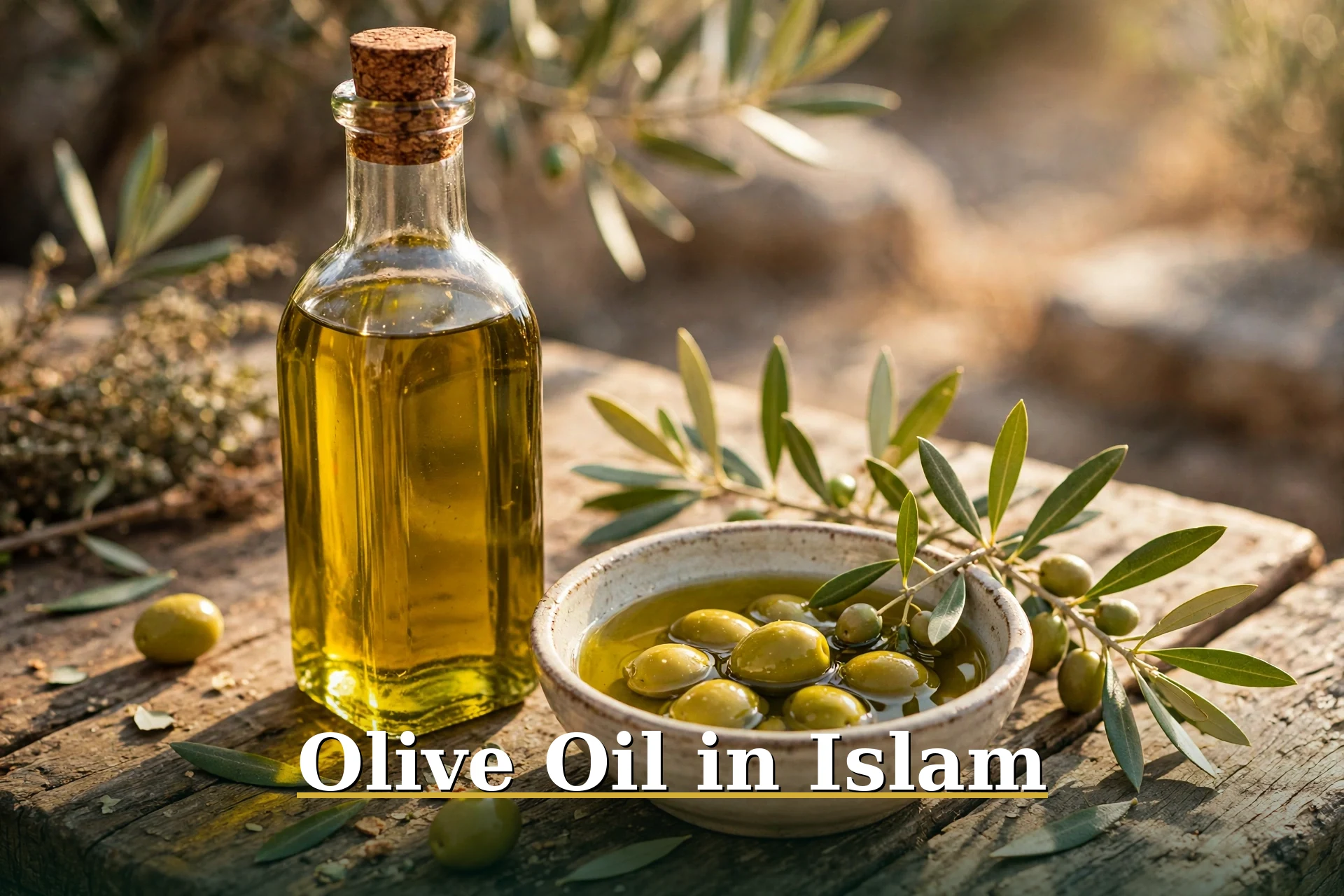
Olive Oil Islamic and Scientific Benefits
Olive oil in Islam is more than a cooking ingredient. The Qur’an calls the olive a blessed tree, and the Prophet Muhammad (peace be upon him) told his followers to eat olive oil and anoint themselves with it. Modern science, in turn, associates extra-virgin olive oil with heart health, but it is a healthy food, not a medicine.
Key Points
- The olive is from a blessed tree (Qur’an 24:35).
- The Prophet (peace be upon him) said to eat olive oil and anoint with it (Sunan Ibn Majah 3319).
- Olives are mentioned 7 times in the Qur’an.
- Extra-virgin olive oil is rich in monounsaturated fats and polyphenols.
- It is a healthy food, not a medicine.
Olives in the Qur’an
The olive is mentioned in the Qur’an seven times: in Surah al-An’am (6:99 and 6:141), Surah an-Nahl (16:11), Surah al-Mu’minun (23:20), Surah an-Nur (24:35), Surah ‘Abasa (80:29) and Surah at-Tin (95:1). It was mentioned in the Qur’an over 1,400 years ago, long before modern nutrition science began to study it, and it is named among the fruits Allah causes to grow for people.
Arabic:
يُنبِتُ لَكُم بِهِ الزَّرْعَ وَالزَّيْتُونَ وَالنَّخِيلَ وَالأَعْنَابَ وَمِن كُلِّ الثَّمَرَاتِ ۗ إِنَّ فِي ذَٰلِكَ لَآيَةً لِّقَوْمٍ يَتَفَكَّرُونَ
Transliteration: Yunbitu lakum bihi az-zar’a waz-zaytoona wan-nakheela wal-a’naaba wa min kullith-thamaraat, inna fee dhaaalika la-aayatan liqawmin yatafakkaroon
Translation: “He causes to grow for you thereby the crops, olives, palm trees, grapevines, and from all the fruits. Indeed, in that is a sign for a people who give thought.”
(Qur’an 16:11)
In Surah an-Nur, in the Verse of Light, Allah describes the olive as a blessed tree. The relevant phrase reads:
Arabic (relevant phrase from Qur’an 24:35, not the whole verse):
يُوقَدُ مِن شَجَرَةٍ مُّبَارَكَةٍ زَيْتُونَةٍ لَّا شَرْقِيَّةٍ وَلَا غَرْبِيَّةٍ
Transliteration: Yooqadu min shajaratin mubaarakatin zaytoonatin laa sharqiyyatin wa laa gharbiyyah
Translation: “[Its oil is] lit from [the oil of] a blessed olive tree, neither of the east nor of the west.”
(Qur’an 24:35, relevant phrase)
Olive Oil in the Hadith
The Prophet (peace be upon him) spoke about olive oil directly. Umar (may Allah be pleased with him) narrated that the Messenger of Allah (peace be upon him) said.
Arabic:
ائْتَدِمُوا بِالزَّيْتِ وَادَّهِنُوا بِهِ فَإِنَّهُ مِنْ شَجَرَةٍ مُبَارَكَةٍ
Transliteration: I’dadimoo biz-zayti wad-dahinoo bihi fa innahu min shajaratin mubaarakah
Translation: “Season (your food) with olive oil and anoint yourselves with it, for it comes from a blessed tree.”
(Sunan Ibn Majah 3319, narrated from Umar, graded Sahih)
A parallel narration in Jami’ at-Tirmidhi (1851) gives the shorter wording: “Eat olive and use its oil, for indeed it is a blessed tree.” Both narrations point to the same thing: olive oil is to be eaten and used on the body, because it comes from a blessed tree.
What Does ‘Blessed Tree’ Mean?
The Qur’an calls the olive a blessed tree, and that is how Muslims should think of it: a gift from Allah, wholesome and useful, mentioned with honour in revelation. It is not described as a gift from Jannah, and it is not a medicine that cures disease. Its blessing lies in its goodness as food and in the honour Allah gave it in the Qur’an.
How to Use Olive Oil Daily
Olive oil is easy to bring into daily life. Use extra-virgin olive oil for cooking and for salad dressings, drizzle it over bread or vegetables, and use a little on the skin and hair, as the hadith encourages anointing with it. A small amount goes a long way, and extra-virgin olive oil, the least processed kind, is the best choice for the table. Store olive oil in a cool, dark place in a sealed bottle, away from heat and sunlight, so that it keeps its flavour and quality for longer.
What Does Science Say About Olive Oil?
Modern research has looked closely at olive oil, and what it finds is encouraging. Extra-virgin olive oil is rich in monounsaturated fats and polyphenols, the plant compounds that give it its flavour and its stability. Studies of the Mediterranean diet, in which olive oil is the main source of fat, associate it with heart health.
Researchers describe these links as associations: people whose diets are rich in olive oil tend to have better heart-health outcomes, but no study proves that olive oil alone prevents disease. Olive oil is a healthy food, not a medicine. It does not treat diabetes, lower blood sugar or cholesterol on its own, or cure any condition, and nothing in this article promises a guaranteed result. If you have a medical condition, ask your doctor before changing your diet.
Can Olive Oil Be Used for Ruqyah?
Ruqyah means seeking healing through the recitation of the Qur’an and authentic supplications. Some Muslims recite Qur’an over olive oil and then use it on the body, following the general encouragement in the hadith to use olive oil. This is a matter of personal practice. It is not a substitute for medical treatment, and anyone who is unwell should see a doctor.
Conclusion
The olive is a small fruit with a great standing in Islam: a blessed tree named seven times in the Qur’an, praised by the Prophet (peace be upon him), and valued by modern science as a healthy food. Eat it, cook with it, and anoint with it, and remember that its greatest blessing is the one Allah gave it in revelation. It is a food that connects the table to revelation, and that is reason enough to keep a bottle of good extra-virgin olive oil in the kitchen. Keep it simple, use it often, and let a blessed food have its place in your home.
Related Reading
- Top 10 Fruits in Islam and Their Health Benefits
- 5 Sunnah Foods After Eid
- Dua for Shifa for Health Improvement
- 4 Important Benefits of Exercise and Fitness
- Dua for Pain
Frequently Asked Questions
What does the Qur’an say about olives?
The Qur’an mentions olives seven times and calls the olive a blessed tree (Qur’an 24:35). It names the olive among the fruits Allah causes to grow for people, as a sign for those who reflect (Qur’an 16:11).
What did the Prophet (SAW) say about olive oil?
The Prophet (peace be upon him) told his followers to season their food with olive oil and anoint themselves with it, for it comes from a blessed tree (Sunan Ibn Majah 3319). A parallel narration in Jami’ at-Tirmidhi (1851) says to eat olive and use its oil, for indeed it is a blessed tree.
How many times is the olive mentioned in the Qur’an?
The olive is mentioned seven times in the Qur’an: 6:99, 6:141, 16:11, 23:20, 24:35, 80:29 and 95:1.
Is olive oil good for health?
Extra-virgin olive oil is rich in monounsaturated fats and polyphenols, and research on the Mediterranean diet associates it with heart health. It is a healthy food, not a medicine, and it does not treat or cure any condition.
Can olive oil be used for Ruqyah?
Yes, some Muslims recite Qur’an over olive oil and use it on the body as part of Ruqyah. This is a personal practice, not a substitute for medical treatment.
How should olive oil be used daily?
Use extra-virgin olive oil for cooking and salad dressings, drizzle it over bread or vegetables, and use a little on the skin and hair. A small amount goes a long way.
Sources: The Holy Qur’an (Surah an-Nahl 16; Surah an-Nur 24); Sunan Ibn Majah; Jami’ at-Tirmidhi.