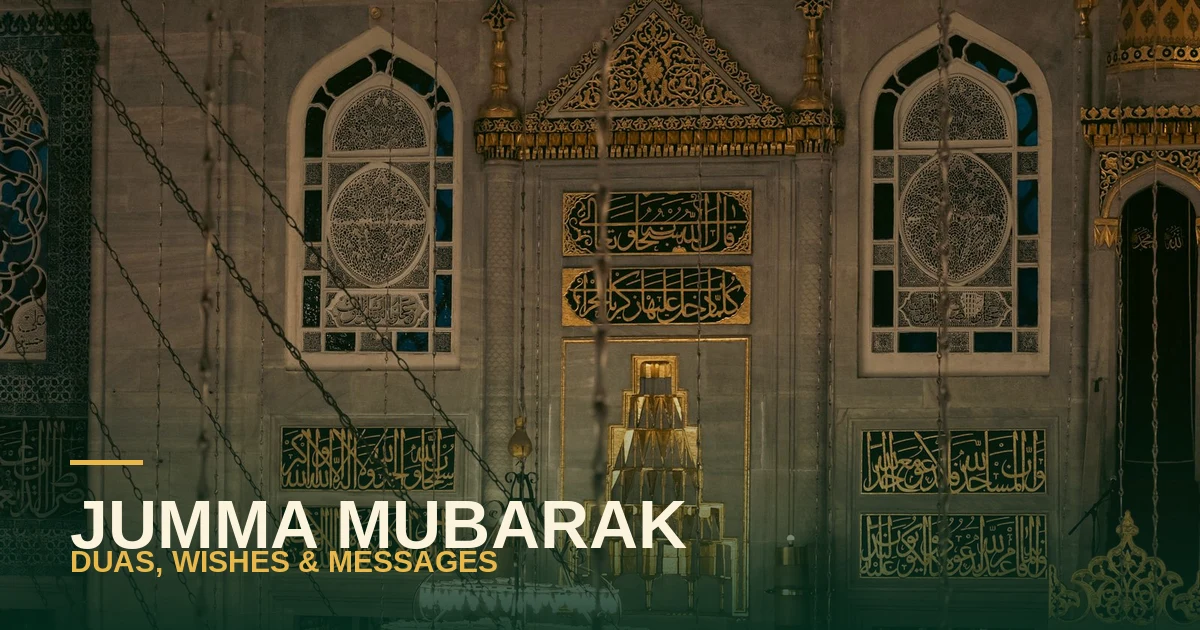
Jumma Mubarak Duas & Wishes Messages
“Jumma Mubarak” means “Blessed Friday” — the greeting Muslims share on Friday, the best day of the week. The Prophet (peace and blessings be upon him) described Friday as the best day on which the sun has risen, and Friday carries the Jumu’ah prayer, the khutbah, and an hour when duas are accepted (Sahih Muslim 854). This guide to Jumma Mubarak duas explains why Friday is special, what to read and do on the day, and shares clean, heartfelt greetings you can send to family and friends.
Key Points
- “Jumma Mubarak” means “Blessed Friday”.
- Friday is the best day of the week (Sahih Muslim 854).
- Read Surah Al-Kahf on Friday.
- Send abundant Salawat on the Prophet (peace and blessings be upon him).
- Attend Jumu’ah prayer and listen to the khutbah.
- Share clean, kind greetings with family and friends.
Why Is Friday Special in Islam?
Friday, or Jumu’ah, is the weekly gathering day for Muslims. The men gather for the Jumu’ah prayer and listen to the khutbah, the sermon, in the mosque. A report in Sunan Ibn Majah (1098, classed Hasan) describes Friday as an Eid which Allah has ordained for the Muslims — a day of celebration and worship that comes every week: “This day is an ‘Eid (festival) which Allah has ordained for the Muslims. Whoever comes to Friday (prayer), let him take a bath and if he has perfume then let him put some on.”
The day is also marked by its Sunnahs: taking a bath (ghusl) for Jumu’ah, wearing clean clothes, and applying perfume if you have it — practices reported in Sahih al-Bukhari and Sahih Muslim on ghusl for Jumu’ah.
Scholars also mention an hour on Friday when duas are accepted. The Prophet (peace and blessings be upon him) said: “There is an hour (opportune time) on Friday and if a Muslim gets it while praying and asks something from Allah, then Allah will definitely meet his demand.” (Sahih al-Bukhari 935.) The exact hour is not fixed to a clock time, so the best approach is to make dua throughout the day, and especially towards the end of the day. For the full list of Friday preparations, see our guide to the 9 things to do before Jumu’ah Friday prayer.
The Hadith on Friday
The Prophet (peace and blessings be upon him) said, as reported by Abu Hurairah (may Allah be pleased with him) in Sahih Muslim 854:
Arabic:
خَيْرُ يَوْمٍ طَلَعَتْ عَلَيْهِ الشَّمْسُ يَوْمُ الْجُمُعَةِ فِيهِ خُلِقَ آدَمُ وَفِيهِ أُدْخِلَ الْجَنَّةَ وَفِيهِ أُخْرِجَ مِنْهَا وَلَا تَقُومُ السَّاعَةُ إِلَّا فِي يَوْمِ الْجُمُعَةِ
Transliteration: Khayru yawmin tala’at ‘alayhish-shamsu yawmul-jumu’ah, feehi khuliqa Aadam, wa feehi udkhilal-jannah, wa feehi ukhrija minhaa, wa laa taqoomus-saa’atu illaa fee yawmil-jumu’ah.
Translation: “The best day on which the sun has risen is Friday. On it Adam was created, on it he was admitted to Paradise, on it he was expelled from it, and the Hour will not be established except on Friday.” (Sahih Muslim 854)
That is why Friday is the best day of the week: it is tied to the beginning of human history and to its end, and it is the day Allah chose for the weekly gathering of the believers.
Duas and Sunnahs for Friday
Friday has its own acts of worship. The best-known is reciting Surah Al-Kahf: a report by al-Hakim and al-Bayhaqi from Abu Sa’id al-Khudri (may Allah be pleased with him) says that whoever recites Surah Al-Kahf on Friday will have a light between the two Fridays:
Arabic:
مَنْ قَرَأَ سُورَةَ الْكَهْفِ فِي يَوْمِ الْجُمُعَةِ أَضَاءَ لَهُ مِنَ النُّورِ مَا بَيْنَ الْجُمُعَتَيْنِ
Transliteration: Man qara’a sooratal-kahfi fee yawmil-jumu’ati adaa’a lahu minan-noori maa baynal-jumu’atayn.
Translation: “Whoever recites Surah al-Kahf on Friday, a light will shine for him between the two Fridays.” (al-Hakim, al-Mustadrak 3392; al-Bayhaqi; graded Sahih by al-Albani, Sahih al-Jami’ 6470)
The report is authenticated and strengthened by a number of later scholars; it is not in Sahih al-Bukhari or Sahih Muslim. Read our guide to Surah Al-Kahf benefits for more on the surah.
Another Friday Sunnah is sending abundant Salawat — blessings — on the Prophet (peace and blessings be upon him). Friday is also a day for personal dua: ask Allah for what you need, for your family, and for the whole Ummah, and remember those who are struggling. The dua after the Adhan is also worth learning; see our guide to the dua after Adhan.
Jumma Mubarak Wishes
- Jumma Mubarak! May Allah fill your Friday with peace, light and answered duas.
- May this Friday bring you closer to Allah and fill your home with barakah.
- Jumma Mubarak to you and your family. May Allah accept your prayers and forgive your sins.
- Have a blessed Friday. May your heart find rest in the remembrance of Allah.
- May Allah bless your Friday, protect your family, and grant you the best of this world and the next.
- Jumma Mubarak! May the light of Surah Al-Kahf guide you until the next Friday.
- May Allah answer your duas on this blessed day and grant you health, peace and contentment.
Jumma Mubarak Messages
- Friday is here again — a gift from Allah. Use it well: pray, recite, and remember Him.
- The best day of the week has arrived. Take a bath, wear your best clothes, and head to the mosque early.
- Send Salawat on the Prophet (peace and blessings be upon him) today, and let your tongue stay busy with dhikr.
- A quiet Friday, a sincere dua, and a heart turned to Allah — that is the best way to spend the day.
- May your Friday be filled with the light of the Qur’an and the peace of prayer.
- Remember those who are struggling in your duas today, and Allah will remember you.
- Jumu’ah Mubarak! Gather with your brothers, listen to the khutbah, and pray together.
Conclusion
Friday is the best day of the week, a weekly Eid, a day of gathering, recitation and answered dua. Read Surah Al-Kahf, send Salawat, attend Jumu’ah and listen to the khutbah, make dua through the day — and share a clean, kind greeting with the people you love. Jumma Mubarak.
Frequently Asked Questions
What does Jumma Mubarak mean?
“Jumma Mubarak” means “Blessed Friday”. Muslims say it on Friday to wish each other the blessings of the day.
Why is Friday special in Islam?
Friday is the best day of the week. Adam was created on it, admitted to Paradise on it, and expelled from it on it, and the Hour will be established on a Friday (Sahih Muslim 854). It is also the day of Jumu’ah prayer and the khutbah.
What should I read on Friday?
Read Surah Al-Kahf, send abundant Salawat on the Prophet (peace and blessings be upon him), and make personal dua, especially in the hour on Friday when duas are accepted.
Is it Sunnah to read Surah Al-Kahf on Friday?
Yes. A report by al-Hakim and al-Bayhaqi from Abu Sa’id al-Khudri (may Allah be pleased with him) says that whoever recites Surah Al-Kahf on Friday will have a light between the two Fridays (al-Hakim, al-Mustadrak 3392; graded Sahih by al-Albani, Sahih al-Jami’ 6470). It is authenticated and strengthened by a number of later scholars. The report is not in Sahih al-Bukhari or Sahih Muslim.
What is the best dua for Friday?
There is no single prescribed “Friday dua”. The best duas are the ones the Prophet (peace and blessings be upon him) taught for all times — Salawat, istighfar, and personal dua from the heart, especially in the hour of acceptance on Friday.
When is the hour on Friday when duas are accepted?
The Prophet (peace and blessings be upon him) said there is an hour on Friday when a Muslim’s dua is answered (Sahih al-Bukhari 935). Its exact time is not fixed to a clock time — scholars mention the time between Asr and Maghrib and the time of the khutbah among the strongest opinions — so the best approach is to make dua throughout Friday, especially towards the end of the day.
Sources: Sahih Muslim; Sunan Ibn Majah; al-Hakim, al-Mustadrak; al-Bayhaqi, Shu’ab al-Iman