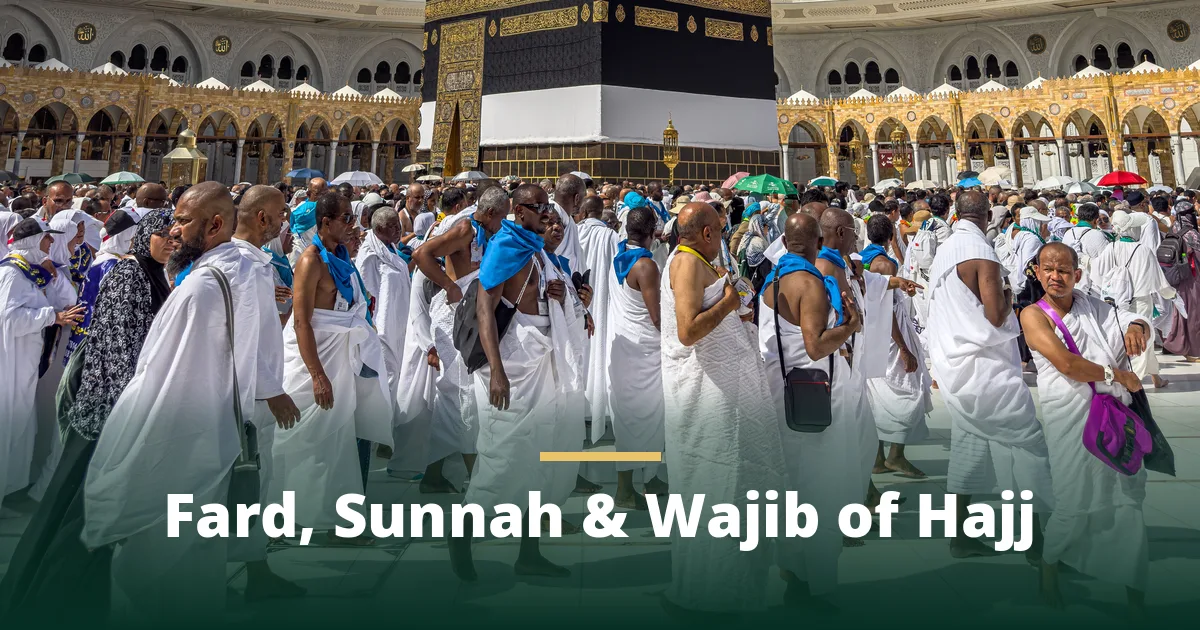
Every Muslim Should Be Aware of The Fard, Sunnah, And Wajib of Hajj
The fard, sunnah and wajib acts of Hajj are the three levels of obligation every pilgrim must know before travelling. The fard acts — the pillars — are the acts without which Hajj is not valid at all: entering ihram, standing at Arafah, the Tawaf al-Ifadah, and the Sa’i (with the schools differing on exactly which of these are pillars).
The wajib acts are required: if a pilgrim misses one, their Hajj is still valid, but they must offer a sacrifice (dam) as expiation. The sunnah acts are the Prophet’s practices that complete and perfect the Hajj — omitting them does not invalidate it and requires no sacrifice, but a pilgrim who follows them earns more reward.
This guide explains each level, lists the acts in each, states where the schools differ, and explains what happens if an act is missed — with Qur’an and hadith references. Hajj 1448 is expected from 14 to 19 May 2027 (Arafah on Saturday 15 May 2027, moon-sighting dependent), so a pilgrim preparing now should learn these distinctions before they travel.
Most pilgrims learn the steps of Hajj — the tawaf, the sa’i, the stoning, the sacrifice — but fewer learn which steps are pillars, which are required, and which are recommended. The difference matters.
A pilgrim who misses a pillar has no Hajj at all. A pilgrim who misses a wajib act has a valid Hajj, but owes a sacrifice. A pilgrim who misses a sunnah has lost reward, but owes nothing. Knowing which is which is what turns a journey into a Hajj done properly.
What Is Hajj, and Who Must Perform It?
Hajj is the pilgrimage to Makkah, and it is the fifth pillar of Islam. Allah made it obligatory on every Muslim who is physically and financially able to undertake it, once in a lifetime:
Arabic:
وَلِلَّهِ عَلَى النَّاسِ حِجُّ الْبَيْتِ مَنِ اسْتَطَاعَ إِلَيْهِ سَبِيلًا
Transliteration: Wa lillaahi ‘alan-naasi hijjul-bayti manistataa’a ilayhi sabeelaa.
Translation: “And [due] to Allah from the people is a pilgrimage to the House — for whoever is able to find thereto a way.” (Qur’an 3:97, key clause, Saheeh International)
Hajj takes place in well-known months, and its main rites fall in the first ten days of Dhul-Hijjah:
Arabic:
الْحَجُّ أَشْهُرٌ مَّعْلُومَاتٌ
Transliteration: Al-hajju ashhurun ma’loomaat.
Translation: “Hajj is [during] well-known months…” (Qur’an 2:197, key clause, Saheeh International)
Hajj 1448 is expected from Friday 14 May to Wednesday 19 May 2027, with the Day of Arafah on Saturday 15 May 2027 and Eid al-Adha on Sunday 16 May 2027 (moon-sighting dependent; local announcements may differ by a day). A pilgrim who understands the fard, sunnah and wajib acts of Hajj before they travel will know what they must not miss, what they must make up if they miss it, and what they can leave without harm.
The Fard Acts of Hajj (The Pillars)
The fard acts — also called the arkan, the pillars — are the acts without which Hajj is not valid. If a pilgrim misses one of them, their Hajj does not count, and no sacrifice can make up for it: they must perform the act itself, or their Hajj is incomplete. The schools differ on the exact list, and the difference should be stated honestly.
The Shafi’i, Maliki and Hanbali schools count four pillars: (1) ihram — entering the state of pilgrimage with the intention; (2) standing at Arafah (wuquf) — being present at the plain of Arafah on the 9th of Dhul-Hijjah, even for a moment, between noon and dawn the next morning; (3) Tawaf al-Ifadah — the circumambulation of the Kaaba after Arafah; and (4) Sa’i — walking between Safa and Marwah.
The Hanafi school counts two pillars — standing at Arafah and Tawaf al-Ifadah — and treats ihram as a condition for Hajj (required, but counted separately) and Sa’i as a wajib act rather than a pillar. In practice, every pilgrim performs all four acts, so the difference only matters if one of them is missed: a Hanafi pilgrim who misses Sa’i owes a sacrifice, while a Shafi’i pilgrim who misses Sa’i has no valid Hajj until it is performed. A pilgrim should follow their own school’s position, and ask a scholar if they are unsure.
Standing at Arafah is the heart of Hajj. The Prophet (peace be upon him) said, “Hajj is Arafah” — a person who misses Arafah has missed Hajj entirely, and there is no way to make it up that year. Tawaf al-Ifadah is the tawaf that completes the pilgrimage, performed after the stoning on the 10th of Dhul-Hijjah. Sa’i commemorates Hajar’s search for water between Safa and Marwah, and it is performed after a tawaf. Ihram is entered at the miqat — the boundary around Makkah — with the intention and the talbiyah:
Arabic:
لَبَّيْكَ اللَّهُمَّ لَبَّيْكَ، لَبَّيْكَ لَا شَرِيكَ لَكَ لَبَّيْكَ، إِنَّ الْحَمْدَ وَالنِّعْمَةَ لَكَ وَالْمُلْكَ، لَا شَرِيكَ لَكَ
Transliteration: Labbaykallaahumma labbayk, labbayka laa shareeka laka labbayk, innal-hamda wan-ni’mata laka wal-mulk, laa shareeka lak.
Translation: “Here I am, O Allah, here I am. Here I am, You have no partner, here I am. Indeed, all praise and blessings are Yours, and all sovereignty is Yours — You have no partner.” (Talbiyah, Sahih al-Bukhari 1549)
The Wajib Acts of Hajj (Required — Sacrifice If Missed)
The wajib acts are required, but they are not pillars. If a pilgrim misses one, their Hajj is still valid — but they must offer a sacrifice (dam), usually a sheep slaughtered in Makkah, as expiation.
The wajib acts, as counted by the majority of scholars, are: (1) entering ihram from the miqat — crossing the miqat without ihram requires a sacrifice (some scholars count ihram itself as a pillar, as above; either way, it must not be skipped);
(2) staying at Muzdalifah on the night of the 10th — even a short stay after midnight is enough for most scholars; (3) spending the nights of the 11th, 12th and (for those who stay) 13th of Dhul-Hijjah at Mina;
(4) stoning the three jamarat (pillars) on the days of Tashreeq — the 11th, 12th and 13th of Dhul-Hijjah (plus the stoning of the Aqaba pillar on the 10th); (5) shaving the head or cutting the hair after the sacrifice on the 10th; and (6) Tawaf al-Wada — the farewell tawaf before leaving Makkah (required for those leaving Makkah; women who are menstruating are excused from it).
The sacrifice for a missed wajib act is a real obligation, not a formality. A pilgrim who realises they missed one should arrange the sacrifice through their Hajj group or a trusted agent in Makkah, and should not leave it undone. If a pilgrim is unsure whether they missed a wajib act, they should ask a scholar or their group’s guide before leaving Makkah — it is much easier to correct it there than after returning home.
The Sunnah Acts of Hajj (Recommended — More Reward)
The sunnah acts are the Prophet’s practices during Hajj. Omitting one does not invalidate the Hajj and requires no sacrifice, but performing them earns more reward and brings the pilgrim’s Hajj closer to the Prophet’s own Hajj.
They include: taking a ghusl (bath) before entering ihram; wearing the ihram garments and applying perfume before entering ihram (perfume on the body, not on the ihram garments themselves); reciting the talbiyah often and loudly (for men);
praying two rakats at the miqat before entering ihram; kissing or touching the Black Stone if it can be done without harming others (and pointing to it if it cannot);
performing tawaf with the right shoulder uncovered (idtiba) for men during the arrival tawaf; walking briskly (ramal) in the first three circuits of the arrival tawaf for men; praying two rakats behind Maqam Ibrahim after tawaf; drinking Zamzam water; and spending the 8th of Dhul-Hijjah (the Day of Tarwiyah) at Mina.
A pilgrim who performs these has followed the Prophet’s Hajj more closely, and that is the point of knowing them — not to add worry, but to add reward.
What Happens If You Miss an Act of Hajj?
The answer depends on which level the act belongs to. Miss a fard act (a pillar) and the Hajj is not valid — the act must be performed, and if it cannot be performed that year, the Hajj must be repeated another year. Miss a wajib act and the Hajj is valid, but a sacrifice (dam) is owed — arrange it in Makkah before leaving. Miss a sunnah act and nothing is owed — the Hajj is valid and complete, with less reward than it could have had.
That is the whole fard sunnah wajib hajj system in three sentences, and it is why every pilgrim should learn the three levels before they travel. If in doubt during Hajj, ask — your Hajj group’s scholars, the guides at the holy sites, or a scholar by phone. Asking is not a sign of weakness. It is how a pilgrim protects a journey they may only make once in their life. For the full step-by-step guide, see our 7 Hajj steps guide, the three types of Hajj and the Hajj prohibited items list.
Frequently Asked Questions
What are the fard acts of Hajj?
The fard acts (pillars) are the acts without which Hajj is not valid: ihram, standing at Arafah, Tawaf al-Ifadah, and Sa’i (Shafi’i, Maliki, Hanbali schools). The Hanafi school counts two pillars — Arafah and Tawaf al-Ifadah — treating ihram as a condition and Sa’i as wajib. Every pilgrim performs all four.
What happens if I miss a fard act of Hajj?
The Hajj is not valid. A missed pillar cannot be made up with a sacrifice — the act itself must be performed, or the Hajj must be repeated another year. Standing at Arafah is the most critical: “Hajj is Arafah.”
What are the wajib acts of Hajj?
The wajib acts include: ihram from the miqat, staying at Muzdalifah, spending the nights of Tashreeq at Mina, stoning the jamarat, shaving or cutting the hair, and the farewell tawaf (Tawaf al-Wada). If one is missed, the Hajj is still valid but a sacrifice (dam) is owed.
What is the difference between fard and wajib in Hajj?
A fard act is a pillar: missing it invalidates the Hajj and cannot be fixed by a sacrifice. A wajib act is required: missing it leaves the Hajj valid, but a sacrifice (dam) must be offered as expiation.
What are the sunnah acts of Hajj?
The Prophet’s practices during Hajj: ghusl before ihram, reciting the talbiyah, the two rakats at the miqat, kissing the Black Stone when possible, walking briskly in the first three circuits of the arrival tawaf, praying behind Maqam Ibrahim, and drinking Zamzam. Omitting one costs reward, not validity, and no sacrifice is owed.
When is Hajj 2027?
Hajj 1448 is expected from Friday 14 May to Wednesday 19 May 2027, with the Day of Arafah on Saturday 15 May 2027 and Eid al-Adha on Sunday 16 May 2027 — all moon-sighting dependent, so local announcements may differ by a day.
Key Points
- The fard, sunnah and wajib acts of Hajj are three levels: pillars (Hajj invalid without them), required acts (sacrifice owed if missed), and recommended acts (more reward, nothing owed if missed).
- Fard (pillars): ihram, standing at Arafah, Tawaf al-Ifadah, and Sa’i (Shafi’i, Maliki, Hanbali); the Hanafi school counts Arafah and Tawaf al-Ifadah as pillars, with Sa’i as wajib.
- “And [due] to Allah from the people is a pilgrimage to the House — for whoever is able to find thereto a way” (Qur’an 3:97, key clause).
- Wajib acts: ihram from the miqat, Muzdalifah, the nights at Mina, stoning the jamarat, shaving/cutting the hair, and Tawaf al-Wada — a missed wajib act requires a sacrifice (dam).
- Sunnah acts: ghusl before ihram, talbiyah, two rakats at the miqat, kissing the Black Stone when possible, ramal in the arrival tawaf, and drinking Zamzam.
- Hajj 1448 is expected 14–19 May 2027, Arafah Saturday 15 May 2027, Eid al-Adha Sunday 16 May 2027 (moon-sighting dependent).
Sources: The Holy Qur’an; Sahih al-Bukhari