Is Gelatin Halal?
Is gelatin halal? It depends entirely on where the gelatin comes from. Gelatin made from fish is halal, and gelatin made from cattle slaughtered in the Islamic way is halal. Gelatin made from pigs is haram according to the majority of scholars and every major halal certification body. The problem for shoppers is that most food labels say only “gelatin” or “gelatine” — or the additive code E441 — with no source given, and most gelatin sold in the West is made from pork. This guide explains each source, why scholars disagree about one of them, and how to check what is actually in your food and medicine.
Key Points
- Gelatin is halal only when its source is halal: fish gelatin is halal; beef gelatin is halal only from Islamically slaughtered cattle; pork gelatin is haram for the majority of scholars.
- A label that says only “gelatin”, “gelatine” or “E441” is doubtful (mushbooh) — the source must be checked before eating it.
- According to Gelatine Manufacturers of Europe, about 80% of the edible gelatine made in Europe comes from pork skins.
- The one real debate is istihalah (transformation): a minority of scholars say processing turns pork gelatin into a new, lawful substance; the majority and the major fatwa councils say it does not.
- Plant-based alternatives — agar-agar, pectin and carrageenan — are halal and widely used in certified products.
What Is Gelatin?
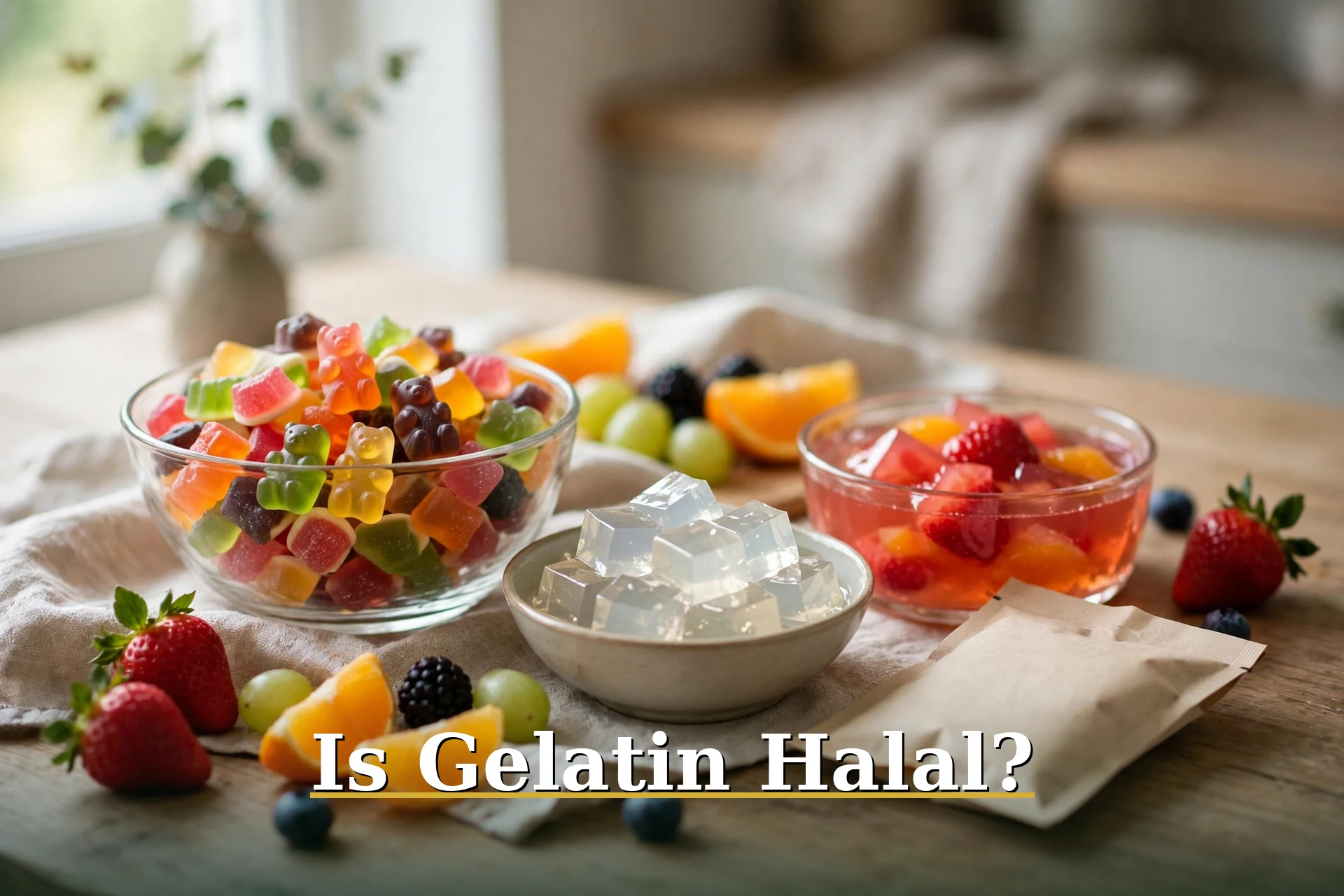
Gelatin is a protein made by breaking down collagen, the connective tissue found in the skin, bones and cartilage of animals. It is what makes jelly set, gives gummy sweets and marshmallows their chew, thickens yoghurts and desserts, and forms the shells of most medicine capsules. It is also used in some vaccines, in photographic film, and in cosmetics. Because it is made from animal parts, its ruling in Islam follows the ruling of the animal it came from — which is why the source, not the product, decides whether it is halal.
Is Pork Gelatin Halal?
No — according to the majority of scholars and every major halal certification body, gelatin made from pigs is haram. The Qur’an forbids the flesh of swine in clear words:
Arabic:
حُرِّمَتْ عَلَيْكُمُ الْمَيْتَةُ وَالدَّمُ وَلَحْمُ الْخِنزِيرِ
Transliteration: Hurrimat ‘alaykumul-maytatu wad-damu wa lahmal-khinzeer
Translation: “Forbidden to you are dead animals, blood, and the flesh of swine.” (Qur’an 5:3)
The Islamic Fiqh Council in Jeddah and the Standing Committee of scholars in Saudi Arabia both hold that pork gelatin is not permissible, and the International Islamic Fiqh Academy (OIC) ruled the same way in Resolution 225 (2018). Halal certifiers including JAKIM (Malaysia), MUI (Indonesia), IFANCA and the Halal Monitoring Committee (UK) all refuse to certify pork gelatin. In practice this is the rule that matters most for shoppers, because pork is the most common gelatin source in Western food manufacturing.
Is Beef Gelatin Halal?
Beef gelatin is halal only if the cattle were slaughtered according to Islamic rules (dhabiha). The word “beef” on a label tells you the animal, not how it was slaughtered — and most scholars hold that gelatin from cattle not slaughtered Islamically takes the ruling of carrion and is not permissible. So “bovine gelatin” without a halal certificate is not automatically halal: it needs evidence that the cattle and the slaughter meet the standard you follow. Gelatin that carries a recognised halal certificate covering the gelatin itself is halal. When in doubt, treat uncertified beef gelatin the same way as an unlabelled one — doubtful, and best avoided.
Is Fish Gelatin Halal?
Yes — for the four Sunni schools, gelatin made from fish skin and scales is halal, because fish do not require ritual slaughter. The only condition is that nothing haram was added during processing. One caveat for Shia readers: Ja’fari rulings permit only fish with scales, so gelatin from a scaleless species such as catfish does not qualify. Fish gelatin is increasingly used by halal brands precisely because it avoids the slaughter question altogether.
Why Do Some Scholars Disagree? The Istihalah Question
The disagreement is about istihalah — transformation. The idea is that a substance can change so completely during processing that it becomes something new, with a new ruling: the classic example is wine turning into vinegar, which is no longer wine. A minority of scholars, including Egypt’s Dar al-Ifta (fatwa 6891, 2014), and the Islamic Organization for Medical Sciences, have argued that gelatin made from pork bones and skin has been transformed enough to be permissible.
The majority disagree. They hold that the chemical change from collagen to gelatin does not erase the origin of the substance, and the major fatwa councils have ruled accordingly. This is a genuine scholarly difference, presented here with attribution on both sides — but the practical position is clear: no halal certifier in the world certifies pork gelatin, so a Muslim who shops by certification will never meet it as halal.
Where Is Gelatin Hidden? Foods and Medicines to Check
Gelatin hides in more places than jelly. Check the label on gummy sweets and jelly beans, marshmallows, cheesecakes and mousses, yoghurts and cream desserts, some ice creams, and capsules for medicines and vitamin supplements. In medicines, the position of most fatwa bodies is that pork gelatin is forbidden in food but may be used only when no alternative exists and the medicine is genuinely needed — so ask your pharmacist for a vegetarian or halal-certified capsule version first, and ask a scholar you trust if no alternative is available. For food, the safe alternatives are plant-based gelling agents: agar-agar, pectin and carrageenan are all halal, and many brands now print “halal gelatin” or “fish gelatin” on the label.
How to Check Gelatin on a Label
- Read the ingredient list. Look for “gelatin”, “gelatine” or “E441”.
- Look for the source. “Fish gelatin”, “halal gelatin” or “halal-certified bovine gelatin” answers the question. “Beef gelatin” alone does not — it still needs a certificate.
- Look for a halal mark. A recognised certifier’s mark covering the product is the simplest check.
- If the source is not stated, ask. Contact the manufacturer or check their website — most large brands publish the source of their gelatin. If you cannot find out, treat it as doubtful and choose another product.
- In the USA, UK, Canada and Australia, halal-certified sweets and desserts are widely available in Muslim grocery shops and online; the same checking habit works in all four countries.
Frequently Asked Questions
Q: Is gelatin halal?
A: It depends on the source. Fish gelatin is halal, beef gelatin is halal only from Islamically slaughtered cattle, and pork gelatin is haram according to the majority of scholars. A label that says only “gelatin” is doubtful until the source is checked.
Q: Is pork gelatin haram?
A: Yes, according to the majority of scholars and every major halal certification body, including the Islamic Fiqh Council in Jeddah and the International Islamic Fiqh Academy. A minority view permits it through the principle of transformation (istihalah).
Q: Is beef gelatin halal?
A: Only if the cattle were slaughtered in the Islamic way and the gelatin is halal-certified. “Beef gelatin” without a certificate is not automatically halal.
Q: Is fish gelatin halal?
A: Yes, for the four Sunni schools, because fish need no ritual slaughter. Under Ja’fari rulings, only gelatin from scaled fish qualifies.
Q: What is E441?
A: E441 is the food additive code for gelatin. It tells you the ingredient is gelatin but not which animal it came from, so it must be checked the same way as the word “gelatin”.
Q: Is gelatin in medicine allowed?
A: Most fatwa bodies hold that pork gelatin in medicine is forbidden in principle but may be used when no alternative exists and the medicine is genuinely needed. Ask your pharmacist for a halal or vegetarian alternative first.
Q: What can I use instead of gelatin?
A: Agar-agar, pectin and carrageenan are plant-based gelling agents that are halal and work in most recipes.
Sources
Sources: The Holy Qur’an (Surah al-Ma’idah 5); International Islamic Fiqh Academy (OIC); Islamic Fiqh Council, Jeddah; Standing Committee for Scholarly Research and Ifta, Saudi Arabia; Dar al-Ifta, Egypt; Islamic Organization for Medical Sciences; Gelatine Manufacturers of Europe; Halal Monitoring Committee; JAKIM; IFANCA