Is Sodium Stearoyl Lactylate (E481) Halal? A Complete Guide
Sodium stearoyl lactylate (SSL), also known as E481, is generally considered Halal when its fatty acid source is plant-based or comes from a Halal-certified animal source. However, the ingredient name alone does not always reveal its source, so consumers who require strict Halal assurance should check the product’s Halal certification or contact the manufacturer.
If you have seen sodium stearoyl lactylate or E481 on a food label and wondered whether it is Halal or Haram, the answer depends mainly on how the ingredient was sourced and manufactured.
This guide explains what E481 is, where it comes from, when it may be considered Halal, and how Muslim consumers can verify it before purchasing a product.
What Is Sodium Stearoyl Lactylate (E481)?
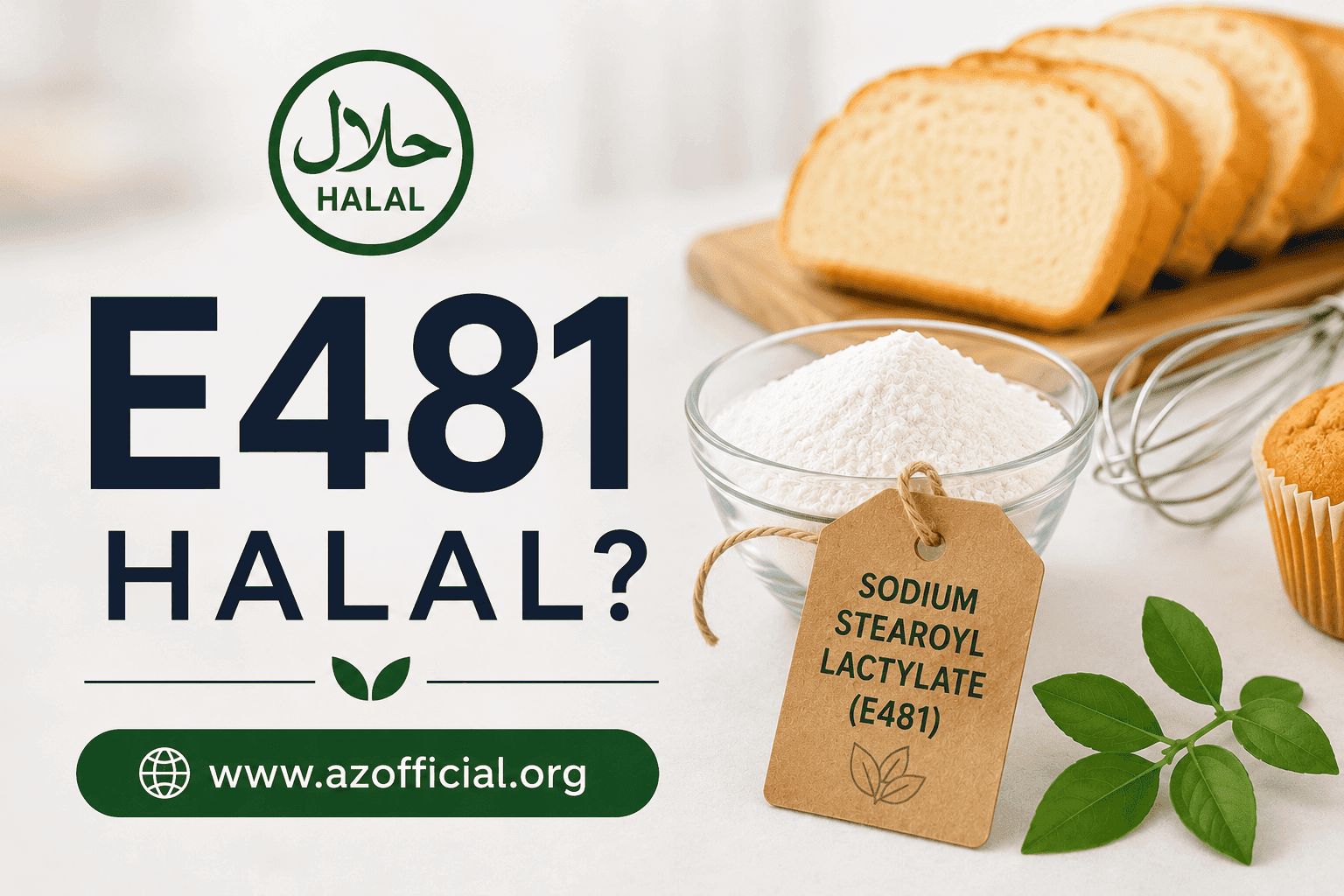
Sodium stearoyl lactylate (SSL) is a food additive identified by the European food additive number E481.
It is primarily used as an emulsifier and dough conditioner. In food manufacturing, it can help ingredients such as water and fat mix more effectively and can improve the texture, volume, and stability of baked products.
You may find E481 in products such as:
- Bread and burger buns
- Packaged bakery products
- Cakes and pastries
- Pancake and waffle mixes
- Some desserts and powdered mixes
- Certain sauces and dressings
- Some coffee creamers and processed food products
The exact products in which it is used vary by country and manufacturer.
What is E481 made from?
Sodium stearoyl lactylate is manufactured from substances, including:
- Stearic acid or related fatty-acid components
- Lactic acid
- Sodium compounds
For Halal purposes, the important question is often the source of the fatty-acid component, particularly whether it originated from vegetable oils or animal fat.
Is Sodium Stearoyl Lactylate Halal or Haram?
The simplest answer is
E481 can be Halal, but its Halal status may depend on the source of the raw materials and the manufacturing process.
If the fatty-acid component is derived from vegetable oils, such as palm or soybean oil, the ingredient would generally be considered permissible.
If an animal-derived source is used, its status may depend on the animal source and whether the source meets applicable Islamic dietary requirements.
For this reason, an ingredient list that simply says “sodium stearoyl lactylate” may not provide enough information to determine its Halal status with complete certainty.
When Is E481 Halal?
1. Plant-Based Source
When the fatty-acid component used to manufacture SSL comes from a permitted vegetable source, such as certain plant oils, E481 is generally considered Halal.
The exact source should ideally be confirmed by the manufacturer or a recognized Halal certification body.
A product carrying a valid Halal certification provides stronger assurance because the certification process can cover the ingredient sources and manufacturing process.
2. Halal-Certified Animal Source
Animal-derived ingredients are not automatically Haram.
If an animal-derived raw material comes from a permissible animal and meets the relevant Islamic slaughter and processing requirements, it may be considered Halal.
However, consumers normally cannot determine this simply by looking at the words “sodium stearoyl lactylate” on an ingredient label.
That is why certification or manufacturer confirmation can be important.
When Could E481 Be Haram?
The ingredient could raise a Halal concern when its animal-derived raw material comes from a prohibited source, such as pork-derived material.
There can also be a concern where a permissible animal source does not meet the applicable Islamic requirements.
Because food manufacturers may source ingredients from different suppliers, it is better not to assume the source solely from the E481 name.
Is E481 Mushbooh?
For consumers who follow a strict approach to doubtful ingredients, E481 may be treated as Mushbooh when its source cannot be established.
“Mushbooh” generally refers to something whose permissible or prohibited status is uncertain.
This does not mean that every product containing E481 is automatically doubtful or Haram.
Instead, the uncertainty may arise because the ingredient label does not always identify whether the fatty-acid component originated from a plant or animal source.
When the product has reliable Halal certification or the manufacturer confirms a permissible source, the uncertainty can be reduced.
E481 Halal Status by Source
| Source or Information | General Halal Consideration |
|---|---|
| Valid Halal certification | Generally considered Halal according to the certification |
| Confirmed plant-based source | Generally Halal |
| Confirmed Halal-certified animal source | Generally Halal |
| Animal source not identified | Source should be verified |
| Pork-derived source | Not permissible |
| Source cannot be established | May be treated as Mushbooh by consumers following a cautious approach |
Important: Islamic rulings can differ depending on the school of jurisprudence and the details of the manufacturing process. For a personal religious ruling, consult a qualified scholar or recognized Halal certification authority.
Does “Vegetarian” or “Vegan” Mean E481 Is Halal?
Not necessarily in every sense.
A vegan or vegetarian declaration can provide useful information about the absence of certain animal-derived ingredients. However, it is important to distinguish between a dietary label and formal Halal certification.
A product can be vegan without being Halal-certified.
Therefore:
Halal certification = stronger direct evidence of Halal compliance.
Vegan/vegetarian labeling = useful information about ingredient sources, but not necessarily a substitute for Halal certification.
If strict Halal assurance is important to you, look for a recognized Halal certification mark or contact the manufacturer.
How to Check Whether E481 Is Halal
If you find E481 on a food label, you can use these steps.
Step 1: Look for Halal Certification
Check the packaging for a recognized Halal certification logo.
A genuine certification indicates that the product has been assessed under the requirements of the relevant certification organization. IFANCA
Step 2: Check the Ingredient and Dietary Information
Look for information such as:
- Halal certified
- Plant-based
- Vegetable-derived
- Vegan
- Suitable for vegetarians
These statements can provide useful clues, but where strict Halal verification is required, certification remains the preferable option.
Step 3: Contact the Manufacturer
If the package only lists “E481” or “sodium stearoyl lactylate”, contact the manufacturer.
You can ask:
“Could you please confirm whether the sodium stearoyl lactylate (E481) used in this product is derived from vegetable sources or animal sources? If animal-derived, could you also confirm whether the source is Halal-certified?”
This is often the most practical way to obtain product-specific information.
Does E481 Contain Pork?
Not necessarily.
The name sodium stearoyl lactylate does not by itself mean that pork is present.
The ingredient can be manufactured using fatty-acid materials obtained from different sources. Therefore, the source needs to be confirmed rather than assumed.
If a manufacturer confirms that its SSL is plant-derived, pork is not the source of that fatty-acid component.
Is Sodium Stearoyl Lactylate Dairy-Free?
The presence of the word “lactylate” can sometimes confuse.
Sodium stearoyl lactylate is not the same thing as milk or lactose. The term relates to lactic acid chemistry, not necessarily to dairy ingredients.
Therefore, E481 itself should not automatically be interpreted as containing milk.
However, if you have a milk allergy or need to avoid dairy for medical or dietary reasons, always check the complete product ingredient and allergen information, because other ingredients in the food may contain milk.
Is E481 Safe to Eat?
Sodium stearoyl lactylate is a regulated food additive and is used in food manufacturing under applicable regulatory requirements.
Its safety assessment and permitted uses depend on the regulations of the country or region where the food is sold. U.S. FDA food additive information
As with any food additive, consumers should follow the product’s labeling and applicable dietary guidance.
It is also important to distinguish food safety from Halal status:
- Food safety concerns whether an ingredient is considered safe for its authorized use.
- Halal status concerns whether the ingredient and its source comply with Islamic dietary requirements.
An ingredient can therefore be considered safe from a food-regulation perspective while still requiring source verification for someone following Halal dietary requirements.
What Foods May Contain E481?
E481 can be used in a variety of processed foods, depending on the manufacturer and local food regulations.
Examples may include:
Bread and Bakery Products
It can help improve dough properties and the texture of certain baked products.
Burger Buns
Commercial buns may use emulsifiers or dough conditioners to improve consistency and softness.
Cakes and Pastries
Some processed bakery products use emulsifiers to improve texture and product stability.
Pancake and Waffle Mixes
Certain dry mixes may contain emulsifiers to improve mixing and finished texture.
Processed Foods
E481 may also appear in selected processed food products where emulsification or texture improvement is required.
Always check the ingredient label of the specific product rather than assuming that every product in a category contains E481.
What Does Islam Say About Doubtful Ingredients?
Islamic dietary guidance distinguishes between clearly permissible and clearly prohibited matters, while also recognizing the concept of doubtful matters.
A commonly cited Hadith states:
“The lawful is clear and the unlawful is clear, and between them are doubtful matters…”
— Sahih al-Bukhari; Sahih Muslim
The practical application of this principle can differ depending on the circumstances and the scholarly approach being followed.
For an ingredient such as E481, the relevant issue is often whether its raw materials and manufacturing process can be established.
If you follow a particular Islamic school or Halal certification standard, it is best to follow the guidance of a qualified scholar or the certification body you trust.
Frequently Asked Questions About E481
1. Is E481 the same as sodium stearoyl lactylate?
Yes. E481 is the European food additive number used for sodium stearoyl lactylate.
2. Is E481 always Halal?
No automatic conclusion should be made from the E481 number alone. Its Halal status can depend on the source of its raw materials and the manufacturing process.
3. Is plant-based E481 Halal?
When the relevant raw materials are from permissible plant sources, E481 is generally considered Halal.
For maximum assurance, look for recognized Halal certification or manufacturer confirmation.
4. Can E481 come from animal fat?
Yes, fatty-acid components used in food additives can potentially have different sources. The exact source depends on the manufacturer and supplier.
5. Does E481 mean pork is present?
No. E481 does not automatically indicate pork. The source must be verified.
6. Is E481 vegan?
E481 may be manufactured from plant-derived materials, but consumers should check the specific product or manufacturer information rather than assuming every E481 ingredient is vegan.
7. Is E481 dairy-free?
E481 itself is not a milk ingredient or lactose. However, the finished food may contain dairy from other ingredients, so always check the allergen statement.
8. Is E481 safe?
E481 is a regulated food additive used in food manufacturing under applicable regulations. Its permitted uses and conditions depend on the relevant regulatory authority and market.
9. How can I know if E481 in a specific product is Halal?
The most reliable options are:
Check for recognized Halal certification.
Check the manufacturer’s dietary information.
Contact the manufacturer and ask about the source of the E481.
If necessary, consult a recognized Halal certification body or qualified Islamic scholar.
Final Verdict: Is Sodium Stearoyl Lactylate (E481) Halal?
Sodium stearoyl lactylate (E481) can be Halal, but its status should not be determined from the E481 name alone.
When the ingredient is confirmed to be made from permissible plant-based sources, it is generally considered halal. An appropriately certified animal-derived source may also be permissible.
If the source is unknown, consumers who follow a cautious approach may consider the ingredient Mushbooh until its origin is verified.
For the strongest assurance, look for a recognized Halal certification or contact the food manufacturer directly.
Quick answer
Plant-derived E481: Generally Halal
Halal-certified animal-derived E481: Generally Halal
Pork-derived E481: Not permissible
Unknown source: Verify before consuming if you follow a strict Halal standard
This article provides general educational information and is not a religious ruling or a substitute for advice from a qualified Islamic scholar or recognized Halal certification authority.
Also Read: 5 Sunnah Foods to Rebalance Your Body After Eid