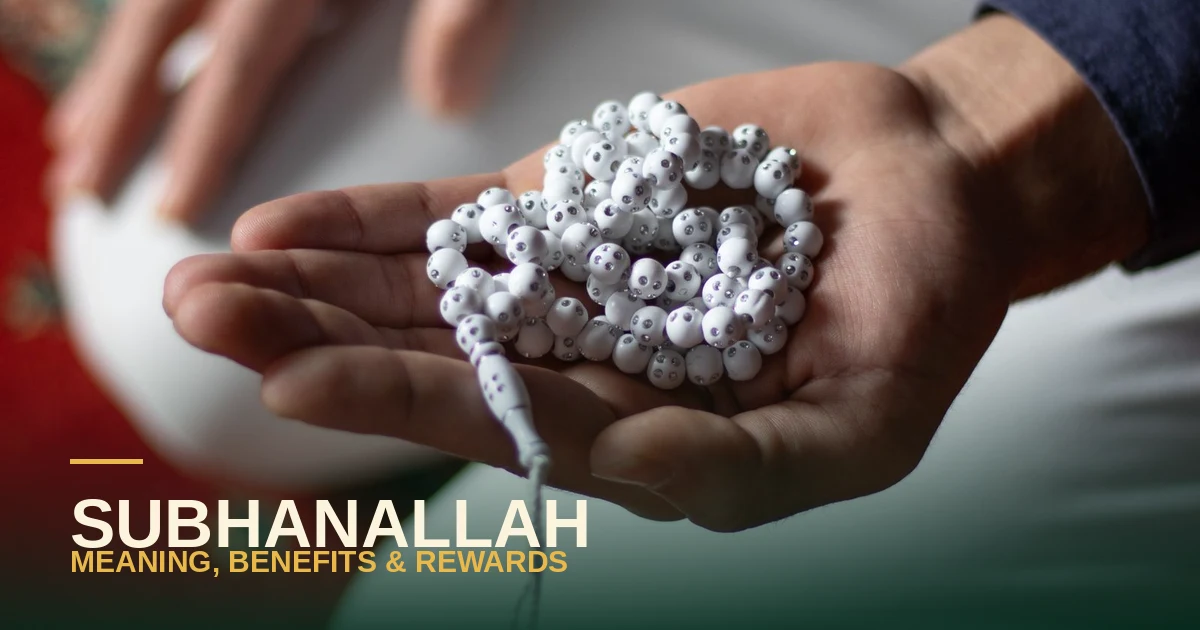
5 Good Benefits of Saying “Subhanallah” that You Can Use
What does “SubhanAllah” mean? It means “Glory be to Allah” — Allah is free from every imperfection, and all praise belongs to Him. It is one of the shortest and most repeated phrases in a Muslim’s life, and the Prophet (peace and blessings be upon him) promised a great reward for it: whoever says “SubhanAllahi wa bihamdihi” one hundred times in a day will have his sins taken away, even if they are as abundant as the foam of the sea (Sahih Muslim 2691). This guide explains what the words mean, gives the rewards the hadiths actually promise, and shows how to make tasbih a daily habit.
Key Points
- “SubhanAllah” means “Glory be to Allah” — Allah is free from every imperfection.
- Allah commands it: “Remember Allah with much remembrance, and exalt Him morning and afternoon” (Qur’an 33:41-42).
- Whoever says “SubhanAllahi wa bihamdihi” one hundred times in a day will have his sins taken away, even if they are as abundant as the foam of the sea (Sahih Muslim 2691 — agreed upon).
- Saying “SubhanAllah” one hundred times earns one thousand virtues and blots out one thousand vices (Sahih Muslim 2698).
- After every prayer, 33 times SubhanAllah, 33 times Alhamdulillah and 33 times Allahu Akbar, completed with the kalima, brings the same promise of forgiveness (Sahih Muslim 597a).
- “Verily, in the remembrance of Allah do hearts find rest” (Qur’an 13:28) — the peace of dhikr is a promise of the Qur’an, not a guarantee of an easy life.
What Does “SubhanAllah” Mean?
“SubhanAllah” comes from the Arabic root meaning to declare Allah free from imperfection. Word by word: “Subhan” means glory, exaltation and freedom from every flaw; “Allah” is the name of God. Together: “Glory be to Allah” — Allah is perfect, and nothing imperfect can be said of Him. The longer form adds praise: “SubhanAllahi wa bihamdihi” — “Glory be to Allah, and praise be to Him.” The Qur’an says that all of creation glorifies Him:
Arabic:
وَإِن مِّن شَيْءٍ إِلَّا يُسَبِّحُ بِحَمْدِهِ
Transliteration: Wa in min shay’in illaa yusabbihu bihamdih.
Translation: “And there is not a thing except that it exalts [Allah] by His praise.” (Saheeh International; Qur’an 17:44 — key sentence of the verse.)
When a believer says “SubhanAllah”, they join that glorification — the heavens, the earth, the birds and the mountains all declare Allah’s perfection, and the believer’s tongue joins them. That is why the word is so short and so heavy: it is the whole of Tawheed in a single breath. For the kalima that completes the tasbih after prayer, see our guide to the Fourth Kalima Tauheed.
What Is the Reward of Saying It One Hundred Times?
The Prophet (peace and blessings be upon him) gave two great promises for one hundred sayings a day. The first is forgiveness:
Arabic:
مَنْ قَالَ سُبْحَانَ اللَّهِ وَبِحَمْدِهِ فِي يَوْمٍ مِائَةَ مَرَّةٍ حُطَّتْ عَنْهُ خَطَايَاهُ وَإِنْ كَانَتْ مِثْلَ زَبَدِ الْبَحْرِ
Transliteration: Man qaala subhaanallaahi wa bihamdihi fee yawmin mi’ata marrah, huttat ‘anhu khataayaahu wa in kaanat mithla zabadil-bahr.
Translation: “Whoever says ‘SubhanAllahi wa bihamdihi’ (Glory be to Allah, and praise be to Him) one hundred times in a day, his sins will be taken away from him, even if they are as abundant as the foam of the sea.” (Sahih al-Bukhari 6405; Sahih Muslim 2691 — agreed upon.)
The second is a counting of virtues: the Prophet asked his companions, “Is one amongst you powerless to get one thousand virtues every day?” and when they asked how, he said: “Recite ‘SubhanAllah’ one hundred times, for one thousand virtues are recorded (to your credit) and one thousand vices are blotted out.” (Sahih Muslim 2698.) Two things must be said honestly about these promises. First, scholars understand the forgiveness of sins here as for minor sins — major sins require sincere repentance, as the Qur’an teaches. The hadiths do not give anyone a “ticket to Jannah” for a hundred sayings; they promise Allah’s forgiveness and reward, and the believer hopes for it with humility. Second, the reward is for saying the words with the heart present, not for rushing through them while the mind is elsewhere. Say them slowly, know what they mean, and the reward follows by Allah’s grace.
When Should I Say SubhanAllah?
Allah’s command is broad:
Arabic:
يَا أَيُّهَا الَّذِينَ آمَنُوا اذْكُرُوا اللَّهَ ذِكْرًا كَثِيرًا وَسَبِّحُوهُ بُكْرَةً وَأَصِيلًا
Transliteration: Yaa ayyuhal-ladheena aamanudh-kurullaaha dhikran katheeraa, wa sabbihoohu bukratan wa aseelaa.
Translation: “O you who have believed, remember Allah with much remembrance, and exalt Him morning and afternoon.” (Saheeh International; Qur’an 33:41-42)
“Morning and afternoon” — the day is framed by dhikr. The established times are: after every prayer — the tasbih of 33 SubhanAllah, 33 Alhamdulillah and 33 Allahu Akbar, completed with the kalima, as the Prophet taught:
Arabic:
مَنْ سَبَّحَ اللَّهَ فِي دُبُرِ كُلِّ صَلَاةٍ ثَلَاثًا وَثَلَاثِينَ وَحَمِدَ اللَّهَ ثَلَاثًا وَثَلَاثِينَ وَكَبَّرَ اللَّهَ ثَلَاثًا وَثَلَاثِينَ فَتِلْكَ تِسْعَةٌ وَتِسْعُونَ وَقَالَ تَمَامَ الْمِائَةِ لَا إِلَهَ إِلَّا اللَّهُ وَحْدَهُ لَا شَرِيكَ لَهُ لَهُ الْمُلْكُ وَلَهُ الْحَمْدُ وَهُوَ عَلَى كُلِّ شَيْءٍ قَدِيرٌ غُفِرَتْ خَطَايَاهُ وَإِنْ كَانَتْ مِثْلَ زَبَدِ الْبَحْرِ
Transliteration: Man sabbahallaaha fee duburi kulli salaatin thalaathan wa thalaatheen, wa hamidallaaha thalaathan wa thalaatheen, wa kabbarallaaha thalaathan wa thalaatheen, fa-tilka tis’atun wa tis’oon, wa qaala tamaamal-mi’ah: laa ilaaha illallaahu wahdahu laa shareeka lah, lahul-mulku wa lahul-hamdu, wa huwa ‘alaa kulli shay’in qadeer, ghufirat khataayaahu wa in kaanat mithla zabadil-bahr.
Translation: “If anyone extols Allah after every prayer thirty-three times, and praises Allah thirty-three times, and declares His Greatness thirty-three times, ninety-nine times in all, and says to complete a hundred: ‘There is no god but Allah, having no partner with Him, to Him belongs sovereignty and to Him is praise due, and He is Potent over everything,’ his sins will be forgiven even if these are as abundant as the foam of the sea.” (Sahih Muslim 597a)
Morning and evening — one hundred “SubhanAllahi wa bihamdihi” spread across the day, as in Sahih Muslim 2691. At any time — walking, waiting, working, driving: dhikr needs no ablution, no place and no special time, and the fingers are its counter. Scholars teach counting on the fingers of the right hand, following the Prophet’s practice. For a full guide to counting dhikr on the fingers, see our guide to dhikr with fingers.
Does Dhikr Really Bring Peace?
Allah says:
Arabic:
أَلَا بِذِكْرِ اللَّهِ تَطْمَئِنُّ الْقُلُوبُ
Transliteration: Alaa bi-dhikrillaahi tatma’innul-quloob.
Translation: “Verily, in the remembrance of Allah do hearts find rest.” (Saheeh International; Qur’an 13:28 — key sentence of the verse.)
This is a promise of the Qur’an, and it is worth stating carefully. Dhikr brings rest to the heart — calm, patience and trust in Allah — but it is not a guarantee of an easy life, and it is not a treatment for illness or a replacement for medical care. The old post claimed that saying SubhanAllah “makes life easier” and “extends your patience” as if they were automatic effects; the honest framing is that remembrance turns the heart towards Allah, and a heart turned towards Allah bears hardship with patience and hope. If you are struggling with anxiety or low mood, dhikr can be part of a healthy routine — alongside sleep, exercise, talking to someone you trust, and professional help when needed. For the duas taught for anxiety and low mood, see our guide to powerful duas for depression, and for duas of healing, see our guide to the dua for shifa.
How Can I Make Tasbih a Daily Habit?
Start small and stay steady. Say the 33 tasbih after every prayer — it takes less than a minute, and the prayer mat is already beneath you. Then add the hundred “SubhanAllahi wa bihamdihi” once a day: after Fajr, or on the way to work, or before sleep. Count on your fingers, or use a tasbih counter — the counting is a help, not the worship itself. Teach it to your children the same way: one word, “SubhanAllah”, repeated together after prayer, until it becomes their habit too. And do not measure the habit by feelings: some days the heart is present and some days it is not. The reward is promised for the saying, and the presence of heart grows with practice. Keep going, and let the habit carry you through the days when the feeling is absent.
“SubhanAllah” is two syllables of pure Tawheed: Allah is free from every imperfection, and all praise belongs to Him. One hundred sayings a day can earn one thousand virtues, blot out one thousand vices, and take away sins like the foam of the sea — by Allah’s promise, for minor sins, with a present heart. Learn the words, say them after every prayer, and let them fill the gaps of your day. The heart that remembers Allah finds rest — and the tongue that glorifies Him is never empty.
Frequently Asked Questions
What does “SubhanAllah” mean?
“SubhanAllah” means “Glory be to Allah” — Allah is free from every imperfection, and all praise belongs to Him.
What is the reward of saying “SubhanAllahi wa bihamdihi” 100 times a day?
Whoever says it one hundred times in a day will have his sins taken away, even if they are as abundant as the foam of the sea (Sahih Muslim 2691). Scholars understand this as referring to minor sins; major sins require sincere repentance.
What is the tasbih after prayer?
33 times SubhanAllah, 33 times Alhamdulillah and 33 times Allahu Akbar, completed with the kalima: ‘There is no god but Allah, having no partner with Him, to Him belongs sovereignty and to Him is praise due, and He is Potent over everything’ (Sahih Muslim 597a).
Does saying SubhanAllah guarantee Jannah?
No — the hadiths promise forgiveness and reward by Allah’s grace; they do not give a guaranteed ticket to Jannah, and major sins require sincere repentance.
When is the best time to say SubhanAllah?
After every prayer, morning and evening, and at any time — Allah says: ‘Remember Allah with much remembrance, and exalt Him morning and afternoon’ (Qur’an 33:41-42).
How many times should I say SubhanAllah a day?
One hundred ‘SubhanAllahi wa bihamdihi’ a day carries the promise of Sahih Muslim 2691, and the 33-times tasbih after each prayer carries the promise of Sahih Muslim 597a.
Sources: The Holy Qur’an; Sahih Muslim; Sahih al-Bukhari; Muwatta Malik; Riyad as-Salihin.