
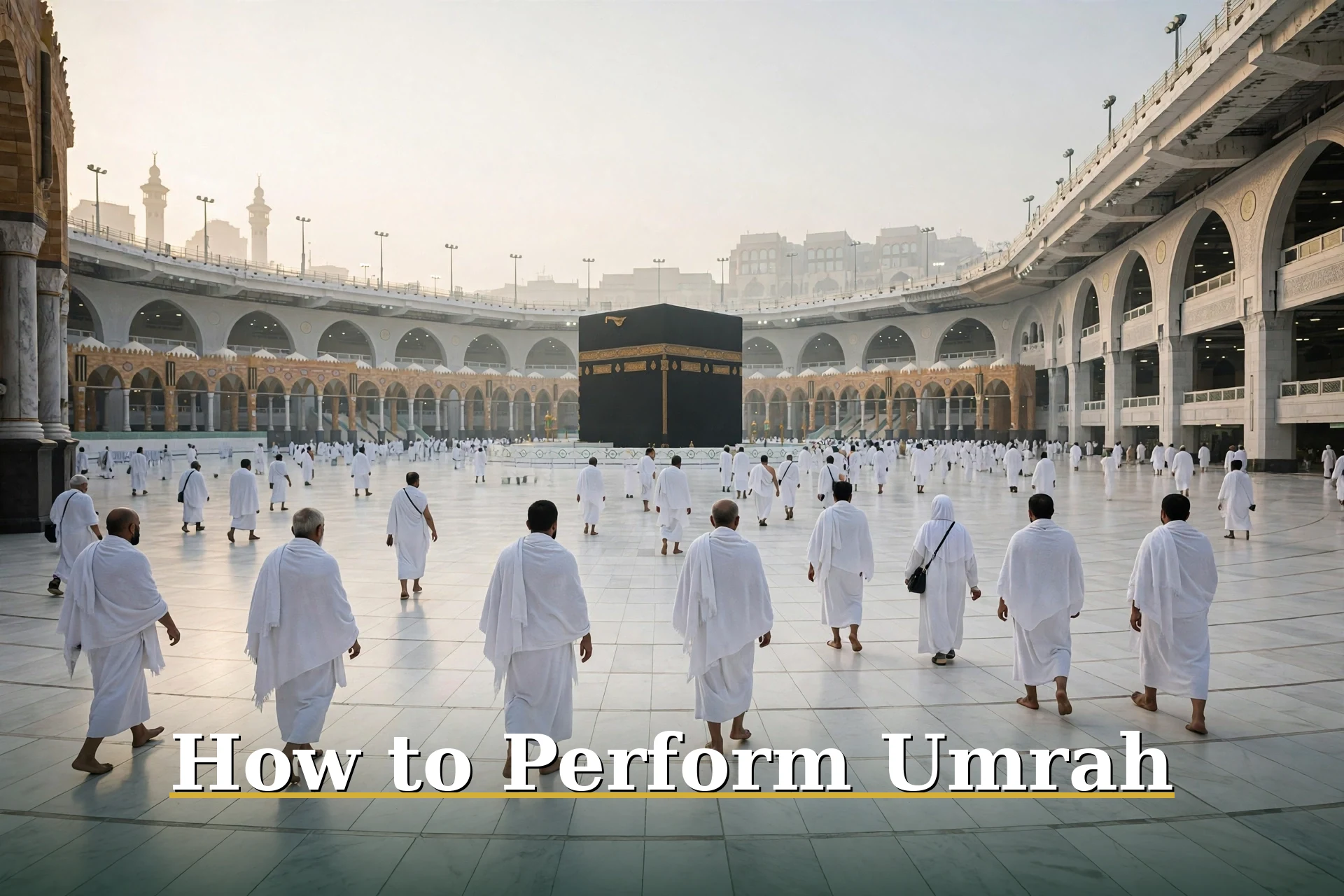
How to Perform Umrah
Umrah is the lesser pilgrimage to Makkah, and it has four steps, always in this order: enter ihram, perform tawaf (seven circuits around the Kaaba), perform sa’i (seven lengths between the hills of Safa and Marwa), and then shave or trim your hair, which ends ihram. Unlike Hajj, Umrah can be performed at any time of year, and the whole rite usually takes a few hours. This guide explains how to perform Umrah, walking through each step in order, with the duas to recite, the practical rules from the official Nusuk platform, and the common mistakes to avoid.
Key Points
- Umrah has four steps in a fixed order: Ihram, Tawaf (7 circuits), Sa’i (7 lengths), Halq or Taqsir (shave or trim the hair).
- Enter ihram before the miqat with the intention and the Talbiyah; women enter ihram in their normal modest dress.
- Tawaf starts at the Black Stone with the Kaaba on your left; after tawaf, pray two rak’ahs, then drink Zamzam.
- Sa’i starts at Safa and ends at Marwa — seven lengths in total, remembering Hajar’s search for water.
- Book your Umrah permit in the Nusuk app before you travel; permit rules change, especially in Ramadan and peak seasons.
- Umrah in Ramadan carries a reward equal to Hajj (Sahih al-Bukhari 1782) — but it does not replace the obligatory Hajj.
What Is Umrah?
Umrah is a visit to the Sacred House in Makkah to perform the rites of tawaf and sa’i. It is called the lesser pilgrimage because it is shorter than Hajj and has no fixed season — Hajj can only be performed on set days in Dhul-Hijjah, while Umrah can be performed at any time of year. The Prophet (SAW) said:
Arabic:
الْعُمْرَةُ إِلَى الْعُمْرَةِ كَفَّارَةٌ لِمَا بَيْنَهُمَا
Transliteration: Al-‘umratu ilal-‘umrati kaffaaratun limaa baynahumaa
Translation: “One Umrah to the next is an expiation for the sins between them.” (Sahih al-Bukhari 1773; Sahih Muslim 1349)
Umrah is a confirmed Sunnah and a greatly rewarded act of worship. Scholars differ on whether it is obligatory once in a lifetime — the Shafi’i and Hanbali schools hold it obligatory for those who are able, while the Hanafi and Maliki schools hold it a strongly emphasised Sunnah. Either way, it never replaces Hajj, which is obligatory for every Muslim who is able.
Before You Travel: Visa and the Nusuk Permit
Before you travel, check the official sources — the rules change. As of November 2026, pilgrims from outside Saudi Arabia enter on an Umrah visa or a tourist eVisa, and an Umrah permit must be booked in the Nusuk app, the official platform of the Saudi Ministry of Hajj and Umrah, for a set date and time. Entry to the Haram for Umrah is tied to your permit time. Residents of Saudi Arabia also book through Nusuk. A visit to Madinah is not part of Umrah, but most pilgrims go — and the Rawdah permit is also booked free in the Nusuk app. Check the Nusuk app and the Ministry of Hajj and Umrah before you travel, and confirm your travel documents, vaccinations and insurance well ahead of your flight.
Step 1: Entering Ihram
Ihram is the sacred state a pilgrim enters for Umrah. It begins with the intention (niyyah), not only with putting on the clothes. Before the miqat — the boundary around Makkah that pilgrims must not cross without ihram — take a ghusl (full bath), trim your nails, and put on the ihram garments. Men wear two white seamless cloths, one around the waist and one over the shoulders; women wear their normal modest dress and do not cover the face or wear gloves in ihram. Perfume the body (men only) before entering ihram.
At the miqat, make the intention for Umrah and say:
Arabic:
لَبَّيْكَ اللَّهُمَّ عُمْرَةً
Transliteration: Labbayk Allaahumma ‘Umrah
Translation: “Here I am, O Allah, for Umrah.”
Then begin the Talbiyah, and repeat it often during the journey:
Arabic:
لَبَّيْكَ اللَّهُمَّ لَبَّيْكَ، لَبَّيْكَ لَا شَرِيكَ لَكَ لَبَّيْكَ، إِنَّ الْحَمْدَ وَالنِّعْمَةَ لَكَ وَالْمُلْكَ، لَا شَرِيكَ لَكَ
Transliteration: Labbayka Allaahumma labbayk, labbayka laa shareeka laka labbayk, innal-hamda wan-ni’mata laka wal-mulk, laa shareeka lak
Translation: “Here I am, O Allah, here I am. Here I am, You have no partner, here I am. Verily all praise and blessings are Yours, and all sovereignty, You have no partner.”
The five miqats are Dhul-Hulayfah (Abyar Ali, for those coming from Madinah), Al-Juhfah (near Rabigh), Qarn al-Manazil (As-Sayl al-Kabir), Yalamlam, and Dhat Irq. If you fly into Jeddah, your flight will usually announce the miqat — make your intention before the plane passes it. Those already inside Makkah who wish to perform a second Umrah go out to the nearest miqat, usually Masjid Aisha at Tan’eem, and enter ihram there.
Once in ihram, the restrictions apply: no perfume, no cutting hair or nails, no stitched clothing for men, no covering the head for men, no hunting, and no marital relations. If you forget and break a restriction, ask a scholar what compensation (fidyah) applies — do not guess.
Step 2: Tawaf — Seven Circuits Around the Kaaba
Enter Masjid al-Haram, ideally through Bab al-Salam, with your right foot, and stop reciting the Talbiyah when you reach the Kaaba. Men uncover the right shoulder (idtiba) for tawaf. Stand in line with the Black Stone (Hajar al-Aswad), keeping the Kaaba on your left, and make the intention for the tawaf of Umrah. Walk anticlockwise around the Kaaba seven times, beginning and ending at the Black Stone. Greet the Black Stone at the start of each circuit — by kissing it if you can reach it safely, or by pointing towards it and saying “Allahu Akbar”. Do not push or harm others to reach it; pointing is enough. Men walk at a brisk pace (ramal) for the first three circuits and at a normal pace for the last four — this is Sunnah for men only.
There is no fixed dua for tawaf. Fill the circuits with dua and dhikr in any language — ask Allah for what you need, for your family, and for the Ummah. Between the Yemeni Corner (Rukn al-Yamani) and the Black Stone, many pilgrims recite the dua from Qur’an 2:201, which is also the dua for rizq and the Hereafter. After the seventh circuit, pray two rak’ahs — behind Maqam Ibrahim if you can, or anywhere in the mosque — and then drink Zamzam water.
Step 3: Sa’i — Seven Lengths Between Safa and Marwa
After tawaf, follow the signs inside Masjid al-Haram to Safa, where sa’i begins. Sa’i is walking between the two hills of Safa and Marwa, seven lengths in total, remembering Hajar (peace be upon her) searching for water for her son Isma’il. Allah mentions the two hills in the Qur’an:
Arabic:
إِنَّ الصَّفَا وَالْمَرْوَةَ مِن شَعَائِرِ اللَّهِ
Transliteration: Innas-Safaa wal-Marwata min sha’aa’irillaah
Translation: “Indeed, Safa and Marwa are among the symbols of Allah.” (Qur’an 2:158)
Start at Safa and walk to Marwa — that is one length. Walk back from Marwa to Safa — that is the second. Seven lengths end at Marwa. Men jog lightly between the two green markers on each length. There is no fixed dua for sa’i either; make dua as you walk, and remember the story of Hajar’s trust in Allah, which is the reason this rite exists. After sa’i, pray two rak’ahs of nafl prayer anywhere in the mosque.
Step 4: Halq or Taqsir — Shaving or Trimming the Hair
The final step ends ihram. Men shave the whole head (halq), which is the more rewarding option, or trim the hair (taqsir). Women trim a fingertip’s length from the ends of their hair. Once this is done, the restrictions of ihram end and your Umrah is complete. If you performed Umrah in Ramadan, you may then continue your stay in Makkah in normal clothes, praying in the Haram and visiting Madinah if you wish.
Umrah in Ramadan
Ramadan is the busiest season for Umrah, and the reward is immense. The Prophet (SAW) said, “When Ramadan comes, do Umrah, for Umrah in Ramadan is equivalent to Hajj” (Sahih al-Bukhari 1782; Sahih Muslim 1256). Scholars explain that this means equality in the amount of reward, not in kind: it does not remove the obligation of Hajj, and it does not carry the special status of the Hajj rites themselves. Ramadan 1448 is expected to begin on Monday 8 February 2027 (moon-sighting dependent), so plan and book permits early — Ramadan permits are the hardest to get, and the Haram is at its most crowded in the last ten nights.
Common Mistakes to Avoid
- Crossing the miqat without ihram. If you pass the boundary intending Umrah and have not entered ihram, you must return to the miqat or offer a sacrifice — ask a scholar rather than guessing.
- Pushing to kiss the Black Stone. Crowding and harming others is forbidden; pointing from a distance carries the same reward.
- Counting sa’i wrong. Seven lengths end at Marwa, not back at Safa. A return trip is two lengths, not one.
- Forgetting the permit. Entry to the Haram for Umrah is tied to your Nusuk permit time — arrive within your slot.
- Treating Umrah as a substitute for Hajj. Even Umrah in Ramadan does not remove the Hajj obligation from a Muslim who is able.
- Skipping the duas. The rites are worship, not a walk — prepare your duas before you travel.
Frequently Asked Questions
Q: How do I perform Umrah step by step?
A: Enter ihram before the miqat with the intention and Talbiyah, perform tawaf (seven circuits around the Kaaba), pray two rak’ahs, perform sa’i (seven lengths between Safa and Marwa), then shave or trim your hair to end ihram.
Q: How long does Umrah take?
A: The rites themselves usually take two to four hours, depending on crowds. Most pilgrims spend several days in Makkah, praying in the Haram and visiting Madinah.
Q: Can I perform Umrah at any time of year?
A: Yes. Unlike Hajj, which has fixed days in Dhul-Hijjah, Umrah can be performed at any time of year. Ramadan is the most rewarding and the most crowded season.
Q: Do I need a permit for Umrah?
A: Yes — as of November 2026, an Umrah permit must be booked in the Nusuk app, the official platform of the Saudi Ministry of Hajj and Umrah. Check Nusuk before you travel, as the rules change.
Q: What is the difference between Hajj and Umrah?
A: Hajj is obligatory once in a lifetime for those who are able, takes place on fixed days (Hajj 1448 is expected 14–19 May 2027, with Arafah on Saturday 15 May 2027), and has more rites. Umrah is shorter, can be done any time, and never replaces Hajj.
Q: Does Umrah in Ramadan equal Hajj?
A: In reward, yes — the Prophet (SAW) said Umrah in Ramadan is equivalent to Hajj (Sahih al-Bukhari 1782). It does not remove the obligation of Hajj.
Q: Can women perform Umrah during menstruation?
A: A woman in menstruation may enter ihram at the miqat, but she must wait until her menstruation ends before performing tawaf, because tawaf requires purity. She can perform sa’i first in some views — ask a scholar you trust for your situation.
Q: What should I pack for Umrah?
A: Ihram garments (men), modest dress (women), comfortable walking shoes or sandals, unscented toiletries for use in ihram, a small bag for the mosque, and your Nusuk permit and travel documents. Keep your duas written down before you travel.
Sources
Sources: The Holy Qur’an (Surah al-Baqarah 2); Sahih al-Bukhari; Sahih Muslim; Nusuk — official platform of the Saudi Ministry of Hajj and Umrah; Saudi Ministry of Hajj and Umrah — Umrah and Visit Guide; IslamQA
